Thank you for visiting SNEWPapers!
Sign up free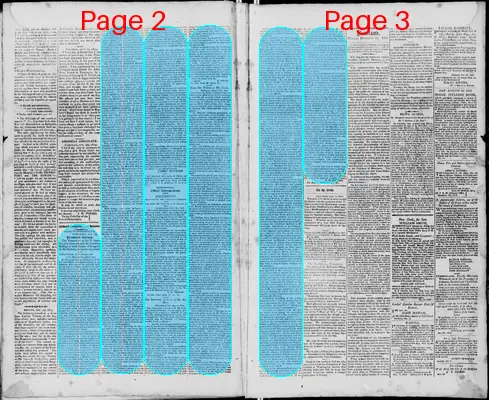
Portland Gazette, And Maine Advertiser
Portland, Cumberland County, Maine
What is this article about?
On November 29, 1809, President James Madison delivered his message to the 11th Congress, 2nd Session, expressing concern over Britain's disavowal of the Erskine agreement, continuation of Orders in Council, and tensions with France affecting U.S. commerce. He discussed fortifications, navy, militia, finances, and domestic prosperity. Accompanying documents include correspondence between British Minister Erskine and Secretary of State Smith on the failed provisional arrangement.
Merged-components note: President's message to Congress and accompanying official correspondence documents span multiple components across pages 2 and 3.
Clippings
1 of 2
OCR Quality
Full Text
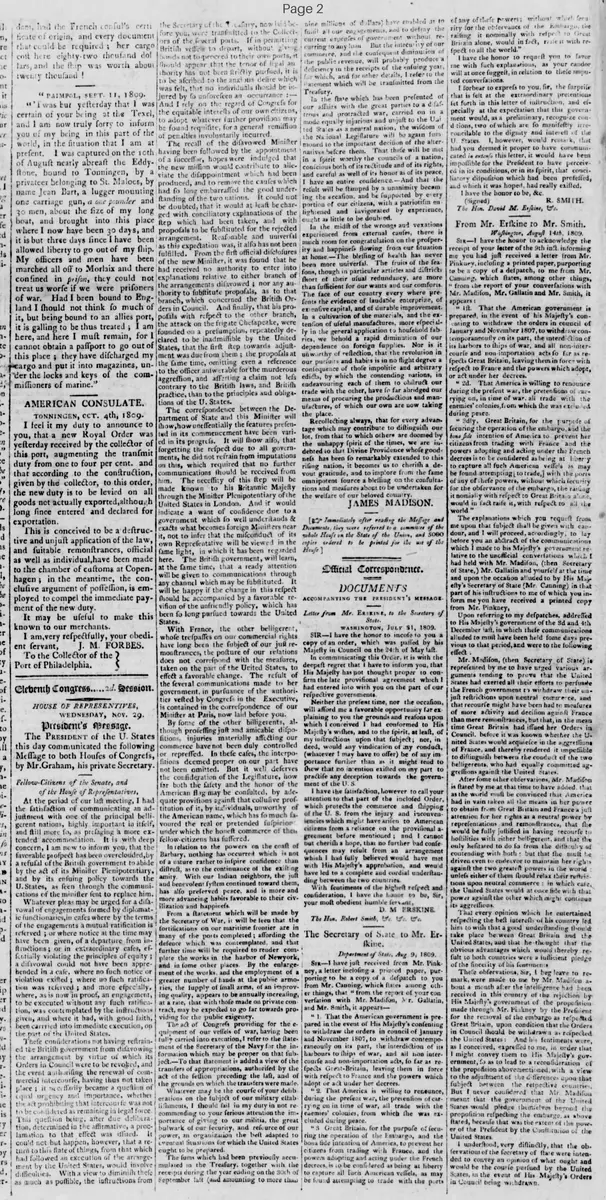
HOUSE OF REPRESENTATIVES,
WEDNESDAY, NOV.29.
President's Message.
The President of the U. States this day communicated the following Message to both Houses of Congress, by Mr. Graham, his private Secretary.
Fellow-Citizens of the Senate, and of the House of Representatives,
At the period of our last meeting, I had the satisfaction of communicating an adjustment with one of the principal belligerent nations, highly important in itself, and still more so, as presaging a more extended accommodation. It is with deep concern, I am now to inform you, that the favorable prospect has been overclouded, by a refusal of the British government to abide by the act of its Minister Plenipotentiary, and by its ensuing policy towards the U. States, as seen through the communications of the minister sent to replace him.
Whatever pleas may be urged for a disavowal of engagements formed by diplomatic functionaries, in cases where by the terms of the engagements a mutual ratification is reserved; or where notice at the time may have been given, of a departure from instructions; or in extraordinary cases, especially violating the principles of equity; a disavowal could not have been apprehended in a case, where no such notice or violation existed: where no such ratification was reserved: and more especially, where, as is now in proof, an engagement, to be executed without any such ratification, was contemplated by the instructions given, and where it had, with good faith, been carried into immediate execution, on the part of the United States.
These considerations not having restrained the British government from disavowing the arrangement by virtue of which its Orders in Council were to be revoked, and the event authorising the renewal of commercial intercourse, having thus not taken place; it necessarily became a question of equal urgency and importance, whether the act prohibiting that intercourse was not to be considered as remaining in legal force. This question being, after due deliberation, determined in the affirmative, a proclamation to that effect was issued. It could not but happen, however, that a return to this state of things, from that which had followed an execution of the arrangement by the United States, would involve difficulties. With a view to diminish these as much as possible, the instructions from the Secretary of the Treasury, now laid before you, were transmitted to the Collectors of the several ports. If in permitting British vessels to depart, without giving bonds not to proceed to their own ports, it should appear that the tenor of legal authority has not been strictly pursued, it is to be ascribed to the anxious desire which was felt, that no individuals should be injured by so unforeseen an occurrence: And I rely on the regard of Congress for the equitable interests of our own citizens, to adopt whatever further provisions may be found requisite, for a general remission of penalties involuntarily incurred.
The recall of the disavowed Minister having been followed by the appointment of a successor, hopes were indulged that the new mission would contribute to alleviate the disappointment which had been produced, and to remove the causes which had so long embarrassed the good understanding of the two nations. It could not be doubted, that it would at least be charged with conciliatory explanations of the step which had been taken, and with proposals to be substituted for the rejected arrangement. Reasonable and universal as this expectation was, it also has not been fulfilled. "From the first official disclosures of the new Minister, it was found that he had received no authority to enter into explanations relative to either branch of the arrangements disavowed; nor any authority to substitute proposals, as to that branch, which concerned the British Orders in Council. And finally, that his proposals with respect to the other branch, the attack on the frigate Chesapeake, were founded on a presumption, repeatedly declared to be inadmissible by the United States, that the first step towards adjustment was due from them; the proposals at the same time, omitting even a reference to the officer answerable for the murderous aggression, and asserting a claim not less contrary to the British laws, and British practice, than to the principles and obligations of the U. States.
The correspondence between the Department of State and this Minister will show, how unessentially the features presented in its commencement have been varied in its progress. It will show also, that forgetting the respect due to all governments, he did not refrain from imputations on this, which required that no further communications should be received from him. The necessity of this step will be made known to his Britannic Majesty through the Minister Plenipotentiary of the United States in London. And it would indicate a want of confidence due to a government which so well understands & exact what becomes foreign Ministers near it, not to infer that the misconduct of its own Representative will be viewed in the same light in which it has been regarded here. The British government, will learn, at the same time, that a ready attention will be given to communications through any channel which may be substituted. It will be happy if the change in this respect should be accompanied by a favorable revision of the unfriendly policy, which has been so long pursued towards the United States.
With France, the other belligerent, whose trespasses on our commercial rights have long been the subject of our just remonstrances, the posture of our relations does not correspond with the measures, taken on the part of the United States, to effect a favorable change. The result of the several communications made to her government, in pursuance of the authorities vested by Congress in the Executive is contained in the correspondence of our Minister at Paris, now laid before you.
By some of the other belligerents, although professing just and amicable dispositions, injuries materially affecting our commerce have not been duly controlled or repressed. In these cases, the interpositions deemed proper on our part have not been omitted. But it well deserves the consideration of the Legislature, how far both the safety and the honor of the American flag may be consulted, by adequate provisions against that collusive prostitution of it, by individuals, unworthy of the American name, which has so much favoured the real or pretended suspicions under which the honest commerce of these fellow-citizens has suffered.
In relation to the powers on the coast of Barbary, nothing has occurred which is not of a nature rather to inspire confidence than distrust. as to the continuance of the existing amity. With our Indian neighbors, the just and benevolent system continued toward them, has also preserved peace, and is more and more advancing habits favorable to their civilization and happiness
From a statement which will be made by the Secretary of War, it will be seen that the fortifications on our maritime frontier are in many of the ports completed; affording the defence which was contemplated, and that further time will be required to render complete the works in the harbor of Newyork, and in some other places. By the enlargement of the works, and the employment of a greater number of hands at the public armories, the supply of small arms, of an improving quality, appears to be annually increasing, at a rate, that with those made on private contract, may be expected to go far towards providing for the public exigency.
The act of Congress providing for the equipment of our vessels of war, having been fully carried into execution, I refer to the statement of the Secretary of the Navy for the information which may be proper on that subject.—To that statement is added a view of the transfers of appropriations, authorised by the act of the session preceding the last, and of the grounds on which the transfers were made.
Whatever may be the course of your deliberations on the subject of our military establishment, I should fail in my duty in not recommending to your serious attention the importance of giving to our militia, the great bulwark of our security, and resource of our power, an organization the best adapted to actual situations for which the United States ought to be prepared.
The sums which had been previously accumulated in the Treasury, together with the receipts during the year ending on the 30th of September last (and amounting to more than nine millions of dollars) have enabled us to fulfil all our engagements, and to defray the current expenses of government without recurring to any loan But the insecurity of our commerce, and the consequent diminution of the public revenue, will probably produce a deficiency in the receipts of the ensuing year, for which, and for other details, I refer to the statement which will be transmitted from the Treasury.
In the state which has been presented of our affairs with the great parties to a disastrous and protracted war, carried on in a mode equally injurious and unjust to the U. States as a neutral nation, the wisdom of the National Legislature will be again summoned to the important decision of the alternatives before them. 'That these will be met in a spirit worthy the councils of a nation, conscious both of its rectitude and of its rights and careful as well of its honor as of its peace, I have an entire confidence.—And that the result will be stamped by a unanimity becoming the occasion, and be supported by every portion of our citizens, with a patriotism enlightened and invigorated by experience, ought as little to be doubted.
In the midst of the wrongs and vexations experienced from external causes, there is much room for congratulation on the prosperity and happiness flowing from our situation at home—The blessing of health has never been more universal. The fruits of the seasons, though in particular articles and districts short of their usual redundancy, are more than sufficient for our wants and our comforts. The face of our country every where presents the evidence of laudable enterprise, of extensive capital, and of durable improvement. In a cultivation of the materials, and the extension of useful manufactures, more especially in the general application to household fabrics, we behold a rapid diminution of our dependence on foreign supplies. Nor is it unworthy of reflection, that the revolution in our pursuits and habits is in no slight degree a consequence of those impolitic and arbitrary edicts, by which the contending nations, in endeavouring each of them to obstruct our trade with the other, have so far abridged our means of procuring the productions and manufactures, of which our own are now taking the place.
Recollecting always, that for every advantage which may contribute to distinguish our lot, from that to which others are doomed by the unhappy spirit of the times, we are indebted to that Divine Providence whose goodness has been so remarkably extended to this rising nation, it becomes us to cherish a devout gratitude, and to implore from the same omnipotent source a blessing on the consultations and measures about to be undertaken for the welfare of our beloved country.
JAMES MADISON.
Immediately after reading the Message and Documents, they were referred to a committee of the whole House on the State of the Union, and 5000 copies ordered to be printed for the use of the House.
Official Correspondence.
DOCUMENTS ACCOMPANYING THE PRESIDENT'S MESSAGE.
Letter from Mr. Erskine, to the Secretary of State.
WASHINGTON, JULY 31, 1809.
SIR—I have the honor to inclose to you a copy of an order, which was passed by his Majesty in Council on the 24th of May last. In communicating this Order, it is with the deepest regret that I have to inform you, that His Majesty has not thought proper to conform the late provisional agreement which I had entered into with you on the part of our respective governments.
Neither the present time, nor the occasion. will afford me a favorable opportunity far explaining to you the grounds and reasons upon which I conceived I had conformed to His Majesty's wishes, and to the spirit, at least, of my instructions upon that subject; nor, indeed, would any vindication of any conduct, (whatever I may have to offer) be of any importance further than as it might tend to shew that no intention existed on my part to practise any deception towards the government of the U. S.
I have the satisfaction, however to call your attention to that part of the inclosed Order, which protects the commerce and shipping of the U. S. from the injury and inconveniences which might have arisen to American citizens from a reliance on the provisional agreement before mentioned; and I cannot but cherish a hope, that no further bad consequences may result from an arrangement which I had fully believed would have met with His Majesty's approbation, and would have led to a complete and cordial understanding between the two countries.
With sentiments of the highest respect and consideration, I have the honor to be, Sir, your most obedient humble servant,
D. M ERSKINE
The Hon, Robert Smith, Fe. Ge. De
The Secretary of State to Mr. Erskine.
Department of State, Aug 9, 1809.
Sir—I have just received from Mr. Pinkney, a letter inclosing a printed paper, purporting to be a copy of a despatch to you from Mr. Canning, which states among other things, that "from the report of your conversation with Mr. Madison, Mr. Gallatin, and Mr. Smith, it appears—
"1. That the American government is prepared in the event of His Majesty's consenting to withdraw the orders in council of January and November 1807, to withdraw contemporaneously on its part, the interdiction of its harbours to ships of war, and all non intercourse and non-importation acts, so far as respects Great-Britain, leaving them in force with respect to France and the powers which adopt or act under her decrees.
"2. That America is willing to renounce, during the present war, the pretension of carrying on in time of war, all trade with the enemies' colonies, from which the was excluded during peace.
"3 Great Britain, for the purpose of securing the operation of the Embargo, and the bona fide intention of America, to prevent her citizens from trading with France, and the powers adopting and acting under the French decrees, is to be considered as being at liberty to capture all such American vessels, as may be found attempting to trade with the ports of any of these powers; without which security for the observance of the Embargo, the raising it nominally with respect to Great Britain alone, would in fact, raise it with respect to all the world."
I have the honor to request you to favor me with such explanations, as your candor will at once suggest, in relation to these imputed conversations.
I forbear to express to you, sir, the surprize that is felt at the extraordinary pretensions set forth in this letter of instruction, and especially at the expectation that the government would, as a preliminary, recognize conditions, two of which are so manifestly irreconcilable to the dignity and interest of the U. States. I, however, would remark, that had you deemed it proper to have communicated in extenso this letter, it would have been impossible for the President to have percieved in its conditions, or in its spirit, that conciliatory disposition which had been professed, and which it was hoped, had really existed.
I have the honor to be, &c
(Signed)
R. SMITH.
The Hon. David M. Erskine, Gc.
From Mr. Erskine to Mr. Smith.
Washington, August 14th, 1809.
Sir—I have the honor to acknowledge the receipt of your letter of the 9th inst. informing me you had just received a letter from Mr. Pinkney, inclosing a printed paper, purporting to be a copy of a despatch, to me from Mr. Canning, which states, among other things, "from the report of your conversations with Mr. Madison, Mr. Gallatin and yourself it appears:
"1st. That the American government is prepared, in the event of his Majesty's consenting to withdraw the orders in council of January and November 1807, to withdraw contemporaneously on its part, the interdiction of its harbors to ships of war, and all non-intercourse and non-importation acts so far as respects Great Britain, leaving them in force with respect to France and the powers which adopt, or act under her decrees.
"2d. That America is willing to renounce during the present war, the pretensions of carrying on, in time of war. all trade with the enemies'colonies,from which she was excluded during peace.
"3dly. Great Britain, for the purpose of securing the operation of the embargo, and the bona fide intention of America to prevent her citizensfrom trading with France and the powers adopting and acting under the French decrees is to be considered as being at liberty to capture all such American vessels as may be found attempting to trade,] with the ports of any of these powers, without which security for the observance of the embargo, the raising it nominally with respect to Great Britain alone, would in fact raise it, with respect to all the world."
The explanations which you request from me upon that subject shall be given with candour, and I will proceed, accordingly, to lay before you an abstract of the communications which I made to his Majesty's government relative to the unofficial conversations which I had held with Mr. Madison, (then Secretary of State,) Mr. Gallatin and yourself at the time and upon the occasion alluded to by His Majesty's Secretary of State (Mr. Canning) in that part of his instructions to me of which you inform me you have received a printed copy from Mr. Pinkney,
Upon referring to my despatches, addressed to His Majesty's government of the 3d and 4th December last, in which these communications alluded to must have been held some days previous to that period, and were to the following effect:
Mr. Madison, (then Secretary of State) is represented by me to have urged various arguments tending to prove that the United States had exerted all their efforts to persuade the French government to withdraw their unjust restrictions upon neutral commerce, and that recourse might have been had to measures of more activity and decision against France than mere remonstrances, but that, in the mean time Great Britain had issued her Orders in Council. before it was known whether the U. nited States would acquiesce in the aggressions of France, and thereby rendered it impossible to distinguish between the conduct of the two belligerents, who had equally committed aggressions against the United States.
After some other observations, Mr. Madison is stated by me at that time to have added. that as the world must be convinced that America had in vain taken all the means in her power to obtain from Great Britain and France a just attention for her rights as a neutral power by representations and remonstrances, that she would be fully justified in having recourse to hostilities with either belligerent, and that she only hesitated to do so from the difficulty of contending with both : but that she must be driven even to endeavor to maintain her rights against the two greatest powers in the world ; unless either of them should relax their restrictions upon neutral commerce : in which case, the United States would at once side with that power against the other which might continue its aggressions.
That every opinion which he entertained respecting the best interests of his country led him to wish that a good understanding should take place between Great Britain and the United States, and that he thought that the obvious advantages which would thereby result to both countries were a sufficient pledge of the sincerity of his sentiments
These observations, Sir, I beg leave to remark, were made to me by Mr. Madison about a month after the intelligence had been received in this country of the rejection by His Majesty's government of the proposition made through Mr. Pinkney by the President for the removal of the embargo as respected Great Britain, upon condition that the Orders in Council should be withdrawn as respected the United States: And his sentiments were, as I conceived, expressed to me, in order that I might convey them to His Majesty's government, so as to lead to a reconsideration of the proposition abovementioned, with a view to the adjustment of the differences upon that subject between the respective countries.
But I never considered that Mr. Madison meant that the government of the United States would pledge themselves beyond the proposition respecting the embargo, as above stated, because that was the extent of the power of thePresident by the Constitution of the United States.
I understood, very distinctly, that the observations of the secretary of state were intended to convey an opinion of what ought and would be the course pursued by the United States, in the event of Is Majesty's Orders in Council being withdrawn.
In these sentiments and opinions, you concurred, as I collected from the tenor of several conversations which I held with you at that period.
With respect to the second point, as stated in your letter to be contained in a despatch from Mr. Canning, I beg leave to offer the following explanation:
In the course of a private interview I had with Mr. Gallatin, (the Secretary of the Treasury) he intimated that the non-intercourse law which was then likely to be passed by the Congress, might be considered as removing two very important grounds of difference with Great Britain, viz. the nonimportation act, as applicable to her alone, and also the President's proclamation, whereby the ships of Great Britain were excluded from the ports of the U. States, while those of France were permitted to enter—but that by the nonintercourse law, both powers were placed on the same footing. He did not pretend to say that this measure had been taken from any motives of concession to Great Britain; but as, in fact, those consequences followed, he conceived they might be considered as removing the two great obstacles to a conciliation.
He adverted also to the probability of an adjustment of another important point in dispute between the two countries, as he said he knew that it was intended by the United States to abandon the attempt to carry on a trade with the colonies of belligerents in time of war, which was not allowed in time of peace, and to trust to their being permitted by the French to carry on such trade in peace, so as to entitle them to a continuance of it in time of war.
As it may be very material to ascertain what "trade with the colonies of belligerents" was, in my conception, meant by Mr. Gallatin, as intended to be abandoned by the United States, I feel no hesitation in declaring, that I supposed he alluded to the trade from the colonies of belligerents direct to their mother country, or to the ports of other belligerents, because the right to such trade had been the point in dispute: whereas the right to carry on a trade from the colonies of belligerents to the United States had never been called in question, and had been recognised by His Majesty's Supreme Court of Admiralty: and the terms even upon which such colonial produce might be re-exported from the United States had been formally arranged in a treaty signed in London by the Ministers Plenipotentiary of both countries, which was not indeed ratified by the President of the United States; but was not objected to as to that article of it which settled the terms upon which such trade was to be permitted.
Such was the substance, sir, of the unofficial conversations which I had held with Mr. Madison, Mr. Gallatin, and yourself which I did not consider or represent to His Majesty's government as intended with any other view than to endeavor to bring about the repeal of the Orders in Council by shewing that many of the obstacles which had stood in the way of an amicable adjustment of the differences between the two countries were already removed, and that a fair prospect existed of settling what remained; since the United States had exhibited a determination to resist the unjust aggressions upon her neutral rights, which was all that Great Britain had ever required; but I certainly never received any assurances from the American government that they would pledge themselves to adopt the conditions specified in Mr. Canning's instructions as preliminaries; nor did I ever hold out such an expectation to His Majesty's government: having always stated to them that in the event of His Majesty thinking it just or expedient to cause his Orders in Council to be withdrawn, that the President would take off the embargo as respects England, leaving it in operation against France and the powers which adopted, or acted under, her decrees; according to the authority which was vested in him at that time by the Congress of the United States, and that there was every reason to expect that a satisfactory arrangement might be made upon the points of the colonial trade which had been so long in dispute between the two countries.
As to the third condition referred to by you, specified in Mr. Canning's instructions, I have only to remark, that I never held any conversation with the members of the government of the U. States, relative to it, until my late negotiation; or had ever mentioned the subject to His Majesty's government; it having, for the first time, been presented to my consideration in Mr. Canning's despatch to me of the 23d January, in which that idea is suggested, and is stated to have been assented to by Mr. Pinkney.
It would be unavailing at the present moment to enter upon an examination of the "pretensions set forth in Mr. Canning's letter of instructions" (which you are pleased to term) "extraordinary." I consider it, however, to be my duty to declare that, during my negotiation with you which led to the conclusion of the provisional agreement, I found no reason to believe that any difficulties would occur, in the accomplishment of the two former conditions, as far as it was in the power of the President of the United States to accede to the first, and consistently with the explanation which I have before given of the second point: On the contrary I received assurances through you, that the President would comply (as far as it was in his power) with the first condition, and that there could be no doubt that the Congress would think it incumbent upon them to assert the rights of the United States against such powers as should adopt or act under the decrees of France as soon as their actual conduct or determinations upon that subject could be ascertained—but that, in the mean time, the President had not the power, and could not undertake to pledge himself in the formal manner required to that effect. I received also assurances from you, that no doubt could be reasonably entertained that a satisfactory arrangement might be made in a treaty upon the subject of the second condition mentioned in Mr. Canning's instructions according to my explanation of it in the foregoing part of this letter, but that it necessarily would form an article of a treaty in which the various pretensions of the two countries should be settled.
The third condition you certainly, very distinctly informed me could not be recognised by the President. but you added, what had great weight in my mind, that you did not see why any great importance should be attached to such a recognition; because it would be impossible that a citizen of the United States could prefer a complaint to his government on account of the capture of his vessel while engaged in a trade absolutely interdicted by the laws of his country.
Under these circumstances, therefore, finding that I could not obtain the recognitions specified in Mr. Canning's despatch of the 23d of January (which formed but ONE PART of his instructions to me) in the formal manner required, I considered that it would be in vain to lay before the government of the United States the despatch in question, which I was at liberty to have done in extenso, had I thought proper.- But as I had such strong grounds for believing that the object of His Majesty's government could be obtained though in a different manner, and the spirit, at least, of my SEVERAL LETTERS OF INSTRUCTIONS be fully complied with, I felt a thorough conviction upon my mind, that I should be acting in conformity to His Majesty's wishes; and, accordingly concluded the late provisional agreement on His Majesty's behalf with the government of the United States.
The disavowal by His Majesty is a painful proof to me that I had formed an erroneous judgment of His Majesty's views, and the intention of my instructions; and I have most severely to lament that an act of mine, (though unintentionally) should produce any embarrassments in the relations between the two countries.
It is a great consolation to me, however, to perceive that measures have been adopted by both governments to prevent any losses and to obviate any inconveniences which might have arisen to the citizens or subjects of either country from a reliance on the fulfilment of that provisional agreement; and I cannot but cherish a hope that a complete and cordial understanding between the two countries may be effected.
I beg leave to add that it would have given me great happiness to have contributed to so desirable an object, and to offer you the assurances of the great respect and high consideration with which I remain,
Sir, your most obedient humble servant,
D. M. ERSKINE.
The Hon. R. Smith, Sec. of State.
What sub-type of article is it?
What keywords are associated?
What entities or persons were involved?
Where did it happen?
Domestic News Details
Primary Location
Washington
Event Date
1809 11 29
Key Persons
Outcome
britain disavowed the erskine provisional agreement; u.s. non-intercourse act remains in force; fortifications progressing; treasury sufficient without loans; message referred to committee, 5000 copies printed.
Event Details
President Madison's message to Congress details diplomatic setbacks with Britain over the disavowed Erskine agreement and Orders in Council, tensions with France, positive relations with Barbary powers and Indians, progress on fortifications and arms, navy equipment, militia recommendations, financial status, and domestic prosperity. Accompanying documents include letters explaining the failed agreement and U.S. responses.