Thank you for visiting SNEWPapers!
Sign up free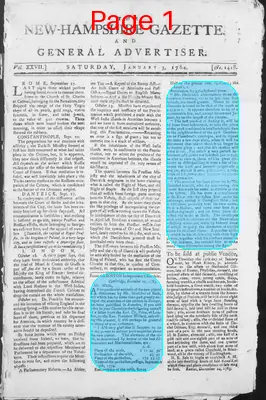
The New Hampshire Gazette And General Advertiser
Portsmouth, Exeter, Rockingham County, New Hampshire
What is this article about?
Report from Cambridge, December 10, 1783, on the discovery of a new planet by Mr. Herschel of Bath, including orbital elements from Rev. Dr. Price's letter to Rev. President Willard, details on its size, visibility, and Herschel's background.
Clipping
OCR Quality
Full Text
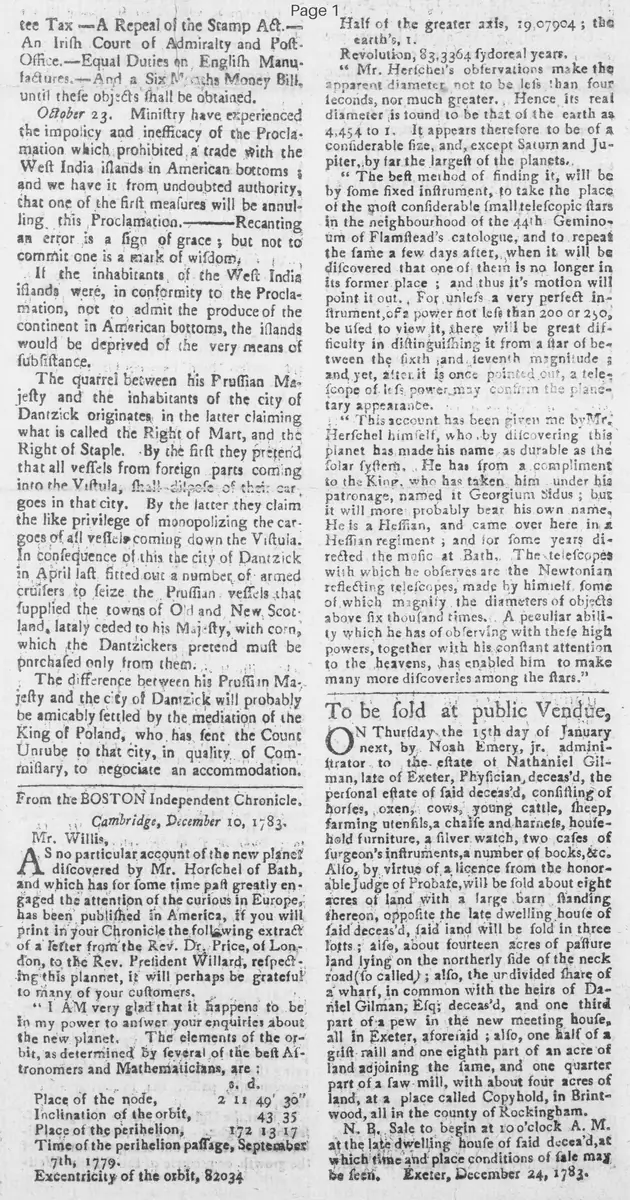
Cambridge, December 10, 1783.
Mr. Willis,
Sir, no particular account of the new planet discovered by Mr. Herschel of Bath, and which has for some time past greatly engaged the attention of the curious in Europe, has been published in America, if you will print in your Chronicle the following extract of a letter from the Rev. Dr. Price, of London, to the Rev. President Willard, respecting this planet, it will perhaps be grateful to many of your customers.
"I AM very glad that it happens to be in my power to answer your enquiries about the new planet. The elements of the orbit, as determined by several of the best Astronomers and Mathematicians, are:
Place of the node. 2 11 49' 30"
Inclination of the orbit. 43.35
Place of the perihelion, 172 13 17.
Time of the perihelion passage, September 7th, 1779
Excentricity of the orbit, 0.2034
Half of the greater axis, 19,07904 ; the earth's.
Revolution, 83.3364 sidereal years."
Mr. Herschel's observations make the apparent diameter not to be less than four seconds, nor much greater. Hence its real diameter is found to be that of the earth as 4454 to 1. It appears therefore to be of a considerable size, and, except Saturn and Jupiter, by far the largest of the planets.
The best method of finding it will be by some fixed instrument, to take the place of the most considerable small telescopic stars in the neighbourhood of the 44th Gemini of Flamsteed's catalogue, and to repeat the same a few days after, when it will be discovered that one of them is no longer in its former place; and thus its motion will point it out. For unless a very perfect instrument, of a power not less than 200 or 250, be used to view it, there will be great difficulty in distinguishing it from a star of between the sixth and seventh magnitude; and yet, after it is once pointed out, a telescope of less power may confirm the planetary appearance.
This account has been given me by Mr. Herschel himself, who, by discovering this planet has made his name as durable as the solar system. He has from a compliment to the King, who has taken him under his patronage, named it Georgium Sidus; but it will more probably bear his own name. He is a Hessian, and came over here in a Hessian regiment; and for some years directed the music at Bath. The telescopes with which he observes are the Newtonian reflecting telescopes, made by himself, some of which magnify the diameters of objects above six thousand times. A peculiar ability which he has of observing with these high powers, together with his constant attention to the heavens, has enabled him to make many more discoveries among the stars."
What sub-type of article is it?
What keywords are associated?
What entities or persons were involved?
Where did it happen?
Foreign News Details
Primary Location
Bath
Event Date
December 10, 1783
Key Persons
Outcome
named georgium sidus in compliment to the king; real diameter of the earth as 4454 to 1; largest planet except saturn and jupiter; revolution 83.3364 sidereal years.
Event Details
Extract of letter from Rev. Dr. Price detailing orbital elements of new planet discovered by Mr. Herschel: place of node 2 11 49' 30", inclination 43.35, place of perihelion 172 13 17, perihelion passage September 7th, 1779, eccentricity 0.2034, half greater axis 19,07904 the earth's, revolution 83.3364 sidereal years. Apparent diameter 4 seconds; method to find it near 44th Gemini; requires high-power telescope; Herschel's background as Hessian musician turned astronomer using self-made Newtonian telescopes magnifying over 6000 times.