Thank you for visiting SNEWPapers!
Sign up free
New York Tribune
New York, New York County, New York
What is this article about?
Book review of Gideon Welles' 'Lincoln and Seward,' defending Lincoln's superior intellect and resolve against Seward's adaptable but unprincipled politics during the Civil War, including accounts of McClellan's reinstatement and emancipation origins. (214 chars)
Clipping
OCR Quality
Full Text
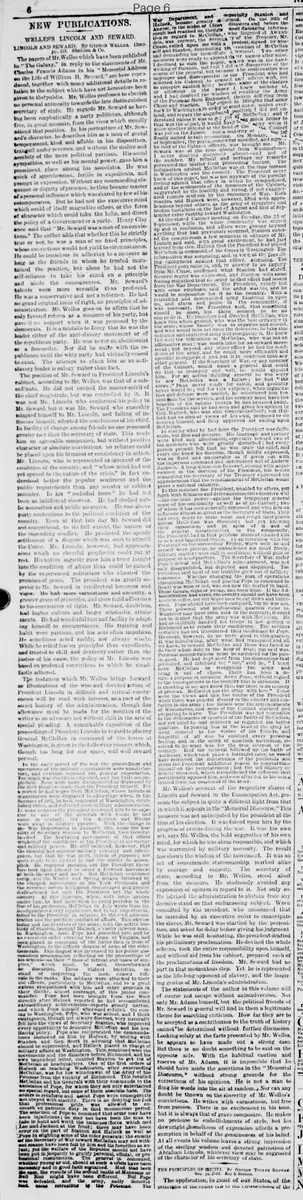
WELLES'S LINCOLN AND SEWARD
LINCOLN AND SEWARD. By GIDEON WELLES. 12mo. pp. 215. Sheldon & Co.
The papers of Mr. Welles which have been published in "The Galaxy," in reply to the statements of Mr. Charles Francis Adams in his "Memorial Address on the Life of William H. Seward," are here reproduced, together with many additional details in relation to the subject which have not heretofore been given to the public. Mr. Welles professes to cherish no personal animosity towards the late distinguished secretary of state. He regards Mr. Seward as having been emphatically a party politician, although free, in great measure, from the vices which usually attend that position. In his portraiture of Mr. Seward's character, he describes him as a man of genial temperament, kind and affable in his disposition, sympathies, as well as his mental power, gave him a prominent place among his associates. He was quick of apprehension, fertile in expedients, and prompt in expression. Without any commanding eloquence or dignity of presence, he thus became master of a personal influence which was shared by few of his contemporaries. But he had not the executive mind which could of itself magnetize others, or the force of character which could take the helm, and direct the policy of a Government or a party. Henry Clay once said that "Mr. Seward was a man of no convictions." The author adds that whether this be strictly true or not, he was a man of no fixed principles whose convictions would not yield to circumstances. He could be tenacious in adhering to a measure as long as the friends in whom he trusted maintained the position, but alone he had not the self-reliance to take his stand on a principle and abide the consequences. Mr. Seward's talents were more versatile than profound. He was a conservative and not a reformer. He had no grand original ideas of right, no principles of administration. Mr. Welles goes on to affirm that he only favored reform as a measure of his party, but gave it no support when it was proposed by the democrats. It is a mistake to fancy that he was the leader either of the anti-slavery movement or of the republican party. He was never an abolitionist or a free-soiler. Nor did he unite with the republicans until the whig party had virtually ceased to exist. The attempt to claim him as an anti-slavery leader is eulogy rather than fact.
The position of Mr. Seward in President Lincoln's cabinet, according to Mr. Welles, was that of a subordinate. He did not control the master-spirit of the chief magistrate, but was controlled by it. It was not Mr. Lincoln who conformed his policy to Mr. Seward, but it was Mr. Seward who smoothly adapted himself to Mr. Lincoln, and failing of influence himself, adopted the conclusions of his chief. In facility of change among friends no one possessed greater tact than the secretary of state. This made him an agreeable companion, but without positive character or absolute convictions, no reliance could be placed upon his firmness or consistency in action.
Mr. Lincoln, who is represented as ignorant of the condition of the country, and "whose mind had not yet opened to the nature of the crisis," in fact understood better the popular sentiment and the public requirements than any senator or cabinet minister. In his "secluded home" he had not been an indifferent observer. He had studied public necessities and public measures. He rose above party contentions to the political condition of the country. Even at that late day Mr. Seward did not comprehend, to its full extent, the nature of the impending conflict. He predicted the speedy settlement of a dispute which was soon to imperil the Union. Mr. Lincoln, however, had apprehensions which no cheerful prophecies could put at rest. His native sagacity gave him a truer insight into the condition of affairs than could be gained by the experienced politicians who chanted the promises of peace. The president was greatly superior to Mr. Seward in intellectual keenness and vigor. He had more earnestness and sincerity, a greater grasp of principles, and more rigid adherence to his convictions of right. Mr. Seward, doubtless, had higher culture and larger scholastic attainments. He had wonderful tact and facility in adapting himself to circumstances. His training and habit were partisan, and his acts often impulsive. He sometimes acted rashly, not always wisely. While he relied less on principles than expedients, and trusted to skill and dexterity rather than the justice of his cause, the policy of Mr. Lincoln was based on profound convictions to which he steadfastly adhered.
The instances which Mr. Welles brings forward as illustrations of the wise and decided action of President Lincoln in difficult and critical emergencies will be read with interest, as a part of the secret history of the administration, though due allowance must be made for the position of the writer as an advocate not without skill in the arts of special pleading. A remarkable exposition of the proceedings of President Lincoln in regard to placing General McClellan in command of the forces at Washington, is given in the following passage, which, though too long for our space, will well reward perusal.
In the early period of the war the proceedings and operations of the military commanders were unsatisfactory, and nowhere equaled the general expectation. Too much was doubtless expected, and too little accomplished. None were more disappointed or depressed by the slow progress made than the President himself. For a period he had hopes from McClellan, whose talents at organization were displayed to advantage when, in the Summer of 1861, he took command at Washington, established order, and enforced good military administration. In some respects the President esteemed him to be superior to any of the generals with whom he had come in contact; but the Autumn and Winter wore away in dilatory parades. With the change in the War Department in January, 1862, came the hostility of Secretary Stanton to McClellan, then General-in-chief. The hesitating movements of that officer weakened the confidence of the President in his energy and military power. He still believed, however, that the General had superior military capacity and intelligence, but that he was inert, infirm of purpose; not quite ready to do all that he had the ability to accomplish. He required pushing, and the President therefore took upon himself to order a forward movement of both the army and navy. But McClellan continued tardy, and the Winter and Spring delays, followed by the sluggish movements on the York Peninsula and the reverses before Richmond, discouraged and greatly disheartened not only the President but the whole country. At this juncture, when, with large armies under him, he had more than he could perform in the line of his profession, McClellan in July wrote from his headquarters a very injudicious, not to say impertinent, letter to the President in relation to the civil administration and the political conduct of affairs. This unwise letter and the reverses of the army, with the active hostility of Stanton, brought Halleck, a vastly inferior man, to Washington. Gen. Pope had preceded him, and by an executive order creating the Army of Virginia, had been placed in command of the forces then in front of Washington, to the infinite disgust of some of the older Generals. This disgust was increased by his public gasconading proclamation reflecting on the proceedings of his seniors—on their "lines of retreat and bases of supplies,"
which must, he said, thereafterward be discarded.
These blatant bulletins, instead of inspiriting the men, caused ridicule in the ranks. The soldiers were attached to their old officers, particularly to McClellan, and to a great extent sympathized with him and other generals in their dislike, almost contempt, of this junior commander. Pope had been brought from the West directly after Halleck reported he had accomplished extraordinary achievements—reports grossly untrue, and which Pope himself afterward refuted. On coming to Washington, Pope, who was ardent, and I think courageous, though not always discreet, very naturally fell into the views of Secretary Stanton, who improved every opportunity to denounce McClellan and his hesitating policy. Pope also reciprocated the commendations bestowed on him by Halleck, by uniting with Stanton and Gen. Scott in advising that McClellan should be superseded, and Halleck placed in charge of military affairs at Washington. This, combined with the movements and the disasters before Richmond, and his own imprudent letter, enabled Stanton to get rid of McClellan at headquarters. One of the first orders of Halleck on reaching Washington, after superseding McClellan, was for the withdrawal of the Army of the Potomac from the vicinity of Richmond. This recalled McClellan and his Generals with their commands to the assistance of Pope, for whom they not only entertained no special regard, but some of them absolute hate. The orders to reinforce and assist Pope were consequently not obeyed with alacrity. There is no denying the fact that professional pride was allowed to encroach on patriotic duty in that momentous period.
The selection of Pope to command that army may have been injudicious; he may not have been the man to take in hand and wield the immense force which met Lee and Jackson at the front; there may have been error on the part of Stanton and Halleck as well as Pope in slighting some of the older generals; the enmity of the Secretary of War toward McClellan may not without reason have been felt by him and his favorites as unjust; yet the welfare of the Republic should not have been put in jeopardy to gratify personal, official, or professional resentments.
The general in command, whether young or old, should at such a crisis have been earnestly and in good faith supported. Had this been the case, the results of the second battle at Manassas or Bull Run might have been different. But Pope defeated, and the army, sadly demoralized, retreating the Potomac. The Department and especially Stanton and Halleck, became greatly alarmed. On the 30th of August, in the midst of these disasters and before the final action in regard to McClellan, who lingered at Alexandria, was current, the Secretary of the Treasury, Mr. Chase, called upon me with a protest, signed by himself and Stanton, denouncing the conduct of McClellan and demanding his immediate dismissal. Two other members were ready to append their names after mine. I declined to sign the paper, which was in the handwriting of Stanton, not that I did not disapprove of the course of the general, but because the combination was improper and disrespectful to the President who had selected his Cabinet to consult and advise with, not to conspire against him; besides, some of the charges against McClellan I had doubted the wisdom of recalling the Army of the Potomac from Richmond, therein differing from Chase and Stanton. The object in bringing that army back to Washington in order to start anew, march overland to get rid of McClellan: and if so, while it was yet on the James. But a majority of the Cabinet finally united in this proceeding. On Monday, the 1st of September, the paper, somewhat modified, and signed by four of the Cabinet officers, was brought me. Mr. Seward was at the time absent from Washington—I never doubted purposely absent—and not of the number. My refusal and perhaps my remarks prevented the matter from proceeding further. The indignation against McClellan was at the time intense in Washington and the country. The President never knew of this paper, but was not unaware of the popular feeling against that officer in which he sympathized, and of the sentiments of the members of the Cabinet, aggravated by the hostility and strong, if not exaggerated, statements of rumors sent out by the Secretary of War. Stanton and Halleck were, however, filled with apprehensions beyond others, as the army of stragglers and broken battalions on the last of August and first of September came rushing toward Washington. At the stated Cabinet meeting on Tuesday, the 2d of September, while the whole community was stirred up and in confusion, and affairs were gloomy beyond anything that had previously occurred, Stanton entered the council-room a few moments in advance of Mr. Lincoln and said, with great excitement, he had just learned from Gen. Halleck that the President had placed McClellan in command of the forces in Washington. The information was surprising, and, in view of the prevailing excitement against that officer, alarming. The President soon came in, and, in answer to an inquiry from Mr. Chase, confirmed what Stanton had stated. General regret was expressed, and Stanton with some feeling remarked that no order to that effect had issued from the War Department. The President, calmly but with some emphasis, said the order was his, and he would be responsible for it to the country. With a retreating and demoralized army tumbling in upon us, and alarm and panic in the community, it was necessary, the President said, that something should be done, but there seemed to be no one to do it. He therefore had directed McClellan, who knew this whole ground, who was the best organizer in the army, whose faculty was to organize and defend, and who would here act upon the defensive, to take this defeated and shattered army and reorganize it. He knew full well the infirmities of McClellan, who was not an affirmative man; was worth little for an onward movement; but beyond any other officer he had the confidence of the army, and he could more efficiently and speedily reorganize it and put it in condition than any other general. If the Secretary of War, or any member of the Cabinet, would name a general that could do this as promptly and well, he would appoint him. For an active fighting general he was sorry to say McClellan was a failure; he had "the slows;" 'twas never ready for battle, and probably never would be; but for this exigency, when organization and defense were needed, he considered him the best man for the service, and the country must have the benefits of his talents though he had behaved badly. The President said he had seen and given his opinion to Gen. Halleck, who was still General-in-Chief; but Halleck had no plan or views of his own, proposed to do nothing himself, and fully approved his calling upon McClellan. In stating what he had done the President was deliberate, but firm and decisive. His language and manner were kind and affectionate, especially toward two of the members who were greatly disturbed; but every person present felt that he was truly the chief, and every one knew his decision, though mildly expressed, was as fixed and unalterable as if given out with the imperious command and determined will of Andrew Jackson. A long discussion followed, closing with acquiescence in the decision of the President, but before separating the Secretary of the Treasury expressed his apprehension that the reinstatement of McClellan would prove a national calamity. In this instance the President, unaided by others, put forth with firmness and determination the executive will—the one-man power—against the temporary general sense of the community as well as of his Cabinet; two of whom it has been generally supposed had with him an influence almost as great as the Secretary of State. They had been ready to make issue and resign their places unless McClellan was dismissed; but yet knowing the general dissatisfaction in the community, the President had in that perilous moment exalted him to new and important trusts. In an interview with the President on the succeeding Friday, when only he and myself were present, he unburdened his mind freely. Military matters were still in confusion, without plan or purpose at headquarters. The Secretary of War, under Pope's defeat and McClellan's reinstatement, was not only disappointed but dejected. President said most of our troubles grew out of military jealousies. Whether changing the plan of operations (discarding McClellan and placing Pope in command in front) was wise or not, was not now the matter in hand. These things, right or wrong, had been done. If the Administration had erred, the country should not have been made to suffer, nor our brave men be cut down and butchered. Pope should have been sustained, but he was not. These personal and professional quarrels came too much to the front. Whatever may have been said to the contrary, it could not be denied that the army was with McClellan. He had so skillfully handled his troops in not getting to Richmond as to retain their confidence. The soldiers certainly had not transferred their confidence to Pope. He could, however, do no more good in this quarter. It was humiliating, after what had transpired and all we knew, to reward McClellan and those who failed to do their whole duty in the hour of trial; but so it was. Personal considerations must be sacrificed for the public good. He had kept aloof from the dissensions that have McClellan to reorganize the army and bring it out of chaos. There has been a design, a purpose in breaking down Pope, without regard to the consequences to the country that is atrocious. It is shocking to see and know this, but there is no remedy present. McClellan has the army were the views and this the course of the President when there was general dismay in the country and confusion in the army; the Rebels near the intrenchments of Washington, and some of the Cabinet alarmed and preparing to leave. The President was not insensible to the deficiencies or ignorant of the faults of McClellan, nor yet blind to, and stubborn as regarded his better qualities. In placing him at the head of the army he went counter to the wishes of his friends, and forgetful of all else he subdued every personal feeling, and in the spirit of unselfish patriotism, resolved to do what was for the true interest of the country. Had the General followed up the battle of Antietam, which took place a fortnight later, he would have retrieved the misfortunes of the peninsula and given the President additional reason to congratulate himself on the reinstatement; but the old dilatory infirmity remained, which strengthened the influence that persistently opposed him, and soon after led to his being relieved from the command of the army.
Mr. Welles's account of the respective shares of Lincoln and Seward in the Emancipation Act, presents the subject in quite a different light from that in which it appears in the "Memorial Discourse." This measure was not anticipated by the president at the time of his election. It was forced upon him by the progress of events during the war. It was his own act, says Mr. Welles, the bold suggestion of his own mind, for which he was alone responsible, and which was warranted by military necessity. The result has shown the wisdom of the movement. It was an act of consummate statesmanship, marked alike by courage and sagacity. The secretary of state, according to Mr. Welles, stood aloof from the measure. He studiously avoided any expression of opinion in regard to it. Not only so. He advised the administration to abstain from any decisive stand on that embarrassing subject. When consulted by the president, who announced that he intended by an executive order to emancipate the slaves, Mr. Seward was startled by the proposition, and asked for delay before giving his judgment. While he was still hesitating, the president drafted his preliminary proclamation. He devised the whole scheme, took the entire responsibility upon himself, and without aid from his cabinet, prepared each of the proclamations of freedom. Mr. Seward had no part in that momentous step. Yet he is represented as the life-long opponent of slavery, and the inspiring genius of Mr. Lincoln's administration.
The statements of the author in this volume will of course not escape without animadversion. Not only Mr. Adams himself but the political friends of Mr. Seward in general will find in them a legitimate theme for searching criticism. How far they are to be accepted as a contribution to the truth of history cannot be determined without further discussion. Looking solely at the facts presented by Mr. Welles he appears to have made out a strong case. But there is no doubt something to be said on the opposite side. With the habitual caution and reserve of Mr. Adams, it is impossible that he should have made the assertions in the "Memorial Discourse," without strong grounds for the correctness of his opinions. He is not a man to fling his words into the air at random. Nor can any doubt be thrown on the sincerity of Mr. Welles's convictions. He writes with earnestness, but free from passion. There is no excitement in his tone, but it is always that of grave composure. He makes no pretense to embellishments of style, but his downright homeliness of expression affords a presumption in behalf of the genuineness of his belief. At all events his volume leaves a strong impression of the sterling wisdom and devoted patriotism of Abraham Lincoln, whatever view may be suggested of the character of his secretary of state.
What sub-type of article is it?
What themes does it cover?
What keywords are associated?
What entities or persons were involved?
Where did it happen?
Story Details
Key Persons
Location
Washington
Event Date
1861 1862
Story Details
Gideon Welles' book reproduces his articles rebutting Charles Francis Adams' memorial on Seward, portraying Seward as a versatile but principle-lacking politician subordinate to Lincoln's firm leadership. Details Lincoln's decisions on McClellan's command amid Civil War crises and his independent role in the Emancipation Proclamation, contrasting with Seward's hesitancy.