Thank you for visiting SNEWPapers!
Sign up free
Literary
June 29, 1830
Daily Richmond Whig
Richmond, Virginia
What is this article about?
A letter from Gibraltar, dated January 31, 1830, by the author of 'The Military Sketch Book,' recounts the true story of pirate Benito de Soto. It details his origins in the slave trade off Africa in 1821, mutiny, rise to captaincy, sale of slaves, piratical raids including the brutal 1828 capture of the British ship Morning Star near Ascension Island, and his impending trial and execution after 19 months imprisonment.
Clipping
OCR Quality
95%
Excellent
Full Text
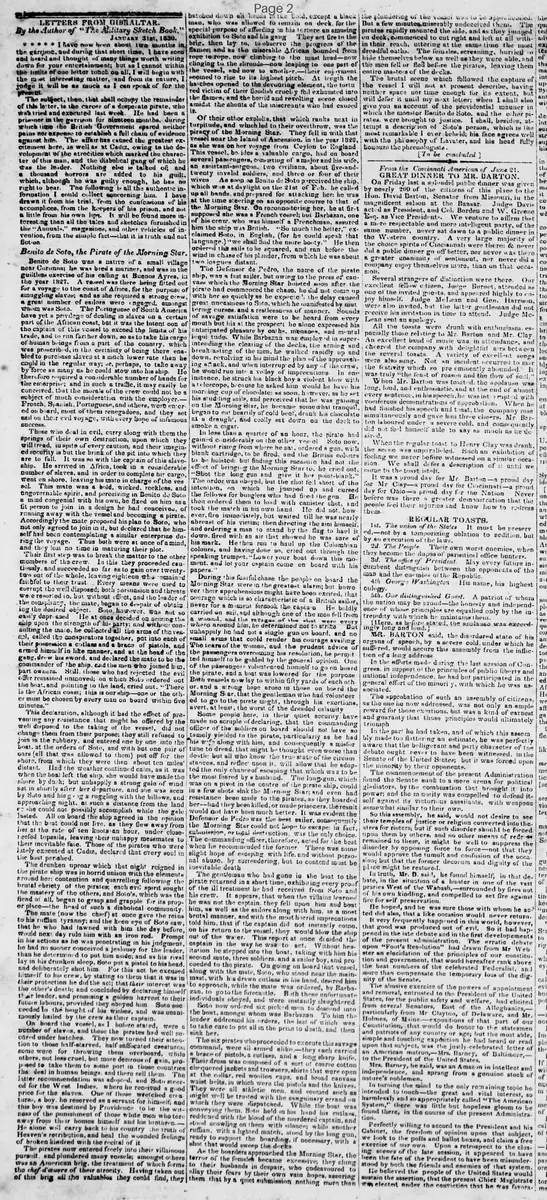
LETTERS FROM GIBRALTAR
By the Author of "The Military Sketch Book."
January 31st, 1830.
*** I have now been about two months in the garrison, and during that short time, I have seen and heard and thought of many things worth writing down for your entertainment; but as I cannot within the limits of one letter touch on all, I will begin with the most interesting matter, and from its nature, I judge it will be as much as I can speak of for the present.
The subject, then, that shall occupy the remainder of this letter, is the career of a desperate pirate, who was tried and executed last week. He had been a prisoner in the garrison for nineteen months, during which time the British Government spared neither pains nor expense to establish a full chain of evidence against him. The affair has caused the greatest excitement here, as well as at Cadiz, owing to the development of the atrocities which marked the character of this man, and the diabolical gang of which he was the leader. Nothing else is talked of: and thousand horrors are added to his guilt, which, although he was guilty enough, he has no right to bear. "The following is all the authentic information I could collect concerning him. I have drawn it from his trial, from the confessions of his accomplices, from the keepers of his prison, and not a little from his own lips. It will be found more interesting than all the tales and sketches furnished in the 'Annuals,' magazines, and other vehicles of invention, from the simple fact—that it is truth and not fiction."
Benito de Soto, the Pirate of the Morning Star.
Benito de Soto was a native of a small village near Corunna; he was bred a mariner, and was in the guiltless exercise of his calling at Buenos Ayres, in the year 1821. A vessel was there being fitted out for a voyage to the coast of Africa, for the purpose of smuggling slaves; and as she required a strong crew, a great number of sailors were engaged, amongst whom was Soto. The Portuguese of South America have yet a privilege of dealing in slaves on a certain part of the African coast, but it was the intent of the captain of this vessel to exceed the limits of his trade, and to run farther down, so as to take his cargo of human beings from a part of the country which was proscribed, in the certainty of being there enabled to purchase slaves at a much lower rate than he could in the regular way; or, perhaps, to take away by force as many as he could stow into his ship. He therefore required a considerable number of hands for the enterprise; and in such a traffic, it may easily be conceived, that the morals of the crew could not be a subject of much consideration with the employer. French, Spanish, Portuguese, and others, were entered on board, most of them renegadoes, and they set sail on their evil voyage, with every hope of infamous success.
Those who deal in evil, carry along with them the springs of their own destruction, upon which they will tread, in spite of every caution, and their imagined security is but the brink of the pit into which they are to fall. It was so with the captain of this slave-ship. He arrived in Africa, took in a considerable number of slaves, and in order to complete his cargo, went on shore, leaving his mate in charge of the vessel. This mate was a bold, wicked, reckless, and ungovernable spirit, and perceiving in Benito de Soto a mind congenial with his own, he fixed on him as a fit person to join in a design he had conceived, of running away with the vessel and becoming a pirate. Accordingly the mate proposed his plan to Soto, who not only agreed to join in it, but declared that he himself had been contemplating a similar enterprise during the voyage. Thus both were at once of a mind, and they lost no time in maturing their plot.
Their first step was to break the matter to the other members of the crew. In this they proceeded cautiously, and succeeded so far as to gain over twenty-two out of the whole, leaving eighteen who remained faithful to their trust. Every means were used to corrupt the well disposed; both persuasion and threats were resorted to, but without effect, and the leader of the conspiracy, the mate, began to despair of obtaining the desired object. Soto, however, was not so easily depressed. He at once decided on seizing the ship upon the strength of his party: and without consulting the mate, he collected all the arms of the vessel, called the conspirators together, put into each of their possession a cutlass and a brace of pistols, and armed himself in like manner, and at the head of the gang, drew his sword, and declared the mate to be the commander of the ship, and the men who joined him, part owners. Still, those who had rejected the evil offer remained unmoved; on which Soto ordered out the boat, and pointing to the land, cried out, "There is the African coast; this is our ship—one or the other must be chosen by every man on board within five minutes."
This declaration, although it had the effect of preventing any resistance that might be offered by the well disposed to the taking of the vessel, did not change them from their purpose; they still refused to join in the robbery, and entered one by one into the boat, at the orders of Soto, and with but one pair of oars (all that was allowed to them) put off for the shore, from which they were then about ten miles distant. Had the weather continued calm, as it was when the boat left the ship, she would have made the shore by dark; but unhappily a strong gale of wind set in shortly after her departure, and she was seen by Soto and his gang struggling with the billows, and approaching night, at such a distance from the land as she could not possibly accomplish while the gale lasted. All on board the ship agreed in the opinion that the boat could not live, as they flew away from her at the rate of ten knots an hour, under close-reefed topsails, leaving their unhappy messmates to their inevitable fate. Those of the pirates who were lately executed at Cadiz, declared that every soul in the boat perished.
The drunken uproar which that night reigned in the pirate ship was in horrid unison with the elements around her: contention and quarrelling following the brutal ebriety of the pirates; each evil spirit sought the mastery of the others, and Soto's, which was the fiend of all, began to grasp and grapple for its proper place—the head of such a diabolical community. The mate (now the chief) at once gave the reins to his ruffian tyranny; and the keen eye of Soto saw, that he who had lawed with him the day before, would next day rule him with an iron rod. Prompt in his actions as he was penetrating in his judgment, he had no sooner conceived a jealousy for the leader, than he determined to put him aside; and as his rival lay in his drunken sleep, Soto put a pistol to his head, and deliberately shot him. For this act he excused himself to his crew, by stating to them that it was in their protection he did the act; that their interest was the other's death; and concluded by declaring himself their leader, and promising a golden harvest to their future labours, provided they obeyed him. Soto succeeded to the height of his wishes, and was unanimously hailed by the crew as their captain.
On board the vessel, as I before stated, were a number of slaves, and these the pirates had well secured under hatches. They now turned their attention to those half-starved, half-suffocated creatures; some were for throwing them overboard, while others, not less cruel, but more desirous of gain, proposed to take them to some port in those countries that deal in human beings, and there sell them. The latter recommendation was adopted, and Soto steered for the West Indies, where he received a good price for the slaves. One of those wretched creatures, a boy, he reserved as a servant for himself: and this boy was destined by Providence to be the witness of the punishment of those white men who tore away from their homes himself and his brethren. He alone will carry back to his country the truth of Heaven's retribution, and heal the wounded feelings of broken kindred with the recital of it.
The pirates now entered freely into their villainous pursuit, and plundered many vessels; amongst others was an American brig, the treatment of which forms the chef-d'oeuvre of their atrocity. Having taken out of this brig all the valuables they could find, they butchered down all hands in the hold, except a black man, who was allowed to remain on deck, for the special purpose of affording in his torture an amusing exhibition to Soto and his gang. They set fire to the brig, then lay to, to observe the progress of the flames; and as the miserable African bounded from rope to rope, now climbing to the mast head—now clinging to the shrouds—now leaping to one part of the vessel, and now to another—their enjoyment seemed to rise to its highest pitch. At length the hatches opened to the devouring element, the tortured victim of their fiendish cruelty fell exhausted into the flames, and the horrid and revolting scene closed amidst the shouts of the miscreants who had caused it.
Of their other exploits, that which ranks next in turpitude, and which led to their overthrow, was the piracy of the Morning Star. They fell in with that vessel near the Island of Ascension, in the year 1828, as she was on her voyage from Ceylon to England. This vessel, besides a valuable cargo, had on board several passengers, consisting of a major and his wife, an assistant-surgeon, two civilians, about five-and-twenty invalid soldiers, and three or four of their wives.
As soon as Benito de Soto perceived the ship, which was at daylight on the 21st of Feb., he called up all hands, and prepared for attacking her: he was at the time steering on an opposite course to that of the Morning Star. On reconnoitering her, he at first supposed she was a French vessel; but Barbazan, one of his crew, who was himself a Frenchman, assured him the ship was British. "So much the better," exclaimed Soto, in English, (for he could speak that language,) "we shall find the more booty." He then ordered the sails to be squared, and ran before the wind in chase of his plunder, from which he was about two leagues distant.
The Defensor de Pedro, the name of the pirate ship, was a fast sailer, but owing to the press of canvas which the Morning Star hoisted soon after the pirate had commenced the chase, he did not come up with her so quickly as he expected: the delay caused great uneasiness to Soto, which he manifested by muttering curses, and a restlessness of manner. Sounds of savage satisfaction were to be heard from every mouth but his at the prospect; he alone expressed his anticipated pleasure by oaths, menaces, and mental inquietude. While Barbazan was employed in superintending the clearing of the decks, the arming and breakfasting of the men, he walked rapidly up and down, revolving in his mind the plan of the approaching attack, and when interrupted by any of the crew, he would run into a volley of imprecations. In one instance, he struck his black boy a violent blow with a telescope, because he asked him would he have his morning cup of chocolate: as soon, however, as he set his studding sails, and perceived that he was gaining on the Morning Star, he became somewhat tranquil, began to eat heartily of cold beef, drank his chocolate at a draught, and coolly sat down on the deck to smoke a cigar.
In less than a quarter of an hour, the pirate had gained considerably on the other vessel. Soto now, without rising from where he sat, ordered a gun, with blank cartridge, to be fired, and the British colours to be hoisted: but finding this measure had not the effect of bringing the Morning Star to, he cried out, "Shot the long gun and give it her point-blank." The order was obeyed, but the shot fell short of the intention, on which he jumped up and cursed the fellows for bunglers who had fired the gun. He then ordered them to load with canister shot, and took the match in his own hand. He did not, however, fire immediately, but waited till he was nearly abreast of his victim; then directing the aim himself, and ordering a man to stand by the flag to haul it down, fired with an air that showed he was sure of his mark. He then ran to haul up the Colombian colours, and having done so, cried out through the speaking trumpet, "Lower your boat down this moment, and let your captain come on board with his papers."
During this fearful chase the people on board the Morning Star were in the greatest alarm; but however their apprehensions might have been excited, that courage which is so characteristic of a British sailor, never for a moment forsook the captain. He boldly carried on sail, and although one of the men fell from a wound, and the ravages of the shot were every where around him, he determined not to strike. But unhappily he had not a single gun on board, and no small arms that could render his courage availing. The tears of the women, and the prudent advice of the passengers overcoming his resolution, he permitted himself to be guided by the general opinion. One of the passengers volunteered himself to go on board the pirate, and a boat was lowered for the purpose. Both vessels now lay to within fifty yards of each other, and a strong hope arose in those on board the Morning Star, that the gentleman who had volunteered to go to the pirate might, through his exertions, avert, at least, the worst of the dreaded calamity.
Some people here, in their quiet security, have made no scruple of declaring, that the commanding officer of the soldiers on board should not have so tamely yielded to the pirate, particularly as he had his wife along with him, and consequently a misfortune to dread that might be thought even worse than death: but all who know the true state of the circumstances, and reflect upon it, will allow that he adopted the only chance of escaping that which was to be the most feared by a husband. "The long-gun, which was on a pivot in the centre of the pirate ship, could in a few shots sink the Morning Star; and even had resistance been made to the pirates, as they boarded her—had they been killed, or made prisoners, the result would not have been much better. It was evident the Defensor de Pedro was the best sailer, consequently the Morning Star could not hope to escape: in fact, submission, or total destruction, was the only choice. The commanding officer, therefore, acted for the best when he recommended the former. There was some slight hope of escaping with life, and without personal abuse, by surrendering, but to contend must be inevitable death."
The gentleman who had gone in the boat to the pirate returned in a short time, exhibiting every proof of the ill treatment he had received from Soto and his crew. It appears, that when the villains learned he was not the captain, they fell upon him and beat him, as well as the sailors along with him, in a most brutal manner, and with the most horrid imprecations told him, that if the captain did not instantly come, on his return to the vessel, they would blow the ship out of the water. This report at once decided the captain in the way he was to act. Without hesitation he stepped into the boat, taking with him his second mate, three soldiers, and a sailor boy, and proceeded to the pirate. On going on board that vessel, along with the mate, Soto, who stood near the main-mast, with his drawn cutlass in his hand, desired him to approach, while the mate was ordered, by Barbazan, to go to the forecastle. Both these unfortunate individuals obeyed, and were instantly slaughtered.
Soto now ordered six picked men to descend into the boat, amongst whom was Barbazan. To him the leader addressed his orders, the last of which was to take care to put all in the prize to death, and then sink her.
The six pirates who proceeded to execute this savage command, were all armed alike,—they each carried a brace of pistols, a cutlass, and a long sharp knife. Their dress was composed of a sort of coarse cotton chequered jackets and trowsers, shirts that were open at the collar, red woollen caps, and broad canvass waist belts, in which were the pistols and the knives. They were all athletic men, and seemed such as might well be trusted with the sanguinary errand on which they were dispatched. While the boat was conveying them, Soto held in his hand his cutlass, reeking with the blood of the murdered captain, and stood scowling on them with silence: while another ruffian, with a lighted match, stood by the long gun, ready to support the boarding, if necessary, with a shot that would sweep the decks.
As the boarders approached the Morning Star, the terror of the females became excessive; they clung to their husbands in despair, who endeavoured to allay their fears by their own vain hopes, assuring them that by a quiet submission nothing more than the plundering of the vessel was to be apprehended. But a few minutes miserably undeceived them. The pirates rapidly mounted the side, and as they jumped on deck, commenced to cut right and left at all within their reach, uttering at the same time the most dreadful oaths. The females, screaming, hurried to hide themselves below as well as they were able, and the men fell or fled before the pirates, leaving them entire masters of the decks.
The brutal scene which followed the capture of the vessel I will not at present describe, having neither space nor time enough for its extent, but will defer it until my next letter; when I shall also give you an account of the providential manner in which the monster Benito de Soto, and the other pirates, were brought to justice. I shall, besides, attempt a description of Soto's person, which is the most remarkable I ever beheld: his face agrees well with the philosophy of Lavater, and his head fully honours the phrenologists.
[To be continued]
By the Author of "The Military Sketch Book."
January 31st, 1830.
*** I have now been about two months in the garrison, and during that short time, I have seen and heard and thought of many things worth writing down for your entertainment; but as I cannot within the limits of one letter touch on all, I will begin with the most interesting matter, and from its nature, I judge it will be as much as I can speak of for the present.
The subject, then, that shall occupy the remainder of this letter, is the career of a desperate pirate, who was tried and executed last week. He had been a prisoner in the garrison for nineteen months, during which time the British Government spared neither pains nor expense to establish a full chain of evidence against him. The affair has caused the greatest excitement here, as well as at Cadiz, owing to the development of the atrocities which marked the character of this man, and the diabolical gang of which he was the leader. Nothing else is talked of: and thousand horrors are added to his guilt, which, although he was guilty enough, he has no right to bear. "The following is all the authentic information I could collect concerning him. I have drawn it from his trial, from the confessions of his accomplices, from the keepers of his prison, and not a little from his own lips. It will be found more interesting than all the tales and sketches furnished in the 'Annuals,' magazines, and other vehicles of invention, from the simple fact—that it is truth and not fiction."
Benito de Soto, the Pirate of the Morning Star.
Benito de Soto was a native of a small village near Corunna; he was bred a mariner, and was in the guiltless exercise of his calling at Buenos Ayres, in the year 1821. A vessel was there being fitted out for a voyage to the coast of Africa, for the purpose of smuggling slaves; and as she required a strong crew, a great number of sailors were engaged, amongst whom was Soto. The Portuguese of South America have yet a privilege of dealing in slaves on a certain part of the African coast, but it was the intent of the captain of this vessel to exceed the limits of his trade, and to run farther down, so as to take his cargo of human beings from a part of the country which was proscribed, in the certainty of being there enabled to purchase slaves at a much lower rate than he could in the regular way; or, perhaps, to take away by force as many as he could stow into his ship. He therefore required a considerable number of hands for the enterprise; and in such a traffic, it may easily be conceived, that the morals of the crew could not be a subject of much consideration with the employer. French, Spanish, Portuguese, and others, were entered on board, most of them renegadoes, and they set sail on their evil voyage, with every hope of infamous success.
Those who deal in evil, carry along with them the springs of their own destruction, upon which they will tread, in spite of every caution, and their imagined security is but the brink of the pit into which they are to fall. It was so with the captain of this slave-ship. He arrived in Africa, took in a considerable number of slaves, and in order to complete his cargo, went on shore, leaving his mate in charge of the vessel. This mate was a bold, wicked, reckless, and ungovernable spirit, and perceiving in Benito de Soto a mind congenial with his own, he fixed on him as a fit person to join in a design he had conceived, of running away with the vessel and becoming a pirate. Accordingly the mate proposed his plan to Soto, who not only agreed to join in it, but declared that he himself had been contemplating a similar enterprise during the voyage. Thus both were at once of a mind, and they lost no time in maturing their plot.
Their first step was to break the matter to the other members of the crew. In this they proceeded cautiously, and succeeded so far as to gain over twenty-two out of the whole, leaving eighteen who remained faithful to their trust. Every means were used to corrupt the well disposed; both persuasion and threats were resorted to, but without effect, and the leader of the conspiracy, the mate, began to despair of obtaining the desired object. Soto, however, was not so easily depressed. He at once decided on seizing the ship upon the strength of his party: and without consulting the mate, he collected all the arms of the vessel, called the conspirators together, put into each of their possession a cutlass and a brace of pistols, and armed himself in like manner, and at the head of the gang, drew his sword, and declared the mate to be the commander of the ship, and the men who joined him, part owners. Still, those who had rejected the evil offer remained unmoved; on which Soto ordered out the boat, and pointing to the land, cried out, "There is the African coast; this is our ship—one or the other must be chosen by every man on board within five minutes."
This declaration, although it had the effect of preventing any resistance that might be offered by the well disposed to the taking of the vessel, did not change them from their purpose; they still refused to join in the robbery, and entered one by one into the boat, at the orders of Soto, and with but one pair of oars (all that was allowed to them) put off for the shore, from which they were then about ten miles distant. Had the weather continued calm, as it was when the boat left the ship, she would have made the shore by dark; but unhappily a strong gale of wind set in shortly after her departure, and she was seen by Soto and his gang struggling with the billows, and approaching night, at such a distance from the land as she could not possibly accomplish while the gale lasted. All on board the ship agreed in the opinion that the boat could not live, as they flew away from her at the rate of ten knots an hour, under close-reefed topsails, leaving their unhappy messmates to their inevitable fate. Those of the pirates who were lately executed at Cadiz, declared that every soul in the boat perished.
The drunken uproar which that night reigned in the pirate ship was in horrid unison with the elements around her: contention and quarrelling following the brutal ebriety of the pirates; each evil spirit sought the mastery of the others, and Soto's, which was the fiend of all, began to grasp and grapple for its proper place—the head of such a diabolical community. The mate (now the chief) at once gave the reins to his ruffian tyranny; and the keen eye of Soto saw, that he who had lawed with him the day before, would next day rule him with an iron rod. Prompt in his actions as he was penetrating in his judgment, he had no sooner conceived a jealousy for the leader, than he determined to put him aside; and as his rival lay in his drunken sleep, Soto put a pistol to his head, and deliberately shot him. For this act he excused himself to his crew, by stating to them that it was in their protection he did the act; that their interest was the other's death; and concluded by declaring himself their leader, and promising a golden harvest to their future labours, provided they obeyed him. Soto succeeded to the height of his wishes, and was unanimously hailed by the crew as their captain.
On board the vessel, as I before stated, were a number of slaves, and these the pirates had well secured under hatches. They now turned their attention to those half-starved, half-suffocated creatures; some were for throwing them overboard, while others, not less cruel, but more desirous of gain, proposed to take them to some port in those countries that deal in human beings, and there sell them. The latter recommendation was adopted, and Soto steered for the West Indies, where he received a good price for the slaves. One of those wretched creatures, a boy, he reserved as a servant for himself: and this boy was destined by Providence to be the witness of the punishment of those white men who tore away from their homes himself and his brethren. He alone will carry back to his country the truth of Heaven's retribution, and heal the wounded feelings of broken kindred with the recital of it.
The pirates now entered freely into their villainous pursuit, and plundered many vessels; amongst others was an American brig, the treatment of which forms the chef-d'oeuvre of their atrocity. Having taken out of this brig all the valuables they could find, they butchered down all hands in the hold, except a black man, who was allowed to remain on deck, for the special purpose of affording in his torture an amusing exhibition to Soto and his gang. They set fire to the brig, then lay to, to observe the progress of the flames; and as the miserable African bounded from rope to rope, now climbing to the mast head—now clinging to the shrouds—now leaping to one part of the vessel, and now to another—their enjoyment seemed to rise to its highest pitch. At length the hatches opened to the devouring element, the tortured victim of their fiendish cruelty fell exhausted into the flames, and the horrid and revolting scene closed amidst the shouts of the miscreants who had caused it.
Of their other exploits, that which ranks next in turpitude, and which led to their overthrow, was the piracy of the Morning Star. They fell in with that vessel near the Island of Ascension, in the year 1828, as she was on her voyage from Ceylon to England. This vessel, besides a valuable cargo, had on board several passengers, consisting of a major and his wife, an assistant-surgeon, two civilians, about five-and-twenty invalid soldiers, and three or four of their wives.
As soon as Benito de Soto perceived the ship, which was at daylight on the 21st of Feb., he called up all hands, and prepared for attacking her: he was at the time steering on an opposite course to that of the Morning Star. On reconnoitering her, he at first supposed she was a French vessel; but Barbazan, one of his crew, who was himself a Frenchman, assured him the ship was British. "So much the better," exclaimed Soto, in English, (for he could speak that language,) "we shall find the more booty." He then ordered the sails to be squared, and ran before the wind in chase of his plunder, from which he was about two leagues distant.
The Defensor de Pedro, the name of the pirate ship, was a fast sailer, but owing to the press of canvas which the Morning Star hoisted soon after the pirate had commenced the chase, he did not come up with her so quickly as he expected: the delay caused great uneasiness to Soto, which he manifested by muttering curses, and a restlessness of manner. Sounds of savage satisfaction were to be heard from every mouth but his at the prospect; he alone expressed his anticipated pleasure by oaths, menaces, and mental inquietude. While Barbazan was employed in superintending the clearing of the decks, the arming and breakfasting of the men, he walked rapidly up and down, revolving in his mind the plan of the approaching attack, and when interrupted by any of the crew, he would run into a volley of imprecations. In one instance, he struck his black boy a violent blow with a telescope, because he asked him would he have his morning cup of chocolate: as soon, however, as he set his studding sails, and perceived that he was gaining on the Morning Star, he became somewhat tranquil, began to eat heartily of cold beef, drank his chocolate at a draught, and coolly sat down on the deck to smoke a cigar.
In less than a quarter of an hour, the pirate had gained considerably on the other vessel. Soto now, without rising from where he sat, ordered a gun, with blank cartridge, to be fired, and the British colours to be hoisted: but finding this measure had not the effect of bringing the Morning Star to, he cried out, "Shot the long gun and give it her point-blank." The order was obeyed, but the shot fell short of the intention, on which he jumped up and cursed the fellows for bunglers who had fired the gun. He then ordered them to load with canister shot, and took the match in his own hand. He did not, however, fire immediately, but waited till he was nearly abreast of his victim; then directing the aim himself, and ordering a man to stand by the flag to haul it down, fired with an air that showed he was sure of his mark. He then ran to haul up the Colombian colours, and having done so, cried out through the speaking trumpet, "Lower your boat down this moment, and let your captain come on board with his papers."
During this fearful chase the people on board the Morning Star were in the greatest alarm; but however their apprehensions might have been excited, that courage which is so characteristic of a British sailor, never for a moment forsook the captain. He boldly carried on sail, and although one of the men fell from a wound, and the ravages of the shot were every where around him, he determined not to strike. But unhappily he had not a single gun on board, and no small arms that could render his courage availing. The tears of the women, and the prudent advice of the passengers overcoming his resolution, he permitted himself to be guided by the general opinion. One of the passengers volunteered himself to go on board the pirate, and a boat was lowered for the purpose. Both vessels now lay to within fifty yards of each other, and a strong hope arose in those on board the Morning Star, that the gentleman who had volunteered to go to the pirate might, through his exertions, avert, at least, the worst of the dreaded calamity.
Some people here, in their quiet security, have made no scruple of declaring, that the commanding officer of the soldiers on board should not have so tamely yielded to the pirate, particularly as he had his wife along with him, and consequently a misfortune to dread that might be thought even worse than death: but all who know the true state of the circumstances, and reflect upon it, will allow that he adopted the only chance of escaping that which was to be the most feared by a husband. "The long-gun, which was on a pivot in the centre of the pirate ship, could in a few shots sink the Morning Star; and even had resistance been made to the pirates, as they boarded her—had they been killed, or made prisoners, the result would not have been much better. It was evident the Defensor de Pedro was the best sailer, consequently the Morning Star could not hope to escape: in fact, submission, or total destruction, was the only choice. The commanding officer, therefore, acted for the best when he recommended the former. There was some slight hope of escaping with life, and without personal abuse, by surrendering, but to contend must be inevitable death."
The gentleman who had gone in the boat to the pirate returned in a short time, exhibiting every proof of the ill treatment he had received from Soto and his crew. It appears, that when the villains learned he was not the captain, they fell upon him and beat him, as well as the sailors along with him, in a most brutal manner, and with the most horrid imprecations told him, that if the captain did not instantly come, on his return to the vessel, they would blow the ship out of the water. This report at once decided the captain in the way he was to act. Without hesitation he stepped into the boat, taking with him his second mate, three soldiers, and a sailor boy, and proceeded to the pirate. On going on board that vessel, along with the mate, Soto, who stood near the main-mast, with his drawn cutlass in his hand, desired him to approach, while the mate was ordered, by Barbazan, to go to the forecastle. Both these unfortunate individuals obeyed, and were instantly slaughtered.
Soto now ordered six picked men to descend into the boat, amongst whom was Barbazan. To him the leader addressed his orders, the last of which was to take care to put all in the prize to death, and then sink her.
The six pirates who proceeded to execute this savage command, were all armed alike,—they each carried a brace of pistols, a cutlass, and a long sharp knife. Their dress was composed of a sort of coarse cotton chequered jackets and trowsers, shirts that were open at the collar, red woollen caps, and broad canvass waist belts, in which were the pistols and the knives. They were all athletic men, and seemed such as might well be trusted with the sanguinary errand on which they were dispatched. While the boat was conveying them, Soto held in his hand his cutlass, reeking with the blood of the murdered captain, and stood scowling on them with silence: while another ruffian, with a lighted match, stood by the long gun, ready to support the boarding, if necessary, with a shot that would sweep the decks.
As the boarders approached the Morning Star, the terror of the females became excessive; they clung to their husbands in despair, who endeavoured to allay their fears by their own vain hopes, assuring them that by a quiet submission nothing more than the plundering of the vessel was to be apprehended. But a few minutes miserably undeceived them. The pirates rapidly mounted the side, and as they jumped on deck, commenced to cut right and left at all within their reach, uttering at the same time the most dreadful oaths. The females, screaming, hurried to hide themselves below as well as they were able, and the men fell or fled before the pirates, leaving them entire masters of the decks.
The brutal scene which followed the capture of the vessel I will not at present describe, having neither space nor time enough for its extent, but will defer it until my next letter; when I shall also give you an account of the providential manner in which the monster Benito de Soto, and the other pirates, were brought to justice. I shall, besides, attempt a description of Soto's person, which is the most remarkable I ever beheld: his face agrees well with the philosophy of Lavater, and his head fully honours the phrenologists.
[To be continued]
What sub-type of article is it?
Epistolary
Essay
What themes does it cover?
Slavery Abolition
Moral Virtue
Religious
What keywords are associated?
Benito De Soto
Pirate
Morning Star
Slave Trade
Gibraltar
Mutiny
Atrocities
What entities or persons were involved?
By The Author Of "The Military Sketch Book."
Literary Details
Title
Letters From Gibraltar
Author
By The Author Of "The Military Sketch Book."
Subject
The Career Of Pirate Benito De Soto
Form / Style
Narrative Letter Recounting Historical Events
Key Lines
There Is The African Coast; This Is Our Ship—One Or The Other Must Be Chosen By Every Man On Board Within Five Minutes.
So Much The Better," Exclaimed Soto, In English, (For He Could Speak That Language,) "We Shall Find The More Booty."
The Brutal Scene Which Followed The Capture Of The Vessel I Will Not At Present Describe, Having Neither Space Nor Time Enough For Its Extent, But Will Defer It Until My Next Letter;