Thank you for visiting SNEWPapers!
Sign up free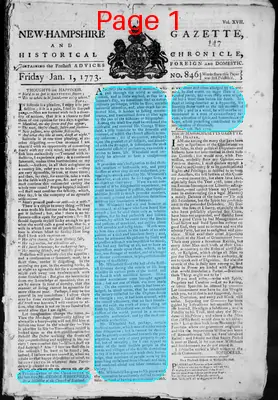
Editorial
January 1, 1773
The New Hampshire Gazette And Historical Chronicle
Portsmouth, Greenland, Rockingham County, New Hampshire
What is this article about?
A Minister of the Church of Scotland defends the character of the late Rev. George Whitefield against posthumous critics, praising his eloquence, sincerity, and role in promoting piety and morality through preaching that reformed many from vice. Accusations of embezzlement and hypocrisy are refuted. Edinburgh, July 1772.
Clipping
OCR Quality
98%
Excellent
Full Text
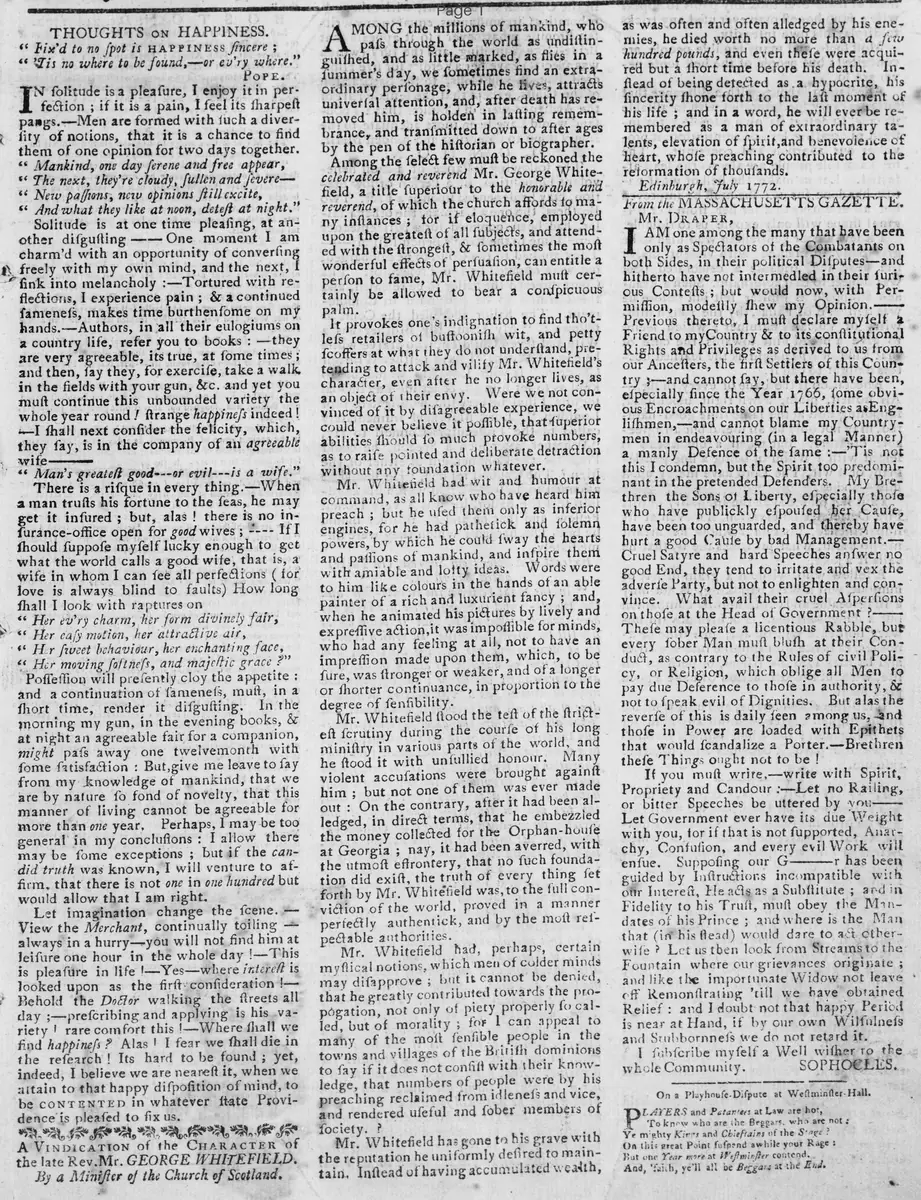
A Vindication of the Character of the late Rev. Mr. GEORGE WHITEFIELD.
By a Minister of the Church of Scotland.
AMONG the millions of mankind, who pass through the world as distinguished, and as little marked, as flies in a summer's day, we sometimes find an extraordinary personage, while he lives, attracts universal attention, and, after death has removed him, is holden in lasting remembrance, and transmitted down to after ages by the pen of the historian or biographer.
Among the select few must be reckoned the celebrated and reverend Mr. George Whitefield, a title superior to the honorable and reverend, of which the church affords to many instances; for if eloquence, employed upon the greatest of all subjects, and attended with the strongest, & sometimes the most wonderful effects of persuasion, can entitle a person to fame, Mr. Whitefield must certainly be allowed to bear a conspicuous palm.
It provokes one's indignation to find thoughtless retailers of buffoonish wit, and petty scoffers at what they do not understand, pretending to attack and vilify Mr. Whitefield's character, even after he no longer lives, as an object of their envy. Were we not convinced of it by disagreeable experience, we could never believe it possible, that superior abilities should so much provoke numbers, as to raise pointed and deliberate detraction without any foundation whatever.
Mr. Whitefield had wit and humour at command, as all know who have heard him preach; but he used them only as inferior engines, for he had pathetick and solemn powers, by which he could sway the hearts and passions of mankind, and inspire them with amiable and lofty ideas. Words were to him like colours in the hands of an able painter of a rich and luxuriant fancy; and, when he animated his pictures by lively and expressive action, it was impossible for minds, who had any feeling at all, not to have an impression made upon them, which, to be sure, was stronger or weaker, and of a longer or shorter continuance, in proportion to the degree of sensibility.
Mr. Whitefield stood the test of the strictest scrutiny during the course of his long ministry in various parts of the world, and he stood it with unsullied honour. Many violent accusations were brought against him: but not one of them was ever made out: On the contrary, after it had been alleged, in direct terms, that he embezzled the money collected for the Orphan-house at Georgia; nay, it had been averred, with the utmost effrontery, that no such foundation did exist, the truth of every thing set forth by Mr. Whitefield was, to the full conviction of the world, proved in a manner perfectly authentick, and by the most respectable authorities.
Mr. Whitefield had, perhaps, certain mystical notions, which men of colder minds may disapprove; but it cannot be denied, that he greatly contributed towards the propagation, not only of piety properly so called, but of morality; for I can appeal to many of the most sensible people in the towns and villages of the British dominions to say if it does not consist with their knowledge, that numbers of people were by his preaching reclaimed from idleness and vice, and rendered useful and sober members of society?
Mr. Whitefield has gone to his grave with the reputation he uniformly desired to maintain. Instead of having accumulated wealth, as was often and often alleged by his enemies, he died worth no more than a few hundred pounds, and even these were acquired but a short time before his death. Instead of being detected as a hypocrite, his sincerity shone forth to the last moment of his life; and in a word, he will ever be remembered as a man of extraordinary talents, elevation of spirit, and benevolence of heart, whose preaching contributed to the reformation of thousands.
Edinburgh, July 1772.
By a Minister of the Church of Scotland.
AMONG the millions of mankind, who pass through the world as distinguished, and as little marked, as flies in a summer's day, we sometimes find an extraordinary personage, while he lives, attracts universal attention, and, after death has removed him, is holden in lasting remembrance, and transmitted down to after ages by the pen of the historian or biographer.
Among the select few must be reckoned the celebrated and reverend Mr. George Whitefield, a title superior to the honorable and reverend, of which the church affords to many instances; for if eloquence, employed upon the greatest of all subjects, and attended with the strongest, & sometimes the most wonderful effects of persuasion, can entitle a person to fame, Mr. Whitefield must certainly be allowed to bear a conspicuous palm.
It provokes one's indignation to find thoughtless retailers of buffoonish wit, and petty scoffers at what they do not understand, pretending to attack and vilify Mr. Whitefield's character, even after he no longer lives, as an object of their envy. Were we not convinced of it by disagreeable experience, we could never believe it possible, that superior abilities should so much provoke numbers, as to raise pointed and deliberate detraction without any foundation whatever.
Mr. Whitefield had wit and humour at command, as all know who have heard him preach; but he used them only as inferior engines, for he had pathetick and solemn powers, by which he could sway the hearts and passions of mankind, and inspire them with amiable and lofty ideas. Words were to him like colours in the hands of an able painter of a rich and luxuriant fancy; and, when he animated his pictures by lively and expressive action, it was impossible for minds, who had any feeling at all, not to have an impression made upon them, which, to be sure, was stronger or weaker, and of a longer or shorter continuance, in proportion to the degree of sensibility.
Mr. Whitefield stood the test of the strictest scrutiny during the course of his long ministry in various parts of the world, and he stood it with unsullied honour. Many violent accusations were brought against him: but not one of them was ever made out: On the contrary, after it had been alleged, in direct terms, that he embezzled the money collected for the Orphan-house at Georgia; nay, it had been averred, with the utmost effrontery, that no such foundation did exist, the truth of every thing set forth by Mr. Whitefield was, to the full conviction of the world, proved in a manner perfectly authentick, and by the most respectable authorities.
Mr. Whitefield had, perhaps, certain mystical notions, which men of colder minds may disapprove; but it cannot be denied, that he greatly contributed towards the propagation, not only of piety properly so called, but of morality; for I can appeal to many of the most sensible people in the towns and villages of the British dominions to say if it does not consist with their knowledge, that numbers of people were by his preaching reclaimed from idleness and vice, and rendered useful and sober members of society?
Mr. Whitefield has gone to his grave with the reputation he uniformly desired to maintain. Instead of having accumulated wealth, as was often and often alleged by his enemies, he died worth no more than a few hundred pounds, and even these were acquired but a short time before his death. Instead of being detected as a hypocrite, his sincerity shone forth to the last moment of his life; and in a word, he will ever be remembered as a man of extraordinary talents, elevation of spirit, and benevolence of heart, whose preaching contributed to the reformation of thousands.
Edinburgh, July 1772.
What sub-type of article is it?
Moral Or Religious
Social Reform
What keywords are associated?
George Whitefield
Character Vindication
Religious Preaching
Moral Reform
Piety Propagation
Embezzlement Accusation
Hypocrisy Refutation
What entities or persons were involved?
George Whitefield
Minister Of The Church Of Scotland
Orphan House At Georgia
Editorial Details
Primary Topic
Vindication Of George Whitefield's Character
Stance / Tone
Strongly Defensive And Praising
Key Figures
George Whitefield
Minister Of The Church Of Scotland
Orphan House At Georgia
Key Arguments
Whitefield's Eloquence And Persuasive Preaching On Religious Subjects Entitled Him To Fame
Critics' Attacks On Whitefield Are Unfounded Envy And Detraction
Whitefield's Wit And Pathos Swayed Hearts And Inspired Lofty Ideas
Accusations Of Embezzlement And Non Existence Of Georgia Orphan House Were Proven False By Authentic Authorities
Whitefield Contributed To Piety And Morality, Reclaiming Many From Idleness And Vice
Whitefield Died Without Accumulated Wealth, Maintaining Sincerity To The End
Whitefield's Preaching Reformed Thousands Through His Talents And Benevolence