Thank you for visiting SNEWPapers!
Sign up free
Douglas Daily Dispatch
Douglas, Cochise County, Arizona
What is this article about?
Charles R. Flint, Wall Street financier and 'Father of Trusts,' invested in the Wright brothers' airplane in the early 1900s, predicted its naval warfare role, and offered it to European governments after U.S. rejection. His career spanned shipbuilding, Latin American diplomacy, and trust formation.
Clipping
OCR Quality
Full Text
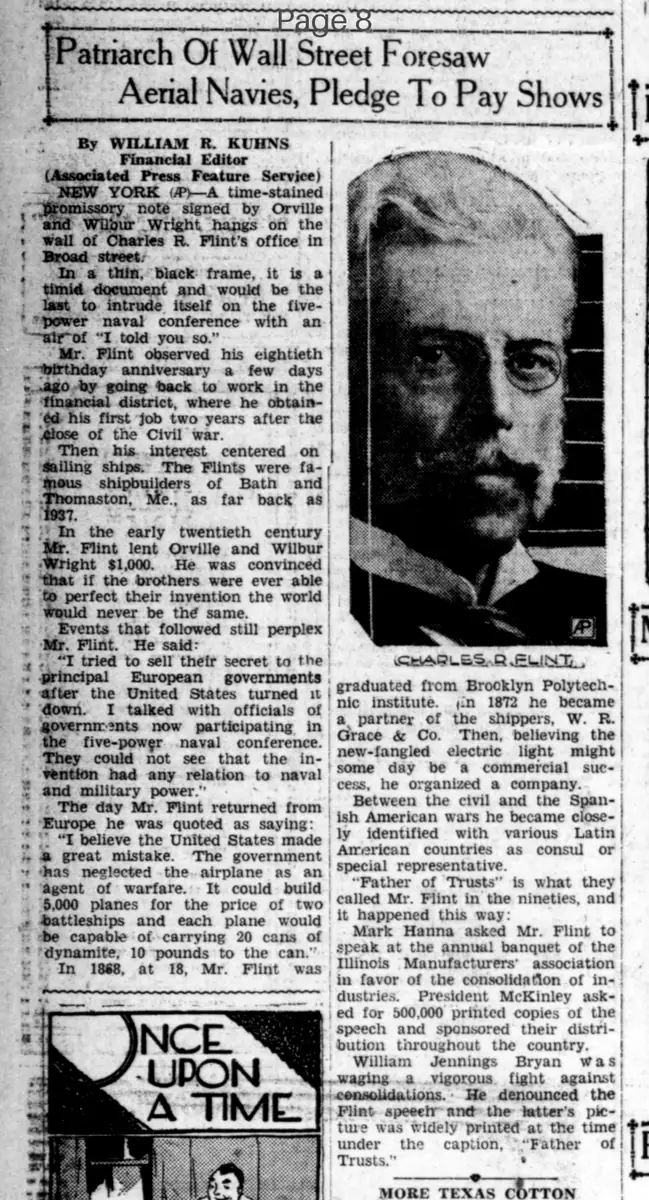
By WILLIAM R. KUHNS Financial Editor (Associated Press Feature Service)
NEW YORK (AP) - A time-stained promissory note signed by Orville and Wilbur Wright hangs on the wall of Charles R. Flint's office in Broad-street.
In a thin, black frame, it is a timid document and would be the last to intrude itself on the five-power naval conference with an air of "I told you so."
Mr. Flint observed his eightieth birthday anniversary a few days ago by going back to work in the financial district, where he obtained his first job two years after the close of the Civil war.
Then his interest centered on sailing ships. The Flints were famous shipbuilders of Bath and Thomaston, Me., as far back as 1837.
In the early twentieth century Mr. Flint lent Orville and Wilbur Wright $1,000. He was convinced that if the brothers were ever able to perfect their invention the world would never be the same.
Events that followed still perplex Mr. Flint. He said: "I tried to sell their secret to the principal European governments after the United States turned it down. I talked with officials of governments now participating in the five-power naval conference. They could not see that the invention had any relation to naval and military power."
The day Mr. Flint returned from Europe he was quoted as saying: "I believe the United States made a great mistake. The government has neglected the airplane as an agent of warfare. It could build 5,000 planes for the price of two battleships and each plane would be capable of carrying 20 cans of dynamite, 10 pounds to the can."
In 1868, at 18, Mr. Flint was graduated from Brooklyn Polytechnic institute. In 1872 he became a partner of the shippers, W. R. Grace & Co. Then, believing the new-fangled electric light might some day be a commercial success, he organized a company.
Between the civil and the Spanish American wars he became closely identified with various Latin American countries as consul or special representative.
"Father of Trusts" is what they called Mr. Flint in the nineties, and it happened this way:
Mark Hanna asked Mr. Flint to speak at the annual banquet of the Illinois Manufacturers' association in favor of the consolidation of industries. President McKinley asked for 500,000 printed copies of the speech and sponsored their distribution throughout the country.
William Jennings Bryan was waging a vigorous fight against consolidations. He denounced the Flint speech and the latter's picture was widely printed at the time under the caption, "Father of Trusts."
What sub-type of article is it?
What themes does it cover?
What keywords are associated?
What entities or persons were involved?
Where did it happen?
Story Details
Key Persons
Location
New York, Broad Street; Bath And Thomaston, Me.; Europe; Latin American Countries
Event Date
Late 19th To Early 20th Century
Story Details
Charles R. Flint, a Wall Street patriarch, invested in the Wright brothers' airplane invention, foresaw its military potential, and tried to sell it to European governments. Known as 'Father of Trusts' for advocating industry consolidations, he had a long career from shipbuilding to business trusts.