Thank you for visiting SNEWPapers!
Sign up free
Daily National Intelligencer
Washington, District Of Columbia
What is this article about?
Extract of a letter from a gentleman on the Tombigby opposing the division of the Mississippi Territory into separate states. He argues for admission as one state into the Union, highlighting inadequate population, inconvenient geography, poor land quality, and strong eastern commercial ties, estimating total population around 230,000.
Clipping
OCR Quality
Full Text
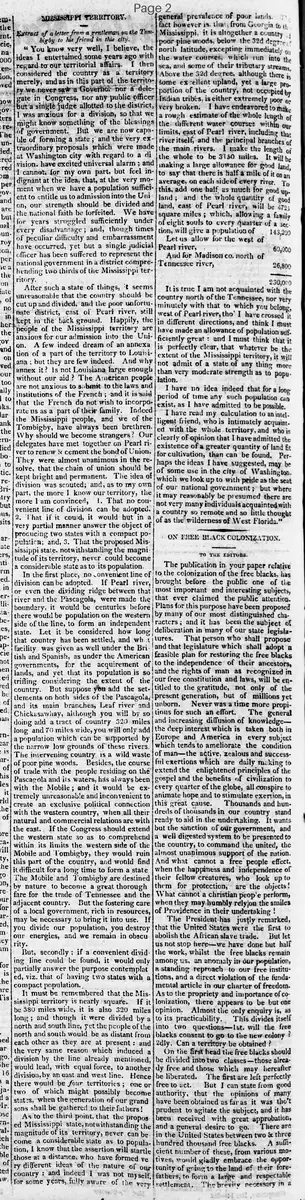
Extract of a letter from a gentleman on the Tombigby to his friend in this city.
"You know very well, I believe, the ideas I entertained some years ago with regard to our territorial affairs. I then considered the country as a territory merely, and as in this part of the territory we never saw a Governor nor a delegate in Congress, nor any public officer but a single judge allotted to the district, I was anxious for a division, so that we might know something of the blessings of government. But we are now capable of forming a state; and the very extraordinary proposals which were made at Washington city with regard to a division, have excited universal alarm: and I cannot, for my own part, but feel indignant at the idea, that, at the very moment when we have a population sufficient to entitle us to admission into the Union, our strength should be divided and the national faith be forfeited. We have for years struggled sufficiently under every disadvantage; and, though times of peculiar difficulty and embarrassment have occurred, yet but a single judicial officer has been suffered to represent the national government in a district comprehending two thirds of the Mississippi territory.
After such a state of things, it seems unreasonable that the country should be cut up and divided, and the poor unfortunate district, east of Pearl river, still kept in the back ground. Happily, the people of the Mississippi territory are anxious for our admission into the Union. A few indeed dream of an annexation of a part of the territory to Louisiana: but they are few indeed. And why annex it? Is not Louisiana large enough without our aid? The American people are not anxious to submit to the laws and institutions of the French;—and it is said that the French do not wish to incorporate us as a part of their family. Indeed the Mississippi people, and we of the Tombigby, have always been brethren. Why should we become strangers? Our delegates have met together on Pearl river to renew & cement the bond of Union. They were almost unanimous in the resolve, that the chain of union should be kept bright and permanent. The idea of division was scouted; and, as to my own part, the more I know our territory, the more I am convinced, 1. That no convenient line of division can be adopted. 2. That if it could, it would but in a very partial manner answer the object of producing two states with a compact population; and, 3. That the proposed Mississippi state, notwithstanding the magnitude of its territory, never could become a considerable state as to its population.
In the first place, no convenient line of division can be adopted. If Pearl river or even the dividing ridge between that river and the Pascagoula, were made the boundary, it would be centuries before there would be population on the western side of the line, to form an independent state. Let it be considered how long that country has been settled, and what facility was given as well under the British and Spanish, as under the American governments, for the acquirement of lands, and yet that its population is so trifling considering the extent of the country. But suppose you add the settlements on both sides of the Pascagoula, and its main branches, Leaf river and Chickasawhay, although you will by so doing add a tract of country 320 miles long and 70 miles wide, you will only add a population which can be supported by the narrow low grounds of these rivers. The intervening country is a wild waste of poor pine woods. Besides, the course of trade with the people residing on the Pascagoula and its waters, has always been with the Mobile: and it would be extremely unreasonable and inconvenient to create an exclusive political connection with the western country, when all their natural and commercial relations are with the east. If the Congress should extend the western state so as to comprehend within its limits the western side of the Mobile and Tombigby, they would ruin this part of the country, and would find it difficult for a long time to form a state The Mobile and Tombigby are destined by nature to become a great thoroughfare for the trade of Tennessee and the adjacent country. But the fostering care of a local government, rich in resources, may be necessary to bring it into use. If you divide our population, you destroy our energies, and we remain in obscurity.
But, secondly; if a convenient dividing line could be found, it would only partially answer the purpose contemplated, viz. that of having two states with a compact population.
It must be remembered that the Mississippi territory is nearly square. If it be 380 miles wide, it is also 320 miles long; and though it were divided by a north and south line, yet the people of the north and south would be as distant from each other as they are at present: and the very same reason which induced a division by the line already mentioned, would lead, with equal force, to another division, by an east and west line. Hence there would be four territories; one or two of which might possibly become states, when the generation of our grandsons shall be gathered to their fathers!
As to the third point, that the proposed Mississippi state, notwithstanding the magnitude of its territory, never can become a considerable state as to population, I know that the assertion will startle those at a distance, who have formed very different ideas of the nature of our country: and indeed I was not myself, for some years, fully aware of the general prevalence of poor lands. The fact however is, that, from Georgia to the Mississippi, it is altogether a country of poor pine woods, below the 32d degree north latitude, excepting immediately on the water courses, which run into the sea, and some of their tributary streams. Above the 32d degree, although there is some excellent upland, yet a large proportion of the country, not occupied by Indian tribes, is either extremely poor or very broken. I have endeavored to make a rough estimate of the whole length of the different water courses within our limits, east of Pearl river, including that river itself, and the principal branches of the main rivers. I make the length of the whole to be 3150 miles. It will be making a large allowance for good land, to say that there is half a mile of it on an average, on each side of every river. To this, add one half as much for good upland; and the whole quantity of good land, east of Pearl river, will be 4725 square miles; which, allowing a family of eight souls to every quarter of a section, will give a population of 143,200
Let us allow for the west of Pearl river, 60,000
And for Madison co. north of Tennessee river, 26,800
230,000
It is true I am not acquainted with the country north of the Tennessee, nor very minutely with that to which you belong. west of Pearl river, tho' I have crossed it in different directions, and think I must have made an allowance of population sufficiently great: and I must think that it is perfectly clear, that whatever be the extent of the Mississippi territory, it will not admit of a state of any thing more than very moderate strength as to population.
I have no idea indeed that for a long period of time any such population can exist, as I have admitted to be possible. I have read my calculation to an intelligent friend, who is intimately acquainted with the whole territory, and who is clearly of opinion that I have admitted the existence of a greater quantity of land fit for cultivation, than can be found. Perhaps the ideas I have suggested, may be of some use in the city of Washington, which we look up to with pride as the seat of our national government; but where it may reasonably be presumed there are not very many individuals acquainted with a country so remote and so little thought of as the wilderness of West Florida."
What sub-type of article is it?
What themes does it cover?
What keywords are associated?
What entities or persons were involved?
Letter to Editor Details
Author
A Gentleman On The Tombigby
Recipient
His Friend In This City
Main Argument
the mississippi territory should be admitted to the union as a single state rather than divided, as division would weaken its population and resources, violate national commitments, and ignore geographical and economic realities that prevent forming compact, viable states.
Notable Details