Thank you for visiting SNEWPapers!
Sign up free
The National Intelligencer And Washington Advertiser
Washington, District Of Columbia
What is this article about?
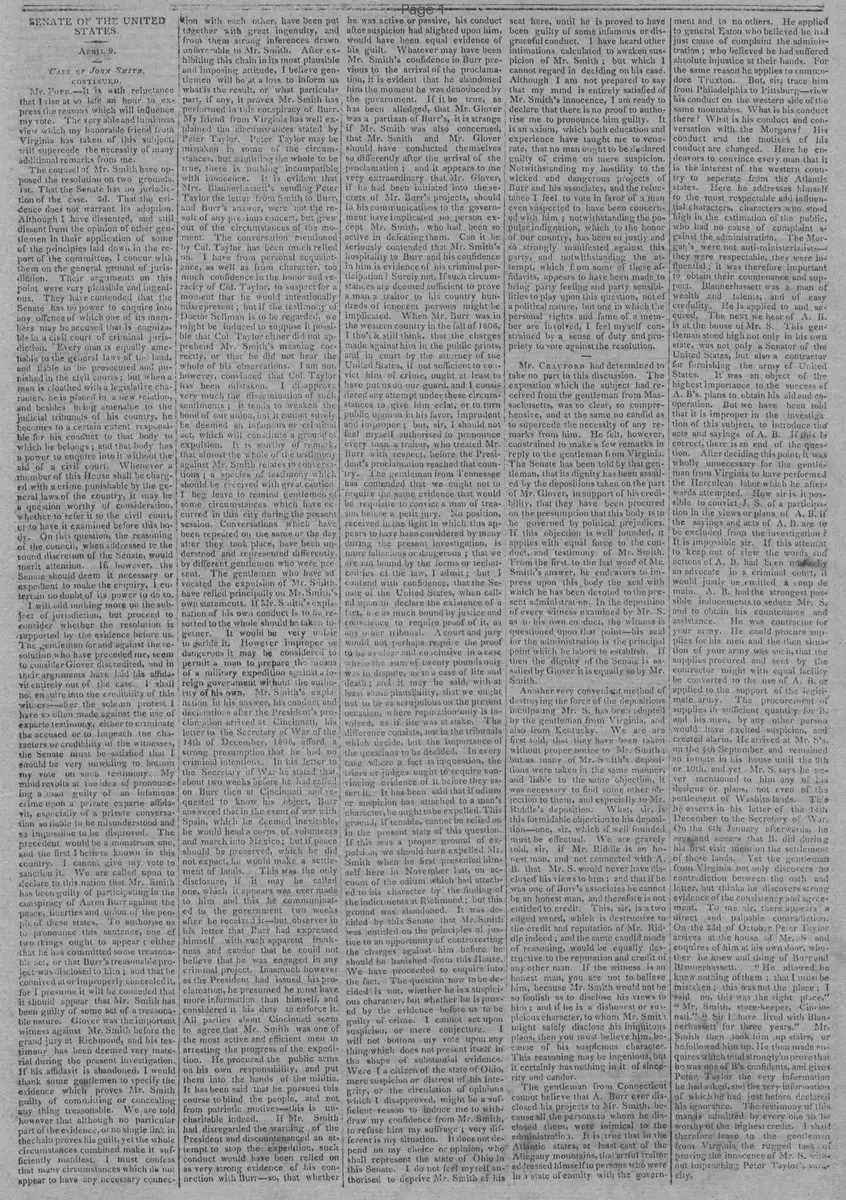
U.S. Senate debate on April 9, 1807, concerning the case of Senator John Smith, accused of involvement in Aaron Burr's conspiracy. Senator Pope argues against expulsion, citing insufficient evidence and jurisdictional concerns. Senator Crawford counters, highlighting contradictions in Smith's statements and supporting evidence of guilt.
Merged-components note: These two components form a single continuous narrative article reporting on the Senate debate regarding the case of John Smith, spanning from page 1 to page 2. The second component picks up directly from the first, maintaining the same topic and flow. Label adjusted to 'story' as it is a full narrative article on domestic political proceedings.
Clippings
1 of 2
OCR Quality
Full Text
APRIL 9
CASE OF JOHN SMITH
CONTINUED:
Mr. Pope.—It is with reluctance that I rise at so late an hour to express the reasons which will influence my vote. The very able and luminous view which my honorable friend from Virginia has taken of this subject, will supersede the necessity of many additional remarks from me.
The counsel of Mr. Smith have opposed the resolution on two grounds. 1st. That the Senate has no jurisdiction of the case. 2d. That the evidence does not warrant its adoption.
Although I have dissented, and still dissent from the opinion of other gentlemen in their application of some of the principles laid down in the report of the committee, I concur with them on the general ground of jurisdiction. Their arguments on this point were very plausible and ingenious. They have contended that the Senate has no power to enquire into any offence of which one of its members may be accused that is cognizable in a civil court of criminal jurisdiction. Every man is equally amenable to the general laws of the land, and liable to be prosecuted and punished in the civil courts; but when a man is clothed with a legislative character, he is placed in a new relation, and besides being amenable to the judicial tribunals of his country, he becomes to a certain extent responsible for his conduct to that body to which he belongs; and that body has a power to enquire into it without the aid of a civil court. Whenever a member of this House shall be charged with a crime punishable by the general laws of the country, it may be a question worthy of consideration, whether to refer it to the civil court, or to have it examined before this body. On this question, the reasoning of the counsel, when addressed to the sound discretion of the Senate, would merit attention. If, however, the Senate should deem it necessary or expedient to make the enquiry, I entertain no doubt of its power to do so.
I will add nothing more on the subject of jurisdiction, but proceed to consider whether the resolution is supported by the evidence before us.
The gentlemen for and against the resolution who have preceded me, seem to consider Glover discredited, and in their arguments have laid his affidavit entirely out of the case. I shall not enquire into the credibility of this witness—after the solemn protest I have so often made against the use of ex parte testimony, either to criminate the accused or to impeach the characters or credibility of the witnesses, the Senate must be satisfied that I should be very unwilling to bottom my vote on such testimony. My mind revolts at the idea of pronouncing a man guilty of an infamous crime upon a private ex parte affidavit, especially of a private conversation so liable to be misunderstood and so impossible to be disproved. The precedent would be a monstrous one, and the first I believe known in this country. I cannot give my vote to sanction it. We are called upon to declare to this nation that Mr. Smith has been guilty of participating in the conspiracy of Aaron Burr against the peace, liberties and union of the people of these states. To authorize us to pronounce this sentence, one of two things ought to appear; either that he has committed some treasonable act, or that Burr's treasonable project was disclosed to him; and that he connived at or improperly concealed it, for I presume it will be conceded that it should appear that Mr. Smith has been guilty of some act of a treasonable nature. Glover was the important witness against Mr. Smith before the grand jury at Richmond, and his testimony has been deemed very material during the present investigation. If his affidavit is abandoned, I would thank some gentlemen to specify the evidence which proves Mr. Smith guilty of committing or concealing any thing treasonable. We are told however that although no particular part of the evidence, or no single link in the chain proves his guilt, yet the whole circumstances combined make it sufficiently manifest. I must confess that many circumstances which do not appear to have any necessary connection with each other, have been put together with great ingenuity, and from them strong inferences drawn unfavorable to Mr. Smith. After exhibiting this chain in its most plausible and imposing attitude, I believe gentlemen will be at a loss to inform us what is the result, or what particular part, if any, it proves Mr. Smith has performed in this conspiracy of Burr.
My friend from Virginia has well explained the circumstances stated by Peter Taylor. Peter Taylor may be mistaken in some of the circumstances, but admitting the whole to be true, there is nothing incompatible with innocence. It is evident that Mrs. Blennerhassett's sending Peter Taylor the letter from Smith to Burr, and Burr's answer, were not the result of any previous concert, but grew out of the circumstances of the moment. The conversation mentioned by Col. Taylor has been much relied on. I have from personal acquaintance, as well as from character, too much confidence in the honor and veracity of Col. Taylor, to suspect for a moment that he would intentionally misrepresent; but if the testimony of Doctor Sellman is to be regarded, we might be induced to suppose it possible that Col. Taylor either did not apprehend Mr. Smith's meaning correctly, or that he did not hear the whole of his observations. I am not however, convinced that Col. Taylor has been mistaken. I disapprove very much the dissemination of such sentiments; it tends to weaken the bond of our union, but it cannot surely be deemed an infamous or criminal act, which will constitute a ground of expulsion. It is worthy of remark that almost the whole of the testimony against Mr. Smith relates to conversations; a species of testimony which should be received with great caution.
I beg leave to remind gentlemen of some circumstances which have occurred in this city during the present session. Conversations which have been repeated on the same or the day after they took place, have been understood and represented differently by different gentlemen who were present. The gentlemen who have advocated the expulsion of Mr. Smith, have relied principally on Mr. Smith's own statements. If Mr. Smith's explanation of his own conduct is to be resorted to the whole should be taken together. It would be very unfair to garble it. However improper or dangerous it may be considered to permit a man to prepare the means of a military expedition against a foreign government without the authority of his own, Mr. Smith's explanation in his answer, his conduct and declarations after the President's proclamation arrived at Cincinnati, his letter to the Secretary of War of the 14th of December, 1806, afford a strong presumption that he had no criminal intentions. In his letter to the Secretary of War he stated that about two weeks before he had called on Burr then at Cincinnati and requested to know his object, Burr answered that in the event of war with Spain, which he deemed inevitable, he would head a corps of volunteers and march into Mexico; but if peace should be preserved, which he did not expect, he would make a settlement of lands. This was the only disclosure, if it may be called one, which it appears was ever made to him and this he communicated to the government two weeks after he received it—but observes in his letter that Burr had expressed himself with such apparent frankness and candor that he could not believe that he was engaged in any criminal project. Inasmuch however as the President had issued his proclamation, he presumed he must have more information than himself, and considered it his duty to enforce it.
All parties about Cincinnati seem to agree that Mr. Smith was one of the most active and efficient men in arresting the progress of the expedition. He procured the public arms on his own responsibility, and put them into the hands of the militia. It has been said that he pursued this course to blind the people, and not from patriotic motives—this is uncharitable indeed. If Mr. Smith had disregarded the warning of the President and discountenanced an attempt to stop the expedition, such conduct would have been relied on as very strong evidence of his connection with Burr—So that whether he was active or passive, his conduct after suspicion had alighted upon him, would have been equal evidence of his guilt. Whatever may have been Mr. Smith's confidence in Burr previous to the arrival of the proclamation, it is evident that he abandoned him the moment he was denounced by the government. If it be true, as has been alleged, that Mr. Glover was a partisan of Burr's, it is strange if Mr. Smith was also concerned, that Mr. Smith and Mr. Glover should have conducted themselves so differently after the arrival of the proclamation; and it appears to me very extraordinary that Mr. Glover, if he had been initiated into the secrets of Mr. Burr's projects, should in his communications to the government have implicated no person except Mr. Smith, who had been so active in defeating them. Can it be seriously contended that Mr. Smith's hospitality to Burr and his confidence in him is evidence of his criminal participation? Surely not. If such circumstances are deemed sufficient to prove a man a traitor to his country hundreds of innocent persons might be implicated.
When Mr. Burr was in the western country in the fall of 1806, I thought & still think, that the charges made against him in the public prints, and in court by the attorney of the United States, if not sufficient to convict him of crime, ought at least to have put us on our guard, and I considered any attempt under these circumstances to give him eclat, or to turn public opinion in his favor, imprudent and improper; but, sir, I should not feel myself authorised to pronounce every man a traitor, who treated Mr. Burr with respect, before the President's proclamation reached that country. The gentleman from Tennessee has contended that we ought not to require the same evidence that would be requisite to convict a man of treason before a petit jury. No position, received in the light in which this appears to have been considered by many during the present investigation, is more fallacious or dangerous; that we are not bound by the forms or technicalities of the law. I admit; but I contend with confidence, that the Senate of the United States, when called upon to declare the existence of a fact, is as much bound by justice and conscience to require proof of it, as any other tribunal. A court and jury would not perhaps require the proof to be as clear and conclusive in a case where the sum of twenty pounds only was in dispute, as in a case of life and death; and it may be said, with at least some plausibility, that we ought not to be as scrupulous on the present occasion, where reputation only is involved, as if life was at stake. The difference consists, not in the tribunals which decide, but the importance of the questions to be decided. In every case where a fact is in question, the triers or judges ought to require convincing evidence of it before they assert it. It has been said that if odium or suspicion has attached to a man's character, he ought to be expelled. This ground, if tenable, cannot be relied on in the present state of this question. If this was a proper ground of expulsion, we should have expelled Mr. Smith when he first presented himself here in November last, on account of the odium which had attached to his character by the finding of the indictments at Richmond; but this ground was abandoned. It was decided by this Senate that Mr. Smith was entitled on the principles of justice to an opportunity of controverting the charges against him before he should be banished from this House. We have proceeded to enquire into the fact. The question now to be decided is not, whether he is a suspicious character, but whether he is proved by the evidence before us to be guilty of crime. I cannot act upon suspicion, or mere conjecture. I will not bottom my vote upon any thing which does not present itself in the shape of substantial evidence.
Were I a citizen of the state of Ohio mere suspicion or distrust of his integrity, or the circulation of opinions which I disapproved, might be a sufficient reason to induce me to withdraw my confidence from Mr. Smith. to refuse him my suffrage; very different is my situation. It does not depend on my choice or opinion, who shall represent the state of Ohio in this Senate. I do not feel myself authorised to deprive Mr Smith of his seat here, until he is proved to have been guilty of some infamous or disgraceful conduct. I have heard other intimations calculated to awaken suspicion of Mr. Smith: but which I cannot regard in deciding on his case. Although I am not prepared to say that my mind is entirely satisfied of Mr. Smith's innocence, I am ready to declare that there is no proof to authorize me to pronounce him guilty. It is an axiom, which both education and experience have taught me to venerate, that no man ought to be declared guilty of crime on mere suspicion. Notwithstanding my hostility to the wicked and dangerous projects of Burr and his associates, and the reluctance I feel to vote in favor of a man even suspected to have been concerned with him; notwithstanding the popular indignation, which to the honor of our country, has been so justly and so strongly manifested against this party, and notwithstanding the attempt, which from some of these affidavits, appears to have been made to bring party feeling and party sensibilities to play upon this question, not of a political nature, but one in which the personal rights and fame of a member are involved, I feel myself constrained by a sense of duty and propriety to vote against the resolution.
Mr. Crawford had determined to take no part in this discussion. The exposition which the subject had received from the gentleman from Massachusetts, was so clear, so comprehensive, and at the same no candid as to supersede the necessity of any remarks from him. He felt, however, constrained to make a few remarks in reply to the gentleman from Virginia. The Senate has been told by that gentleman, that its dignity has been assailed by these depositions taken on the part of Mr. Glover, in support of his credibility, that they have been procured on the presumption that this body is to be governed by political prejudices. If this objection is well founded, it applies with equal force to the conduct, and testimony of Mr. Smith. From the first, to the last word of Mr. Smith's answer, he endeavors to impress upon this body the zeal with which he has been devoted to the present administration. In the deposition of every witness examined by Mr. S. as to his own conduct the witness is questioned upon that point—his zeal for the administration is the principal point which he labors to establish. If then the dignity of the Senate is assailed by Glover it is equally so by Mr. Smith.
Another very convenient method of destroying the force of the depositions inculpating Mr. S. has been adopted by the gentleman from Virginia, and also from Kentucky. We are first told, that they have been taken without proper notice to Mr. Smith; but as many of Mr. Smith's depositions were taken in the same manner, and liable to the same objection, it was necessary to find some other objection to them, and especially to Mr. Riddle's deposition. What, sir, is this formidable objection to his deposition—one, sir. which if well founded must be effectual. We are gravely told, sir, if Mr. Riddle is an honest man, and not connected with A. B. that Mr. S. would never have disclosed his views to him: and that if he was one of Burr's associates he cannot be an honest man, and therefore is not entitled to credit. This, sir, is a two edged sword, which is destructive to the credit and reputation of Mr. Riddle indeed; and the same candid mode of reasoning, would be equally destructive to the reputation and credit of any other man. If the witness is an honest man, you are not to believe him, because Mr. Smith would not be so foolish as to disclose his views to him; and if he is a dishonest or suspicious character. to whom Mr. Smith might safely disclose his iniquitous plans, then you must believe him, because of his suspicious character. This reasoning may be ingenious, but it certainly has nothing in it of sincerity and candor.
The gentleman from Connecticut cannot believe that A. Burr ever disclosed his projects to Mr. Smith, because all the persons to whom he disclosed them, were inimical to the administration. It is true that in the Atlantic states, at least east of the Allegheny mountains, that artful traitor addressed himself to persons who were in a state of enmity with the government and to no others. He applied to general Eaton who believed he had just cause of complaint the administration; who believed he had suffered absolute injustice at their hands. For the same reason he applies to commodore Truxtun. But, sir; trace him from Philadelphia to Pittsburgh—view his conduct on the western side of the same mountains. What is his conduct there? What is his conduct and conversation with the Morgans? His conduct and the motives of his conduct are changed. Here he endeavors to convince every man that it is the interest of the western country to separate from the Atlantic states. Here he addresses himself to the most respectable and influential characters, characters who stood high in the estimation of the public, who had no cause of complaint against the administration. The Morgans were not anti-ministerialists—they were respectable, they were influential; it was therefore important to obtain their countenance and support. Blennerhassett was a man of wealth and talents, and of easy credulity. He is applied to and secured. The next we hear of A. B. is at the house of Mr. S. This gentleman stood high not only in his own state, was not only a Senator of the United States, but also a contractor for furnishing the army of United States. It was an object of the highest importance to the success of A. B's. plans to obtain his aid and co-operation. But we have been told that it is improper in the investigation of this subject, to introduce the acts and sayings of A. B. If this is correct, there is an end of the question. After deciding this point, it was wholly unnecessary for the gentleman from Virginia to have performed the Herculean labor which he afterwards attempted. How sir is it possible to convict J. S. of a participation in the views or plans of A. B. if the sayings and acts of A. B. are to be excluded from the investigation? It is impossible sir. If this attempt to keep out of view the words and actions of A. B. had been made by an advocate in a criminal court, it would justly be entitled a coup de main. A. B. had the strongest possible inducements to seduce Mr. S. and to obtain his countenance and assistance. He was contractor for your army. He could procure supplies or his men and the then situation of your army was such, that the supplies procured and sent by the contractor might with equal facility be converted to the use of A. B. or applied to the support of the legitimate army. The procurement of supplies in sufficient quantity for B. and his men, by any other person would have excited suspicion, and created alarm. He arrived at Mr. S's. on the 4th September and remained an inmate in his house until the 9th or 10th, and yet Mr. S. says he never mentioned to him any of his designs or plans, not even of the settlement of Washita lands. This he asserts in his letter of the 14th December to the Secretary of War. On the 6th January afterwards, he says and swears that B. did during his first visit mention the settlement of those lands. Yet the gentleman from Virginia not only discovers no contradiction between the oath and letter, but thinks he discovers strong evidence of the consistency and agreement. To me sir, there appears a direct and palpable contradiction.
On the 23d of October Peter Taylor arrives at the house of Mr.. S and enquires of him at his own door, whether he knew any thing of Burr and Blennerhassett. "He allowed he knew nothing of them; that I must be mistaken; this was not the place; I said no, this was the right place," "Mr. Smith, store-keeper, Cincinnati." "Sir I have. lived with Blennerhassett or three years." Mr. Smith then took him up stairs, or he followed him up. He then made enquiries which tend strongly to prove that he was one of B's confidants, and gives Peter Taylor the very information he had asked, and the very information of which he had just before declared his ignorance. The testimony of this man is admitted by every one to be worthy of the highest credit. I shall therefore leave to the gentleman from Virginia the rugged task of proving the innocence of Mr. S. without impeaching Peter Taylor's veracity.
That Mr. S. should write a letter to Burr and direct it to Blennerhassett has been satisfactorily explained. But it is not easy to explain nor has it been explained, by what means Burr could devise that the letter directed to Blennerhassett was a letter written to him, or contained a letter for him. The construction which this transaction, and the letters written by Mr. S. and B. to each other, have received from the gentleman from Mass. is the only candid and rational construction of which they are susceptible."
The Senate have been cautioned not to lay much stress upon the testimony of Col. James Taylor, not because he is unworthy of credit, but because he deposes to a conversation which has long since past, and because Dr. Sellman was present and heard no such expressions. Sir, I believe the deposition of Col. James Taylor contains not only a perspicuous declaration of what he believed, but also a correct statement of facts; a correct statement of what he heard. His deposition, it is true, was made long after the conversation happened; but shortly after that event he reduced it to writing, and communicated it to the Secretary of State, and to that writing he referred when under examination before the Senate. He also swears he conversed with General Findley and that his understanding of that conversation was the same. Compare the circumstances under which Col. Taylor testifies, with those which attend Dr. Sellman's deposition. If he was present at all, it does not appear, that any circumstance whatever occurred to impress that conversation upon his mind-it does not appear, that he ever thought of it afterwards, until he was called upon to depose. which was more than fifteen months subsequent to the conversation; but it does appear that Dr. S. has acted the part of a partizan of Mr. Smith's. In truth, sir, there is not a single circumstance tending to confirm his statement of that conversation, in opposition to that of colonel James Taylor.
I agree with the gentleman from Massachusetts, that it would be improper to declare a member of this body unworthy of his seat for the expression of mere speculative opinions; but the expression of these opinions, connected with other circumstances which preceded, and followed after it amounts to very strong proof. We are called upon by the gentleman from Virginia, and also from Kentucky to lay our fingers upon that particular part of the testimony which produces conviction in our minds, of the guilt of Mr. Smith. To this call, sir, I will observe that in all cases of circumstantial evidence, convictions are the result of a combination of circumstances; they are not produced by any one link in the chain of testimony, but by the whole chain taken together I; sir, a conviction cannot place in a court of justice the jury could part their minds o the particular part of the testimony which established the guilt of the accused, it might happen that in nine cases out of ten the culprit would be acquitted.
My friend from Kentucky says if J. S. has participated in B's treasonable and unlawful projects it must have been by performing some act or in concealing it that he is not charged with having performed any act, and that therefore the charge must be founded in his concealment of what he knew. I will not say that Mr. S. has been charged with enlisting troops or A. B.; but sir, I will say, that he has been guilty of an act very much like it-an enlistment of the strongest character an engagement, or enlistment of his two sons to go with A. B.—to march under his banners--subject to his control, under his absolute government, dependent upon him for their future prospects and station in life. And here, sir, I refer to the deposition of Mr. S. himself. He swears, that A. B. did at his second visit to Cincinnati, disclose his views of invading Mexico; and yet, sir, he engaged his sons in the enterprise.
But, sir, there is one point in the testimony, which of itself produces something like conviction on my mind, that Mr. S. was guilty of participating in B's plans. And here, sir, I will refer to the deposition made by Mr. Smith, and that of A. D. S. already referred to by the gentleman from Tennessee, for a different purpose. Mr. S. swears that he never communicated to his son the engagement with A. B. until the day he returned from Marietta, and not till he had expressed a disinclination to co-operate with Col. Burr's object. This deposition was made on the 6th January, 1807, and by a deposition of A. D. Smith of the same date, it appears he returned from Marietta on the 3d day of that month. It also appears in evidence, that for some time previous to this day, that Mr. S. had been in Kentucky, and that during that time A. D. S. had become the bearer of a letter to Bl. from A. B. and for that purpose had gone to Marietta and Belle Prarie: and that the 3d of January was the day he met his father on his return. But A. D. Smith on the 13th August, at Richmond, swears, that he never received any overture from A. B. on that subject'; yet he considered himself as engaged under him, for he says— "From the papers which daily teemed with the treason of Col. Burr's designs; the frequent solicitations, and injunctions of my father, to relinquish the idea of descending the Mississippi as an accomplice of Col. B's ; and Gen. Eaton's deposition alone induced me to abandon him and his projects."
Here, sir, the son declares he did not engage himself with A. B. yet he was engaged; he knew that he was engaged, and reluctantly broke that engagement. The father swears he engaged him; but that he never disclosed that engagement to him until he expressed his disinclination to go. From whom did A. D. S. receive the knowledge of this engagement? The answer is too plain; from his father, and not communicated to him on his return from Marietta, but before he set out for that place ; before the father set out for Kentucky; and a knowledge of this engagement is the only probable reason of his becoming the bearer of that letter. But, sir, there is another contradiction which ought to be noticed here. "A. D. S. and his father met on his return from Marietta, and the frequent solicitations and injunctions of the father induced the son to abandon B. yet the father swears he never disclosed the engagement he had made until the son had expressed a disinclination to go with B. This expression of Mr. S's is a contradiction in itself; but when compared with the declarations of the son-the contradiction is gross and palpable. How could he solicit and enjoin his son to violate an engagement which he knew nothing of?
Sir, it is impossible to reconcile these contradictions. Upon this occasion my mind has received no bias whatever from the conversations and whispers alluded to by the gentlemen from Kentucky. I have lived in a section of the country that has not felt the general impression made by the movements and enterprizes of A. B. I have attended to nothing but the testimony. I have had no acquaintance with Mr. S. I entertain no prejudice against him. I should feel as much gratified as any member of this body, to be able, consistently with my duty, to vote for his retaining his seat. Sir, the feelings of this House have been addressed-an appeal has been made to the humanity of the Senate. We have a duty to perform which is paramount to hu- manity. In the discharge of our duty, we ought to exercise our judgment, and do that which the public good imperiously requires. From a full examination of the evidence, I am constrained to say, that the conduct of Mr. S. has been such as to render it highly improper for him to retain his seat in the highest council of the nation.
What sub-type of article is it?
What themes does it cover?
What keywords are associated?
What entities or persons were involved?
Where did it happen?
Story Details
Key Persons
Location
United States Senate
Event Date
April 9, 1807
Story Details
Senate debate on expelling Senator John Smith for alleged complicity in Aaron Burr's treasonous conspiracy, with arguments on jurisdiction, evidence credibility, and Smith's actions in Cincinnati.