Thank you for visiting SNEWPapers!
Sign up free
Story
April 12, 1947
Hartford Chronicle
Hartford, Hartford County, Connecticut
What is this article about?
Article debunking common myths about tuberculosis (TB), such as it being hereditary, only affecting youth, requiring climate change, and having obvious early symptoms. Emphasizes early detection via X-rays and exams, and transmission through close contact. By Ersa Hines in The Hartford Chronicle.
Clipping
OCR Quality
100%
Excellent
Full Text
The Hartford Chronicle
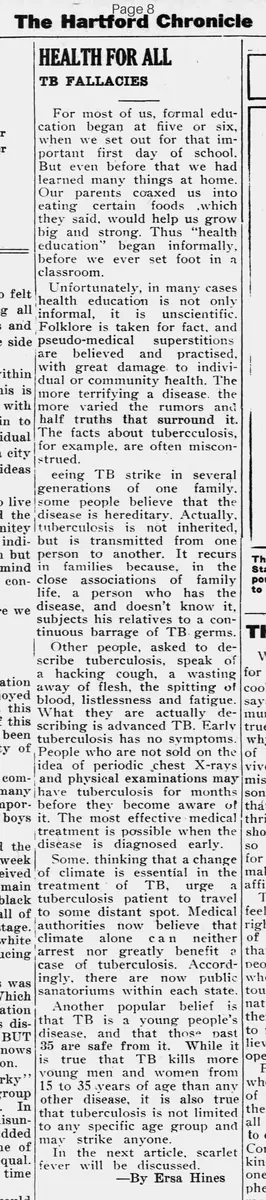
HEALTH FOR ALL
TB FALLACIES
For most of us, formal education began at five or six, when we set out for that important first day of school.
But even before that we had learned many things at home. Our parents coaxed us into eating certain foods which they said, would help us grow big and strong. Thus "health education" began informally before we ever set foot in a classroom.
Unfortunately, in many cases health education is not only informal, it is unscientific. Folklore is taken for fact, and pseudo-medical superstitions are believed and practised with great damage to individual or community health. The more terrifying a disease, the more varied the rumors and half truths that surround it.
The facts about tuberculosis, for example, are often misconstrued. Seeing TB strike in several generations of one family, some people believe that the disease is hereditary. Actually, tuberculosis is not inherited, but is transmitted from one person to another. It recurs in families because, in the close associations of family life, a person who has the disease, and doesn't know it, subjects his relatives to a continuous barrage of TB germs.
Other people, asked to describe tuberculosis, speak of a hacking cough, a wasting away of flesh, the spitting of blood, listlessness and fatigue. What they are actually describing is advanced TB. Early tuberculosis has no symptoms. People who are not sold on the idea of periodic chest X-rays and physical examinations may have tuberculosis for months before they become aware of it. The most effective medical treatment is possible when the disease is diagnosed early.
Some, thinking that a change of climate is essential in the treatment of TB, urge a tuberculosis patient to travel to some distant spot. Medical authorities now believe that climate alone can neither arrest nor greatly benefit a case of tuberculosis. Accordingly, there are now public sanatoriums within each state.
Another popular belief is that TB is a young people's disease, and that those past 35 are safe from it. While it is true that TB kills more young men and women from 15 to 35 years of age than any other disease, it is also true that tuberculosis is not limited to any specific age group and may strike anyone.
In the next article, scarlet fever will be discussed.
By Ersa Hines
HEALTH FOR ALL
TB FALLACIES
For most of us, formal education began at five or six, when we set out for that important first day of school.
But even before that we had learned many things at home. Our parents coaxed us into eating certain foods which they said, would help us grow big and strong. Thus "health education" began informally before we ever set foot in a classroom.
Unfortunately, in many cases health education is not only informal, it is unscientific. Folklore is taken for fact, and pseudo-medical superstitions are believed and practised with great damage to individual or community health. The more terrifying a disease, the more varied the rumors and half truths that surround it.
The facts about tuberculosis, for example, are often misconstrued. Seeing TB strike in several generations of one family, some people believe that the disease is hereditary. Actually, tuberculosis is not inherited, but is transmitted from one person to another. It recurs in families because, in the close associations of family life, a person who has the disease, and doesn't know it, subjects his relatives to a continuous barrage of TB germs.
Other people, asked to describe tuberculosis, speak of a hacking cough, a wasting away of flesh, the spitting of blood, listlessness and fatigue. What they are actually describing is advanced TB. Early tuberculosis has no symptoms. People who are not sold on the idea of periodic chest X-rays and physical examinations may have tuberculosis for months before they become aware of it. The most effective medical treatment is possible when the disease is diagnosed early.
Some, thinking that a change of climate is essential in the treatment of TB, urge a tuberculosis patient to travel to some distant spot. Medical authorities now believe that climate alone can neither arrest nor greatly benefit a case of tuberculosis. Accordingly, there are now public sanatoriums within each state.
Another popular belief is that TB is a young people's disease, and that those past 35 are safe from it. While it is true that TB kills more young men and women from 15 to 35 years of age than any other disease, it is also true that tuberculosis is not limited to any specific age group and may strike anyone.
In the next article, scarlet fever will be discussed.
By Ersa Hines
What sub-type of article is it?
Medical Curiosity
What themes does it cover?
Misfortune
Recovery
What keywords are associated?
Tuberculosis Myths
Tb Fallacies
Health Education
Early Detection
Contagious Disease
What entities or persons were involved?
Ersa Hines
Story Details
Key Persons
Ersa Hines
Story Details
Debunks TB myths: not hereditary but contagious via family contact; early stage asymptomatic, needs X-rays for detection; climate change not essential, state sanatoriums suffice; affects all ages, not just youth.