Thank you for visiting SNEWPapers!
Sign up free
Ripley County Democrat
Doniphan, Ripley County, Missouri
What is this article about?
Nebraska Agricultural Experiment Station's two-year study (1903-1904) concludes that corn suckers are beneficial, increasing yield when left on plants, contrary to common practice of removal. Average yields: 64 bushels removed vs. 81 bushels intact.
Merged-components note: Merged table of experiment yields with the corn suckers article, as the table directly supports the discussed Nebraska experiment.
Clipping
OCR Quality
Full Text
The corn plant is a member of the grass family. One of the important characteristics of the grass plants is the production of many tillers, or suckers, as they are called in the case of the corn plant. Botanically, then, a sucker is a side branch which arises from one of the lower joints of the plant. Through selection in the art of corn breeding the tendency to sucker has been lost to a considerable degree. The present types of corn produce a small amount of suckers.
The development of the tiller is dependent upon various factors. Among the more important ones are variety, rate of planting, and fertility of the soil. Fertile soil and thin planting stimulate suckering.
There is little available data from which to determine the economic value of suckers. However, investigators agree in general that suckers have an economic function to perform the growth of the plant, and that they help to increase the yield where the stand is poor.
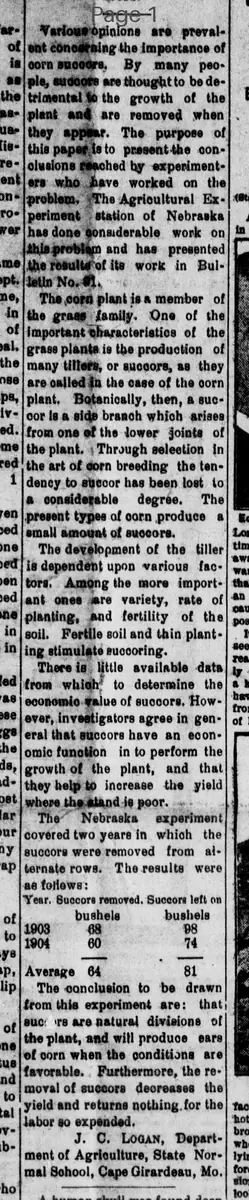
The Nebraska experiment covered two years in which the suckers were removed from alternate rows. The results were as follows:
| Year | Suckers removed | Suckers left on |
| bushels | bushels | |
| 1903 | 68 | 98 |
| 1904 | 60 | 74 |
| Average | 64 | 81 |
The conclusion to be drawn from this experiment are: that suckers are natural divisions of the plant, and will produce ears of corn when the conditions are favorable. Furthermore, the removal of suckers decreases the yield and returns nothing for the labor so expended.
J. C. Logan, Department of Agriculture, State Normal School, Cape Girardeau, Mo.
What sub-type of article is it?
What keywords are associated?
What entities or persons were involved?
Where did it happen?
Domestic News Details
Primary Location
Nebraska
Event Date
1903 1904
Key Persons
Outcome
removal of suckers decreased average yield to 64 bushels per acre from 81 bushels when left on.
Event Details
Nebraska Agricultural Experiment Station conducted experiments over two years, removing suckers from alternate rows of corn plants. Results showed higher yields when suckers were left intact. Suckers are side branches that aid plant growth and ear production under favorable conditions, stimulated by fertile soil and thin planting.