Thank you for visiting SNEWPapers!
Sign up free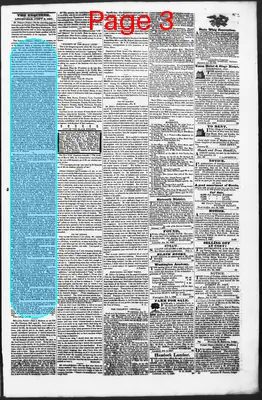
Domestic News
February 2, 1837
Litchfield Enquirer
Litchfield, Litchfield County, Connecticut
What is this article about?
A spectacular display of the Aurora Borealis was observed on the evening of January 25, visible from Washington to Portland, with vivid descriptions of its colors, forms, and movements reported in the New York Express and by Prof. Olmsted of Yale College.
Clipping

OCR Quality
98%
Excellent
Full Text
The Aurora Borealis.—None of our readers, we presume, who love to view the wonders and beauties of Providence, failed of observing the splendid appearance of the sky on Wednesday evening of last week. We could multiply adjective upon adjective to express our views of the beauty and grandeur and sublimity of the scene, but all would fall short; very far short of giving a correct and adequate conception of it. It must have been witnessed to be realized.—We therefore waive any description of our own, and copy one account from the N. Y. Express, and also a more scientific one from Prof. Olmsted, of Yale College, to show what is said of it elsewhere—premising that the Aurora was seen as far south as Washington, and east as far as heard from, Portland.
Brilliant Illumination.—The whole heavens presented a most singular phenomena last evening, from sunset to midnight, unsurpassed in brilliancy, beauty and effect. The night was pleasant, the atmosphere mild and the moon shone with more than its wonted clearness. The sky was studded with an innumerable number of stars, and the evening altogether was like the evenings of September and October, which the husbandman and the hunter have designated as the harvest and the hunter's moon. The night was more like that of a late spring or an early autumn than an evening at midwinter. From the extreme northern horizon to a distance far in the south, the heavens presented a picture of more beauty and variety than we ever remember to have seen before. A thousand rainbows with all their original colors and freshness of the rainbow after the storm were woven in a solid body of light, from which, as from the radii of a circle, a thousand corruscations sparkled forth with as many tints and hues of light. Now a deep crimson body of light, like the blaze from a burning monument—now flashes alternately as variable and as bright as those of lightning, and anon changed into the hues of the sun, and soon again into the paleness of the moon—all appeared in quick succession, changing their rays and colors, brightness and form, in the twinkling of an eye. The meteoric showers could hardly have been more beautiful, and the Aurora Borealis was never in our recollection so magnificent. About 8 o'clock the arch, to use a military phrase, broke into open columns or squadrons, moving slowly and regularly towards the zenith, where at 20 minutes past 8 o'clock it perfected its radiation round the Pleiades, the centre of the halo being a short distance to the eastward of that constellation. The changes, hues and variety of forms exhibited during the phenomenon was awfully grand—far excelling in splendor any thing before witnessed in this region—at one moment the whole firmament appeared to be in a blaze, casting a pink or yellow glare upon the city and surrounding country with the most magnificent effect. The rays of light varied from a deep red to a faint yellow, with here and there an occasional streak of white and light blue.—N. Y. Express.
MAGNIFICENT AURORA.—The evening of the 25th presented us with another grand display of auroral lights, surpassing, in some respects, that of November 17th, 1835, to which, in many particulars, it bore a strong resemblance.
The attention of the writer was first attracted to it as early as 6½ o'clock, before the twilight was over. At this time, the northern sky exhibited a blush not unlike that of the fairest dawn. This was skirted, on the east and west, by ill-defined columns of crimson light, which moved slowly from north to south. At 7 o'clock these began to send up streamers, all of which tended, as usual, to a common focus, a few degrees south and east of the zenith. At 10 minutes past 7 o'clock, the corona was distinctly formed, embracing the Pleiades, which were nearly at its centre, and seemed for a few moments to control its mysterious movements. By the diurnal motion, however, those stars soon moved to the westward; but the common focus, or point of concourse, of all the streamers, held a fixed position in the magnetic meridian and near the pole of the dipping needle, as was the case in the similar exhibition of November, 1835. At three different times during the evening, the corona was dispersed, and as often re-formed; but the position of its centre remained nearly invariable with respect to the magnetic meridian. "Meanwhile, the twilight of the northern sky had moved slowly southward, its boundary spanning the firmament from west to east in a well defined zone, until it left only a segment of the southern hemisphere, about 30 deg. in altitude. This portion of the heavens, thrown as it was into striking contrast with the illuminated parts of the sky, appeared of a dark slate color, and exhibited the interesting spectacle of stars seeming to shine brightly through a stratum of black clouds."
These phenomena played off various interesting evolutions, until 15 minutes after 10 o'clock; when suddenly the meteor rallied all its forces. Innumerable spindles, of silvery lustre, darted from the crimson folds of light that hung around the sky, and all pointed towards the common centre; sheets of a thin vapor, of mingled white and red, flowed over these, and wreathed themselves around the same point, in wavy folds. A universal stillness reigned; and a large portion of all the brightest of the fixed stars, seemed assembled on the spot. Jupiter and Mars, were also present on the occasion, and both at the period of their greatest splendor.
The task of describing this gorgeous canopy, hung with crimson drapery, and supported by pillars of unearthly size and hue, and studded with so many bright stars and planets, transcends the powers of our philosophy : we consign it to the poets.
We could hardly discern that the light of the stars was at all obscured by the auroral covering. Indeed, the two planets appeared through a dense mass of red vapor with seemingly augmented splendor. The ground itself, now covered with snow, which exhibited a delicate rosy tint, contributed to enhance the beauty of the scene.
In these various attributes of grandeur and beauty, the present greatly exceeded all former exhibitions of the aurora ; but there were wanting the auroral waves, or Merry Dancers, which made so conspicuous a figure in the great display of November, 1835.
Although the moon was shining in the east, and but little past the full, yet the distinctness of the auroral lights seemed scarcely impaired by it. This is remarkable : perhaps there is not more than one instance on record, when so splendid an exhibition of the aurora, was witnessed in the presence of so full a moon.
The Magnetic Needle was watched attentively by Mr. E. C. Herrick, and was observed to undergo extraordinary fluctuations—at one time (7h 41m) deviating a whole degree westward of its mean position, and at another time, traversing 45 minutes of a deg. in two minutes of time.
The Barometer had previously been subject to uncommon variations. On the night of the 21st, between 11 and 12 o'clock, it stood at 29.70 inches—depression nearly or quite unexampled at this place. From that time it had risen gradually, and during the aurora it stood at about 30.1 inches. Its entire range since Dec. 16th, when it was 30.86, has been very remarkable.
Early in the evening of the aurora, the thermometer was at 20 deg. (Fah.) but sunk rapidly, and at 10 o'clock was only 4 deg. above zero.
The Zodiacal Light is at this time very conspicuous in the south-west. It may be observed immediately after evening twilight, rising in a pyramid towards the head of Aries, and brighter than the milky way.
Yale College, Jan. 25.
Brilliant Illumination.—The whole heavens presented a most singular phenomena last evening, from sunset to midnight, unsurpassed in brilliancy, beauty and effect. The night was pleasant, the atmosphere mild and the moon shone with more than its wonted clearness. The sky was studded with an innumerable number of stars, and the evening altogether was like the evenings of September and October, which the husbandman and the hunter have designated as the harvest and the hunter's moon. The night was more like that of a late spring or an early autumn than an evening at midwinter. From the extreme northern horizon to a distance far in the south, the heavens presented a picture of more beauty and variety than we ever remember to have seen before. A thousand rainbows with all their original colors and freshness of the rainbow after the storm were woven in a solid body of light, from which, as from the radii of a circle, a thousand corruscations sparkled forth with as many tints and hues of light. Now a deep crimson body of light, like the blaze from a burning monument—now flashes alternately as variable and as bright as those of lightning, and anon changed into the hues of the sun, and soon again into the paleness of the moon—all appeared in quick succession, changing their rays and colors, brightness and form, in the twinkling of an eye. The meteoric showers could hardly have been more beautiful, and the Aurora Borealis was never in our recollection so magnificent. About 8 o'clock the arch, to use a military phrase, broke into open columns or squadrons, moving slowly and regularly towards the zenith, where at 20 minutes past 8 o'clock it perfected its radiation round the Pleiades, the centre of the halo being a short distance to the eastward of that constellation. The changes, hues and variety of forms exhibited during the phenomenon was awfully grand—far excelling in splendor any thing before witnessed in this region—at one moment the whole firmament appeared to be in a blaze, casting a pink or yellow glare upon the city and surrounding country with the most magnificent effect. The rays of light varied from a deep red to a faint yellow, with here and there an occasional streak of white and light blue.—N. Y. Express.
MAGNIFICENT AURORA.—The evening of the 25th presented us with another grand display of auroral lights, surpassing, in some respects, that of November 17th, 1835, to which, in many particulars, it bore a strong resemblance.
The attention of the writer was first attracted to it as early as 6½ o'clock, before the twilight was over. At this time, the northern sky exhibited a blush not unlike that of the fairest dawn. This was skirted, on the east and west, by ill-defined columns of crimson light, which moved slowly from north to south. At 7 o'clock these began to send up streamers, all of which tended, as usual, to a common focus, a few degrees south and east of the zenith. At 10 minutes past 7 o'clock, the corona was distinctly formed, embracing the Pleiades, which were nearly at its centre, and seemed for a few moments to control its mysterious movements. By the diurnal motion, however, those stars soon moved to the westward; but the common focus, or point of concourse, of all the streamers, held a fixed position in the magnetic meridian and near the pole of the dipping needle, as was the case in the similar exhibition of November, 1835. At three different times during the evening, the corona was dispersed, and as often re-formed; but the position of its centre remained nearly invariable with respect to the magnetic meridian. "Meanwhile, the twilight of the northern sky had moved slowly southward, its boundary spanning the firmament from west to east in a well defined zone, until it left only a segment of the southern hemisphere, about 30 deg. in altitude. This portion of the heavens, thrown as it was into striking contrast with the illuminated parts of the sky, appeared of a dark slate color, and exhibited the interesting spectacle of stars seeming to shine brightly through a stratum of black clouds."
These phenomena played off various interesting evolutions, until 15 minutes after 10 o'clock; when suddenly the meteor rallied all its forces. Innumerable spindles, of silvery lustre, darted from the crimson folds of light that hung around the sky, and all pointed towards the common centre; sheets of a thin vapor, of mingled white and red, flowed over these, and wreathed themselves around the same point, in wavy folds. A universal stillness reigned; and a large portion of all the brightest of the fixed stars, seemed assembled on the spot. Jupiter and Mars, were also present on the occasion, and both at the period of their greatest splendor.
The task of describing this gorgeous canopy, hung with crimson drapery, and supported by pillars of unearthly size and hue, and studded with so many bright stars and planets, transcends the powers of our philosophy : we consign it to the poets.
We could hardly discern that the light of the stars was at all obscured by the auroral covering. Indeed, the two planets appeared through a dense mass of red vapor with seemingly augmented splendor. The ground itself, now covered with snow, which exhibited a delicate rosy tint, contributed to enhance the beauty of the scene.
In these various attributes of grandeur and beauty, the present greatly exceeded all former exhibitions of the aurora ; but there were wanting the auroral waves, or Merry Dancers, which made so conspicuous a figure in the great display of November, 1835.
Although the moon was shining in the east, and but little past the full, yet the distinctness of the auroral lights seemed scarcely impaired by it. This is remarkable : perhaps there is not more than one instance on record, when so splendid an exhibition of the aurora, was witnessed in the presence of so full a moon.
The Magnetic Needle was watched attentively by Mr. E. C. Herrick, and was observed to undergo extraordinary fluctuations—at one time (7h 41m) deviating a whole degree westward of its mean position, and at another time, traversing 45 minutes of a deg. in two minutes of time.
The Barometer had previously been subject to uncommon variations. On the night of the 21st, between 11 and 12 o'clock, it stood at 29.70 inches—depression nearly or quite unexampled at this place. From that time it had risen gradually, and during the aurora it stood at about 30.1 inches. Its entire range since Dec. 16th, when it was 30.86, has been very remarkable.
Early in the evening of the aurora, the thermometer was at 20 deg. (Fah.) but sunk rapidly, and at 10 o'clock was only 4 deg. above zero.
The Zodiacal Light is at this time very conspicuous in the south-west. It may be observed immediately after evening twilight, rising in a pyramid towards the head of Aries, and brighter than the milky way.
Yale College, Jan. 25.
What sub-type of article is it?
Weather
What keywords are associated?
Aurora Borealis
Northern Lights
Yale College
New York Express
Magnetic Needle
January 25
What entities or persons were involved?
Prof. Olmsted
Mr. E. C. Herrick
Domestic News Details
Event Date
Evening Of The 25th
Key Persons
Prof. Olmsted
Mr. E. C. Herrick
Event Details
A grand display of the Aurora Borealis occurred, featuring crimson lights, streamers, corona around the Pleiades, and various evolutions until after 10 o'clock, observed widely from Washington to Portland, with scientific notes on magnetic and atmospheric variations.