Thank you for visiting SNEWPapers!
Sign up free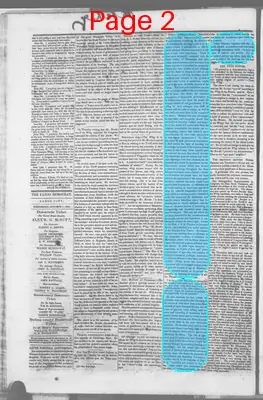
Editorial
October 1, 1845
The Yazoo Democrat
Yazoo City, Yazoo County, Mississippi
What is this article about?
Editorial praises Mississippi's natural advantages and democratic institutions, urges reform of the failing common school system based on Judge Thacher's letter to Gov. Brown, citing 1840 census data showing widespread illiteracy and lack of education access, calling for action to educate the rising generation for the state's prosperity.
Clipping
OCR Quality
95%
Excellent
Full Text
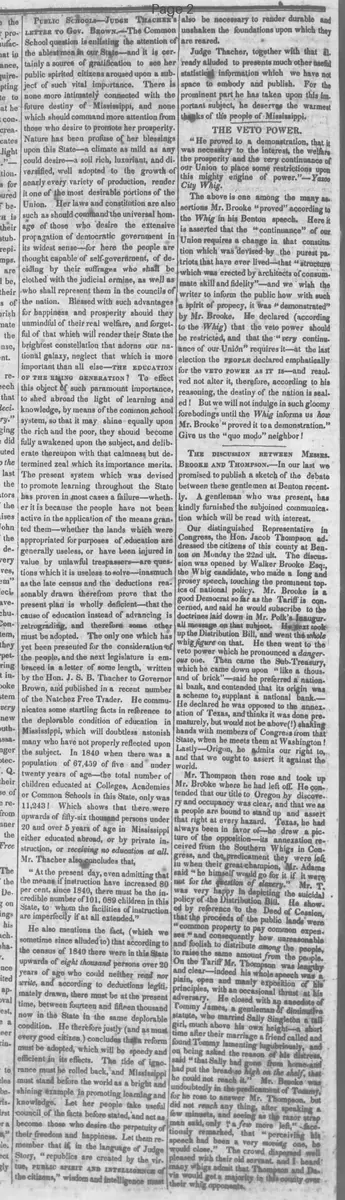
Public Schools—Judge Thacher's Letter to Gov. Brown. The Common School question is enlisting the attention of the ablest men in our State—and it is certainly a source of gratification to see her public spirited citizens aroused upon a subject of such vital importance. There is none more intimately connected with the future destiny of Mississippi, and none which should command more attention from those who desire to promote her prosperity. Nature has been profuse of her blessings upon this State—a climate as mild as any could desire—a soil rich, luxuriant, and diversified, well adopted to the growth of nearly every variety of production, render it one of the most desirable portions of the Union. Her laws and constitution are also such as should command the universal homage of those who desire the extensive propagation of democratic government in its widest sense—for here the people are thought capable of self-government, of deciding by their suffrages who shall be clothed with the judicial ermine, as well as who shall represent them in the councils of the nation. Blessed with such advantages for happiness and prosperity should they be unmindful of their real welfare, and forgetful of that which will render their State the brightest constellation that adorns our national galaxy, neglect that which is more important than all else—THE EDUCATION OF THE RISING GENERATION? To effect this object of such paramount importance, to shed abroad the light of learning and knowledge, by means of the common school system, so that it may shine equally upon the rich and the poor, they should become fully awakened upon the subject, and deliberate thereupon with that calmness but determined zeal which its importance merits.
The present system which was devised to promote learning throughout the State has proven in most cases a failure—whether it is because the people have not been active in the application of the means granted them—whether the lands which were appropriated for purposes of education are generally useless, or have been injured in value by unlawful trespassers—are questions which it is useless to solve—inasmuch as the late census and the deductions reasonably drawn therefrom prove that the present plan is wholly deficient—that the cause of education instead of advancing is retrograding, and therefore some other must be adopted. The only one which has yet been presented for the consideration of the people, and the next legislature is embraced in a letter of some length, written by the Hon. J. S. B. Thacher to Governor Brown, and published in a recent number of the Natchez Free Trader. He communicates some startling facts in reference to the deplorable condition of education in Mississippi, which will doubtless astonish many who have not properly reflected upon the subject. In 1840 when there was a population of 67,459 of five and under twenty years of age—the total number of children educated at Colleges, Academies or Common Schools in this State, only was 11,243! Which shows that there were upwards of fifty-six thousand persons under 20 and over 5 years of age in Mississippi either educated abroad, or by private instruction, or receiving no education at all. Mr. Thacher also concludes that 'At the present day, even admitting that the means of instruction have increased 80 per cent. since 1840, there must be the incredible number of 101,089 children in this State, to whom the facilities of instruction are imperfectly if at all extended.' He also mentions the fact, (which we sometime since alluded to) that according to the census of 1840 there were in this State upwards of eight thousand persons over 20 years of age who could neither read nor write, and according to deductions legitimately drawn, there must be at the present time, between fourteen and fifteen thousand now in the State in the same deplorable condition. He therefore justly (and as must every good citizen,) concludes that a reform must be adopted, which will be speedy and efficient in its effects. The tide of ignorance must be rolled back, and Mississippi must stand before the world as a bright and shining example in promoting learning and knowledge.
Let her people take useful council of the facts before stated, and act as become those who desire the perpetuity of their freedom and happiness. Let them remember that, in the language of Judge Story, 'republics are created by the virtue, PUBLIC SPIRIT AND INTELLIGENCE of the citizens,' wisdom and intelligence must also be necessary to render durable and unshaken the foundations upon which they are reared.
Judge Thacher, together with that already alluded to presents much other useful statistical information which we have not space to embody and publish. For the prominent part he has taken upon this important subject, he deserves the warmest thanks of the people of Mississippi.
The present system which was devised to promote learning throughout the State has proven in most cases a failure—whether it is because the people have not been active in the application of the means granted them—whether the lands which were appropriated for purposes of education are generally useless, or have been injured in value by unlawful trespassers—are questions which it is useless to solve—inasmuch as the late census and the deductions reasonably drawn therefrom prove that the present plan is wholly deficient—that the cause of education instead of advancing is retrograding, and therefore some other must be adopted. The only one which has yet been presented for the consideration of the people, and the next legislature is embraced in a letter of some length, written by the Hon. J. S. B. Thacher to Governor Brown, and published in a recent number of the Natchez Free Trader. He communicates some startling facts in reference to the deplorable condition of education in Mississippi, which will doubtless astonish many who have not properly reflected upon the subject. In 1840 when there was a population of 67,459 of five and under twenty years of age—the total number of children educated at Colleges, Academies or Common Schools in this State, only was 11,243! Which shows that there were upwards of fifty-six thousand persons under 20 and over 5 years of age in Mississippi either educated abroad, or by private instruction, or receiving no education at all. Mr. Thacher also concludes that 'At the present day, even admitting that the means of instruction have increased 80 per cent. since 1840, there must be the incredible number of 101,089 children in this State, to whom the facilities of instruction are imperfectly if at all extended.' He also mentions the fact, (which we sometime since alluded to) that according to the census of 1840 there were in this State upwards of eight thousand persons over 20 years of age who could neither read nor write, and according to deductions legitimately drawn, there must be at the present time, between fourteen and fifteen thousand now in the State in the same deplorable condition. He therefore justly (and as must every good citizen,) concludes that a reform must be adopted, which will be speedy and efficient in its effects. The tide of ignorance must be rolled back, and Mississippi must stand before the world as a bright and shining example in promoting learning and knowledge.
Let her people take useful council of the facts before stated, and act as become those who desire the perpetuity of their freedom and happiness. Let them remember that, in the language of Judge Story, 'republics are created by the virtue, PUBLIC SPIRIT AND INTELLIGENCE of the citizens,' wisdom and intelligence must also be necessary to render durable and unshaken the foundations upon which they are reared.
Judge Thacher, together with that already alluded to presents much other useful statistical information which we have not space to embody and publish. For the prominent part he has taken upon this important subject, he deserves the warmest thanks of the people of Mississippi.
What sub-type of article is it?
Education
Social Reform
What keywords are associated?
Common Schools
Education Reform
Mississippi Education
Judge Thacher Letter
Illiteracy Statistics
Public Schools Failure
What entities or persons were involved?
Judge Thacher
Gov. Brown
Mississippi Citizens
Natchez Free Trader
Editorial Details
Primary Topic
Reform Of The Common School System In Mississippi
Stance / Tone
Urging Reform And Public Action For Education
Key Figures
Judge Thacher
Gov. Brown
Mississippi Citizens
Natchez Free Trader
Key Arguments
Mississippi's Natural And Political Advantages Require Investment In Education For Prosperity
Current Common School System Has Failed, As Shown By 1840 Census Data
Over 56,000 Children Aged 5 20 Uneducated In 1840
Estimated 101,089 Children Currently Lack Proper Instruction
14,000 15,000 Adults Illiterate Now
Reform Needed To Roll Back Ignorance And Promote Learning
Republics Depend On Citizens' Virtue, Public Spirit, And Intelligence