Thank you for visiting SNEWPapers!
Sign up free
Story
June 24, 1901
The Times
Washington, District Of Columbia
What is this article about?
Article explores the human-like sensitivity of watch mechanisms to cold and magnetism, and how 75 years of intricate machinery has honed intelligence in users like American farmers, emphasizing the need for skilled machinists.
Clipping
OCR Quality
98%
Excellent
Full Text
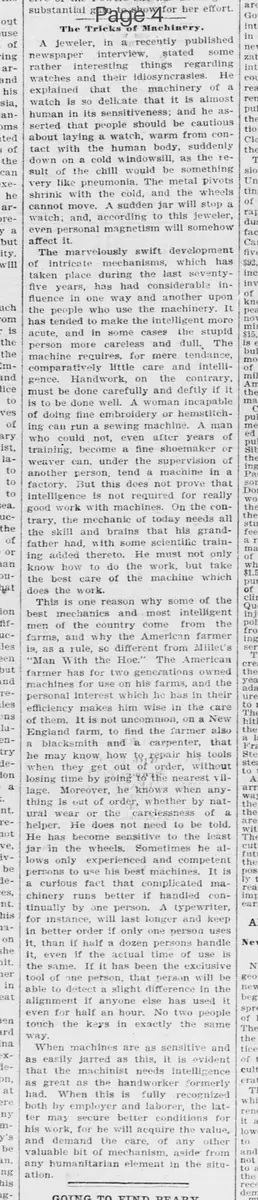
The Tricks of Machinery.
A jeweler, in a recently published newspaper interview, stated some rather interesting things regarding watches and their idiosyncrasies. He explained that the machinery of a watch is so delicate that it is almost human in its sensitiveness; and he asserted that people should be cautious about laying a watch, warm from contact with the human body, suddenly down on a cold windowsill, as the result of the chill would be something very like pneumonia. The metal pivots shrink with the cold, and the wheels cannot move. A sudden jar will stop a watch; and, according to this jeweler, even personal magnetism will somehow affect it.
The marvelously swift development of intricate mechanisms, which has taken place during the last seventy-five years, has had considerable influence in one way and another upon the people who use the machinery. It has tended to make the intelligent more acute, and in some cases the stupid person more careless and dull. The machine requires, for mere tendance, comparatively little care and intelligence. Handwork, on the contrary, must be done carefully and deftly if it is to be done well. A woman incapable of doing fine embroidery or hemstitching can run a sewing machine. A man who could not, even after years of training, become a fine shoemaker or weaver can, under the supervision of another person, tend a machine in a factory. But this does not prove that intelligence is not required for really good work with machines. On the contrary, the mechanic of today needs all the skill and brains that his grandfather had, with some scientific training added thereto. He must not only know how to do the work, but take the best care of the machine which does the work.
This is one reason why some of the best mechanics and most intelligent men of the country come from the farms, and why the American farmer is, as a rule, so different from Millet's "Man With the Hoe." The American farmer has for two generations owned machines for use on his farms, and the personal interest which he has in their efficiency makes him wise in the care of them. It is not uncommon, on a New England farm, to find the farmer also a blacksmith and a carpenter, that he may know how to repair his tools when they get out of order, without losing time by going to the nearest village. Moreover, he knows when anything is out of order, whether by natural wear or the carelessness of a helper. He does not need to be told. He has become sensitive to the least jar in the wheels. Sometimes he allows only experienced and competent persons to use his best machines. It is a curious fact that complicated machinery runs better if handled continually by one person. A typewriter, for instance, will last longer and keep in better order if only one person uses it, than if half a dozen persons handle it, even if the actual time of use is the same. If it has been the exclusive tool of one person, that person will be able to detect a slight difference in the alignment if anyone else has used it even for half an hour. No two people touch the keys in exactly the same way.
When machines are as sensitive and as easily jarred as this, it is evident that the machinist needs intelligence as great as the handworker formerly had. When this is fully recognized both by employer and laborer, the latter may secure better conditions for his work, for he will acquire the value and demand the care, of any other valuable bit of mechanism, aside from any humanitarian element in the situation.
A jeweler, in a recently published newspaper interview, stated some rather interesting things regarding watches and their idiosyncrasies. He explained that the machinery of a watch is so delicate that it is almost human in its sensitiveness; and he asserted that people should be cautious about laying a watch, warm from contact with the human body, suddenly down on a cold windowsill, as the result of the chill would be something very like pneumonia. The metal pivots shrink with the cold, and the wheels cannot move. A sudden jar will stop a watch; and, according to this jeweler, even personal magnetism will somehow affect it.
The marvelously swift development of intricate mechanisms, which has taken place during the last seventy-five years, has had considerable influence in one way and another upon the people who use the machinery. It has tended to make the intelligent more acute, and in some cases the stupid person more careless and dull. The machine requires, for mere tendance, comparatively little care and intelligence. Handwork, on the contrary, must be done carefully and deftly if it is to be done well. A woman incapable of doing fine embroidery or hemstitching can run a sewing machine. A man who could not, even after years of training, become a fine shoemaker or weaver can, under the supervision of another person, tend a machine in a factory. But this does not prove that intelligence is not required for really good work with machines. On the contrary, the mechanic of today needs all the skill and brains that his grandfather had, with some scientific training added thereto. He must not only know how to do the work, but take the best care of the machine which does the work.
This is one reason why some of the best mechanics and most intelligent men of the country come from the farms, and why the American farmer is, as a rule, so different from Millet's "Man With the Hoe." The American farmer has for two generations owned machines for use on his farms, and the personal interest which he has in their efficiency makes him wise in the care of them. It is not uncommon, on a New England farm, to find the farmer also a blacksmith and a carpenter, that he may know how to repair his tools when they get out of order, without losing time by going to the nearest village. Moreover, he knows when anything is out of order, whether by natural wear or the carelessness of a helper. He does not need to be told. He has become sensitive to the least jar in the wheels. Sometimes he allows only experienced and competent persons to use his best machines. It is a curious fact that complicated machinery runs better if handled continually by one person. A typewriter, for instance, will last longer and keep in better order if only one person uses it, than if half a dozen persons handle it, even if the actual time of use is the same. If it has been the exclusive tool of one person, that person will be able to detect a slight difference in the alignment if anyone else has used it even for half an hour. No two people touch the keys in exactly the same way.
When machines are as sensitive and as easily jarred as this, it is evident that the machinist needs intelligence as great as the handworker formerly had. When this is fully recognized both by employer and laborer, the latter may secure better conditions for his work, for he will acquire the value and demand the care, of any other valuable bit of mechanism, aside from any humanitarian element in the situation.
What sub-type of article is it?
Curiosity
What themes does it cover?
Moral Virtue
What keywords are associated?
Watch Sensitivity
Machinery Impact
American Farmer
Machine Care
Personal Magnetism
Where did it happen?
New England Farm
Story Details
Location
New England Farm
Event Date
Last Seventy Five Years
Story Details
A jeweler describes watches as sensitive to cold, jars, and magnetism like human pneumonia. Machinery development sharpens intelligence in users, especially farmers who maintain their own tools. Machines perform better with consistent handling by one person, requiring skilled care from machinists.