Thank you for visiting SNEWPapers!
Sign up free
Gazette Of The United States, & Philadelphia Daily Advertiser
Philadelphia, Philadelphia County, Pennsylvania
What is this article about?
Historical account of May 22, 1797, US House debate on responding to President's speech. Mr. Nicholas pushes amendment for British treaty inquiry to ease French tensions; Mr. W. Smith defends treaty, highlights French indignities like rejecting Pinckney, urges national unity and firmness. Brief May 24 update on continued debate.
Merged-components note: Continuation of the report on the House of Representatives debate from May 22 to May 24 across pages 2 and 3, with sequential reading orders.
Clippings
1 of 2
OCR Quality
Full Text
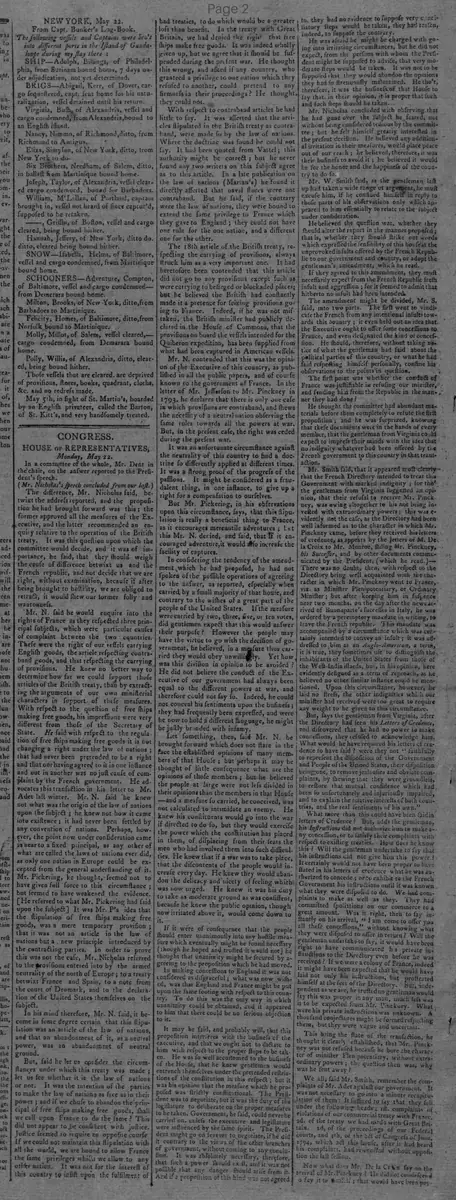
HOUSE OF REPRESENTATIVES,
Monday, May 22.
In a committee of the whole, Mr. Dent in the chair, on the answer reported to the President's speech.
(Mr. Nicholas's speech concluded from our last.)
The difference, Mr. Nicholas said, betwixt the address reported, and the proposition he had brought forward was this; the former approved all the measures of the Executive, and the latter recommended an enquiry relative to the operation of the British treaty. It was this question upon which the committee would decide, and it was of importance, he said, that they should weigh the cause of difference betwixt us and the French republic, and not decide that we are right, without examination, because if after being brought to hostility, we are obliged to retract, it would shew our former folly and wantonness.
Mr. N. said he would enquire into the rights of France as they respected three principal subjects, which were particular causes of complaint between the two countries. These were the right of our vessels carrying English goods, the article respecting contraband goods, and that respecting the carrying of provisions. He knew no better way to determine how far we could support those articles of the British treaty, than by extracting the arguments of our own ministerial characters in support of these measures.
With respect to the question of free ships making free goods, his impressions were very different from those of the Secretary of State. He said with respect to the regulation of free ships making free goods it is not changing a right under the law of nations; that had never been pretended to be a right and that our having agreed to it in one instance and not in another was no just cause of complaint by the French government. He advocates this transaction in his letter to Mr. Adet last winter. Mr. N. said he knew not what was the origin of the law of nations upon the subject; he knew not how it came into existence; it had never been settled by any convention of nations. Perhaps, however, the point now under consideration came as near to a fixed principal, as any other of what are called the laws of nations ever did, as only one nation in Europe could be excepted from the general understanding of it.
Mr. Pickering, he thought, seemed not to have given full force to this circumstance; but seemed to have weakened the evidence. He referred to what Mr. Pickering had said upon the subject. It was Mr. P's idea that the stipulation of free ships making free goods, was a mere temporary provision; that it was not an article in the law of nations but a new principle introduced by the contracting parties. In order to prove this was not the case, Mr. Nicholas referred to the provisions entered into by the armed neutrality of the north of Europe; to a treaty betwixt France and Spain, to a note from the court of Denmark, and to the declaration of the United States themselves on the subject.
In his mind therefore, Mr. N. said, it become in some degree certain that this stipulation was an article of the law of nations, and that an abandonment of it, as a neutral power, was an abandonment of neutral ground.
But, said he let us consider the circumstances under which this treaty was made; let us see whether it is the law of nations or not. It was the intention of the parties to make the law of nations as free as in their power; and if we chuse to abandon the principal of free ships making free goods, shall we call upon France to do the same? This did not appear to be consistent with justice. Justice seemed to require an opposite course If we could not maintain this stipulation with all the world, we are bound to allow France the same privileges which we allow to any other nation. It was not for the interest of this country to insist upon the fulfilment of bad treaties. to do which would be a greater loss than benefit. In the treaty with Great Britain, we had denied the right that free ships make free goods. It was indeed wholly given up, but we agree that it should be suspended during the present war. He thought this wrong, and asked if any country, who granted a privilege to one nation which they refused to another, could pretend to any firmness in their proceedings? He thought, they could not.
With respect to contraband articles he had little to say. It was asserted that the articles stipulated in the British treaty as contraband. were made so by the law of nations, Where the doctrine was found he could not say. It had been quoted from Vattel; this authority might be correct; but he never found any two writers on this subject agree as to this article. In a late publication on the law of nations (Martens) he found it directly asserted that naval stores were not contraband. But he said, if the contrary were the law of nations, they were bound to extend the same privilege to France which they gave to England; they could not have one rule for the one nation, and a different one for the other.
The 18th article of the British treaty, respecting the carrying of provisions, always struck him as a very important one. It had heretofore been contended that this article did not go to any provisions except such as were carrying to besieged or blockaded places; but he believed the British had constantly made it a pretence for seizing provisions going to France. Indeed, if he was not mistaken, the British minister had publicly declared in the House of Commons, that the provisions on board the vessels intended for the Quiberon expedition, had been supplied from what had been captured in American vessels.
Mr. N. contended that this was the opinion of the Executive of this country, as published in all the public papers, and of course known to the government of France. In the letter of Mr. Jefferson to Mr. Pinckney in 1793, he declares that there is only one case in which provisions are contraband, and shews the necessity of a neutral nation observing the same rules towards all the powers at war.
But, in the present case, the right was ceded during the present war.
It was an unfortunate circumstance against the neutrality of this country to find a doctrine so differently applied at different times. It was a strong proof of the progress of the passions. It might be considered as a fraudulent thing, in one instance, to give up a right for a compensation to ourselves.
But Mr. Pickering, in his observations upon this circumstance, says, that this Stipulation is really a beneficial thing to France, as it encourages mercantile adventures; let this Mr. N. denied, and said, that If it encouraged adventure, it would so increase the facility of captures.
In considering the tendency of the amendment which he had proposed, he had not spoken of the possible operations of agreeing to the answer, as reported, especially when carried by a small majority of that house, and contrary to the wishes of a great part of the people of the United States. If the measure were carried by two, three, five, or ten votes, did gentlemen expect that this would answer their purpose? However the people may have the virtue to go with the decision of government, he believed, in a measure thus carried they would obey unwillingly. Yet how was this division in opinion to be avoided? He did not believe the conduct of the Executive of our government had always been equal to the different powers at war, and therefore could not say so. Indeed, he could not conceal his sentiments upon the business; they had frequently been expressed, and were he now to hold a different language, he might be justly branded with infamy.
Let something, then, said Mr. N. be brought forward which does not stare in the face the established opinions of many members of that House; but perhaps it may be thought of little consequence what are the opinions of those members; but he believed the people at large were not less divided in their opinions than the members in that House—and a measure so carried, he conceived, was not calculated to intimidate an enemy. He knew his constituents would go into the war if directed to do so, but they would exercise the power which the constitution has placed in them, of displacing from their seats the men who had involved them into such difficulties. He knew that if a war was to take place, that the discontents of the people would increase every day. He knew they would abandon the delicacy and nicety of feeling which was now urged. He knew it was his duty to take as moderate ground as was consistent, because he knew the public opinion, though now irritated above it, would come down to it.
If it were of consequence that the people should enter unanimously into any hostile measure which eventually might be found necessary (though he hoped and trusted it would not) he thought that unanimity might be secured by agreeing to the proposition which he had moved.
In making concessions to England it was not considered as disgraceful; what was now wished, was that England and France might be put upon the same footing with respect to this country. To do this was the only way in which unanimity could be obtained, and it appeared to him that there could be no serious objection to it.
It may be said, and probably will, that this proposition interferes with the business of the executive, and that we ought not to dictate to him with respect to the proper steps to be taken. He was so well accustomed to the business of the House, that he knew gentlemen would entrench themselves under the pretended restrictions of the constitution in this respect; but it was his opinion that the measure which he proposed was strictly constitutional. The President was to negotiate, but it was the duty of the legislature to deliberate on the proper measures to be taken. Government, he said, could never be carried on, unless the executive and legislature were influenced by the same spirit. The President might go on forever to negotiate, if he did it contrary to the views of the other branches of government, without coming to any conclusion. It was absolutely necessary, therefore, that such a power should exist, and it was not possible that any danger should arise from it.
And if a proposition of this kind was not agreed to. they had no evidence to suppose very conciliatory steps would be taken, they had reason, indeed, to suppose the contrary.
He was afraid he might be charged with going into irritating circumstances, but he did not expect, from the persons with whom the President might be supposed to advise, that very moderate steps would be taken. it was not to be supposed that they would abandon the opinions they had so strenuously maintained. He tho't, therefore, it was the business of that House to say that, in their opinion, it is proper that such and such steps should be taken.
Mr. Nicholas concluded with observing. that he had gone over the subject he feared, not without being considered tedious by the committee; but he felt himself greatly interested in the present decision. He believed any additional irritation in their measures, would place peace out of our reach; he believed, therefore, it was their business to avoid it; he believed it would be for the honor and the happiness of the country to do so.
Mr. W. Smith said, as the gentleman last up had taken a wide range of argument, he must excuse him, if he considered himself in reply to those parts of his observations only which appeared to him essentially to relate to the subject under consideration.
He believed the question was, whether they should alter the report in the manner proposed; that is, whether they should strike out words which expressed the sensibility of this house at the unprovoked insults offered by the French Republic to our government and country, or adopt the gentleman's amendment, which he read.
If they agreed to this amendment, they must necessarily expect from the French Republic fresh insult and aggression; for it seemed to admit that hitherto no insult had been intended
The amendment might be divided, Mr. S. said, into two parts. The first went to vindicate the French from any intentional insults towards this country; it even held out an idea that. the Executive ought to offer some concessions to France, and even designated the kind of concession. He should, therefore, without taking notice of what the gentleman had said about the political parties of this country, or what he had said respecting himself personally, confine his observations to the points in question.
The first point was whether the conduct of France was justifiable in refusing our minister, and sending him from the Republic in the manner they had done?
He thought the committee had abundant materials before them completely to refute the first proposition; and he was surprised, knowing that these documents were in the hands of every member, that the gentleman from Virginia could expect to impress their minds with the idea that no indignity whatever had been offered by the French government to this country in that transaction.
Mr. Smith said, that it appeared most clearly that the French Directory intended to treat this Government with marked indignity; for tho' the gentleman from Virginia suggested an opinion, that their refusal to receive Mr. Pinckney, was owing altogether to his not being invested with extraordinary powers; this was evidently not the case, as the Directory had been well informed as to the character in which Mr, Pinckney came, before they received his letters of credence, as appears by the letters of Mr. De la Croix to Mr. Monroe, telling Mr. Pinckney, his Successor, and by other documents communicated by the President, (which he read.)—There was no doubt, then, with respect to the Directory being well acquainted with the character in which Mr. Pinckney went to France, viz. as Minister Plenipotentiary, or Ordinary Minister; but after keeping him in suspense near two months, on the day after the news arrived of Buonaparte's success in Italy, he was ordered by a peremptory mandate in writing, to leave the French republic. This mandate was. accompanied by a circumstance which was certainly intended to convey an insult; it was addressed to him as an Anglo-American, a term, it is true, they sometimes use to distinguish the inhabitants of the United States from those of the West-India islands, but, in his opinion, here evidently designed as a term of reproach, as he believed no other similar instance could be mentioned. Upon this circumstance, however, he laid no stress, the other indignities which our minister had received were too great to require any weight to be given to this circumstance.
But, says the gentleman from Virginia, after the Directory had seen his Letters of Credence, and discovered that he had no power to make concessions, they refused to acknowledge him. What would he have required his letters of credence to have said? were they not "faithfully to represent the disposition of the Government and People of the United States, whose disposition being one, to remove jealousies and obviate complaints, by shewing that they were groundless, to restore that mutual confidence which had been so unfortunately and injuriously impaired, and to explain the relative interests of both countries, and the real sentiments of his own."
What more than this could have been said in letters of Credence? But, adds the gentleman, his Instructions did not authorize him to make any concession, or to satisfy their complaints with respect to existing treaties. How does he know this? Will the gentleman undertake to say that his.instructions did not give him this power?. It certainly would not have been proper to have stated in his letters of credence what he was authorized to concede; or to exhibit to the French Government his instructions until it was known, what they were disposed to do. We had complaints to make as well as they. They had committed spoliations on our commerce to a great amount. Was it right, then to say instantly on his arrival, "I am come to offer you all these concessions," without knowing what they were disposed to offer in return? Will the gentleman undertake to say, it would have been right to have communicated his private instructions to the Directory even before he was received? If we were a colony of France, indeed it might have been expected that he would have laid not only his instructions, but prostrated himself at the feet of the Directory. But, independent as we are, he trusted no gentleman would say this was proper in any man, much less was it to be expected from Mr. Pinckney. What. were his private instructions was unknown. A thousand conjectures might be formed respecting them, but they were vague and uncertain.
This being the state of the transaction, he thought it clearly established, that Mr. Pinckney was not refused because he bore the character of minister Plenipotentiary, without extraordinary powers; the question then was, why was he sent away?
We all, said Mr. Smith, remember the complaints of Mr. Adet against our government. It was not necessary to go into a minute recapitulation of them: It sufficed to say that they fell. under the following heads'; 1st. complaints of. violations of our commercial treaty with France, 2d. of the treaty we had made with Great Britain. 3d, of the proceedings of our Federal courts, and 4th, of the act of Congress of June, 1794, which act this house, after it had heard his complaints, had re-enacted without opposition the last session.
Now what does Mr. De la Croix say on the arrival of Mr.Pinckney I He did not condescend to say it to myself; that would have been paying too much respect to America.
In him too much respect, he did not pay it to the Minister of the American government, but to the recalled Minister, Mr. Monroe, to whom Mr. De la Croix writes a letter, declaring 'that the Directory will not acknowledge nor receive another Minister Plenipotentiary from the United States, until after the redress of the grievances demanded of the American government, and which the French republic has a right to expect from it.'
Now, what, Mr. S. asked, were the grievances contained in Mr. Adet's note, and to which the directory here refer? They were very numerous; but they chiefly fell under the four heads he had mentioned. According then to this declaration of the French government, what were we to do? We must, said he, annul the British treaty: repeal the law of June 1794, which was last session very unanimously re-enacted; and we must, by some proceeding or other, which he supposed even the ingenuity of the gentleman from Virginia would find it difficult to point out, annul the decrees of the courts of the United States. Yet though all this must be done, before the directory would condescend to receive our minister, the gentleman did not believe any indignity whatever had been intended against this government; and we must not express ourselves as if we thought or felt there had been any. It was, at the best, a mere matter of etiquette on the part of France, it was meant to convey no insult, no indignity; our government had given offence by failure of etiquette, and therefore, to heal the breach, we must send an envoy extraordinary to make the necessary concessions, and all will go well.
With respect to the gentleman's second proposition, if it was proper to be discussed at all, it would have been more properly discussed in a committee of the whole on the state of the Union, after proper notice and being printed. If the House cannot confide in the Executive that he will take the proper measures to heal the wound; if the House were convinced that the executive were not disposed to do this, it might be then their duty to apply to him; but the President, in his speech, had explicitly said, that it was his most sincere desire to restore harmony, and that, notwithstanding the indignities offered to our minister and our government, he did not think the honor and dignity of our government forbade farther advances towards negotiation.
After so candid and free a declaration, he was surprised to hear his disposition in this respect thus called in question. For his part, Mr. S. said, he had not the least hesitation to believe, that the executive would go all lengths consistent with the honor and dignity of the country, to restore harmony between the two republics, because he was satisfied he had the interest of the country at heart, and he trusted that no gentleman, not even the gentleman from Virginia himself, would doubt this.
It had been argued that this country had not acted a proper part with respect to France. In order to show this, the member had adverted to three specific grounds of complaint arising out of the British treaty.
The gentleman from Virginia had confined the complaints of the French government to three articles of the British treaty; though, if the committee referred to the letter of Mr. De la Croix, it would be found that they did not confine them within so narrow a compass.
They complained, first, of the inexecution of treaties; there are several points of complaint relative to that head. 2d. Complaints against the decrees of our federal courts; 3d, against the law of June 1794; and 4th, against the treaty with Great Britain: Yet the gentleman confines himself altogether to the latter. And really he did not expect at this time of day, after the subject had been so fully discussed, and determined, and the objections refuted over and over again, that any gentleman would have endeavored to revive and prove their complaints but this head well founded. The three articles were, 1st. That free ships did not make free goods. 2d. The contraband article. 3d. The provision article.
1. The stipulation with respect to neutral vessels not making neutral goods in the British treaty was not contrary to the law of nations; it only provided that the law of nations was to be carried into effect in the manner most convenient for the United States. But this doctrine, he said, was no new thing. It had been acknowledged most explicitly by Mr. Jefferson, Secretary of State, in July 1793, and was so declared to the minister of France; yet no objection was made to it until the British treaty was ratified, though long previous thereto French property was captured on board our vessels. Mr. Jefferson writing on this subject to the French minister, said 'You have no shadow of complaint;' the thing was so perfectly clear and well understood by the law of nations. This happened so long ago as July or August 1793.
But two years afterwards, when the British treaty was promulgated, the whole country was thrown into a flame by admitting this very same doctrine. France herself had always acted under this law of nations when not restrained by treaty; in Valin's ordinances of France this clearly appears. The armed neutrality was confined to the then existing war; Russia herself, the creator of the armed neutrality, entered into a compact with England in 1793, expressly contravening its principles. The principle was then not established by our treaty with England; but such being the acknowledged law of nations, it was merely stipulated that it should be exercised in the manner the least injurious.
2. The next article of complaint was with respect to contraband goods. If gentlemen will consult the law of nations, they will find, that the articles mentioned in the British treaty are by the law of nations contraband articles. They will find that in all the treaties with Denmark and Sweden, Great Britain had made the same stipulations. Indeed the gentleman had acknowledged, that it was so stated by some writers on the law of nations; but he wished to derogate from the authority of those writers, in the same way as Mr. Genet, in his correspondence with Mr. Jefferson, had called them worm-eaten folios and musty aphorisms; to Vattel might be added Valin's ordinances, a very respectable work in France. How, then, can the gentleman with truth say we have deviated from the law of nations?
No doubt that this government would never allow provisions to be contraband, except when going to a besieged or blockaded port. Tho' he made this declaration, yet it was but candid to acknowledge that this was stated by Vattel to be the law of nations. [He read an extract from Vattel]
When this was stated by Lord Grenville to Mr. Pinckney, our then minister in London, Mr. Pinckney acknowledged it to be so stated in Vattel, but very ingeniously argued, that France could not be considered as in the situation mentioned in Vattel, since provisions were cheaper there than they were in England, and therefore the case did not apply. When our envoy was sent to London, both parties were tenacious on this ground. Our minister was unwilling to agree to this construction of the law of nations, but the British minister insisted upon it, and if there had not been some compromise, the negotiation must have been broken off, and a war probably ensued. The result was, therefore that, without admitting it to be the law of nations, it was agreed that where provisions were contraband and by the law of nations, they should be paid for, but not confiscated, as the law of nations (admitting that construction) would have authorized. Therefore some advantage was secured to France, for if Great Britain had confiscated our vessels going to France with provisions, it would certainly have damped the ardor of our citizens employed in that commerce; but under this regulation, our merchants were certain of being paid for their cargoes, whether they arrived in France or were carried into England. These were the three grounds of objection which the gentleman from Virginia had stated as grounds of complaint by the French against the British treaty.
Before he went further, he would observe, that admitting (which he did not admit) that there had been solid grounds of objection against the British treaty, before it was ratified, yet they ought now to be closed. It had received a full discussion at the time: it had been carried into effect, was become the law of the land, and was generally approved of by the country. Why, then, endeavor to stir up the feelings of the public against it by alleging it to be the just cause of complaint?
If the committee wanted any proof of the approbation which that instrument had received, he thought it might be gathered from the general approbation which had been given of the administration of the late President on his retirement from office, in doing which, the people had doubtless taken into view the whole of his conduct. Nor did he think the people had shewn any hostility to the treaty in their late election of members to that house. Indeed, he believed that the approbation which the treaty received, increased in proportion as the subject came to be understood. Admitting further, that the treaty had changed the existing state of things between Great Britain and France, by having granted commercial favors to Great Britain, by the 2d article of our treaty with France, the same favors would immediately attach to France, so that he could have no reason to complain on that ground. Indeed France had herself now modified the treaty betwixt that country and this, and had taken to herself what she deemed to be the favors granted to Great Britain. (Mr. S. read the decree on this subject of 2d March last)
Mr. Smith said, he believed he had examined all the observations of the gentleman from Virginia, relative to the treaty, which were essential to the subject under consideration. He did not wish to go much farther on the present occasion because he agreed with him, that it was proper they should keep themselves as cool and calm as the nature of the case would admit; but he thought whilst so much deference was paid to the feelings of France, some respect ought to be paid to the feelings of America. He hoped the people of America would always retain a proper respect and consideration for their national character; and however earnestly he wished that the differences subsisting between the two countries might be amicably settled, yet, he trusted, that our national dignity would never be at so low an ebb, as to submit to the insults and indignities of any nation whatever. In saying this, he expressed his hearty wish to keep the door of negotiation with France unclosed; but at the same time he strongly recommended to take every necessary step to place us in a situation to defend ourselves, provided she should still persist in her haughty demeanour.
He trusted they would convince the French and every other nation, that they were determined to preserve the right of self-government, and that they were able to frustrate every attempt which should be made to influence our councils. That such attempts had been made he knew some gentlemen would deny, but to him it was evident that all the ministers of France, who had resided in this country, had endeavoured to obtain an undue influence over our affairs. It was now become a serious question whether we were to make concessions to France of the most humiliating nature, and thereby provoke future aggressions, or act a firm and determined part, in expressing our indignation at their insults, and resolving to resist them if they were persisted in.
He did not wish unnecessarily, he said, to excite indignation; but it was necessary, on this occasion, to take particular notice of the insulting speech of President Barras, in reply to Mr. Monroe's valedictory, a speech evidently calculated to separate the American people from their government.
After the Directory knew that Mr. Monroe was no longer the Minister of this country, after he had presented his letters of recall, and Mr. Pinckney had presented his letters of credence—after the Minister of Foreign Affairs, De la Croix, had said that they considered America as having no Minister in France, the President of the Directory delivered the insulting speech above alluded to, in which he tells our late Minister, at a public audience, in the presence of several Foreign Ministers, to go home and tell his government 'that his country owes its liberty to France.' We have never denied, said Mr. S. that we received great services from France: but was it not degrading to this country that their late Minister should be thus addressed. This address was throughout couched in terms studiously marked with indignities to this country, and an attempt to separate the people from the government.
Notwithstanding all this, the gentleman from Virginia is wonderfully afraid of using language which might irritate France: Mr. S. wished France had not given just cause of irritation, but those who had read the correspondence which had been laid before them, for a few years past, must have seen reiterated insults to this country.
It was sufficient to call to their recollection the many indelicate and offensive expressions used by the various French Ministers, in their diplomatic letters. Indeed, were he inclined to aggravate the aggressions we had received, he might display a whole volume of Genet's abuse. He should, however, satisfy himself by presenting some elegant extracts from the letters of Citizen Adet. Mr. S. here quoted a number of offensive epithets and expressions such as disguised under a cloak of civility, the veil of dissimulation, tyrannical and homicidal rage, insidious proclamation of neutrality, the chicanery of its Courts, presenting a poinard to cut the throat of its ally, all submission to the will of England, prostituting its neutrality, &c. &c.
Mr. S. said, as he knew indecent and harsh language always recoiled upon those who used it, he did not wish to adopt it: but at the same time it was due to ourselves to express our feelings with a proper degree of strength and spirit. He was not in the habit of quoting any thing from Mr. Genet, but there was one expression of his which he thought contained good advice, 'all this accommodation and humility, all this condescension attains no end.'
After the gentleman from Virginia had dwelt sufficiently upon the danger of irritating the French, he had emphatically called upon us to recollect our weakness. It might have been as well if he had left that to have been discovered from another quarter. He hoped we had sufficient confidence in the means of defence which we possessed, if driven to the last resort; and he believed that if there was any one more certain way of provoking war than another, it was that of proclaiming our own weakness.
He hoped such a language would now be spoken as would make known to the French government, that the government and people of this country were one, and that they would repel any attempt to gain an influence over our councils and government. The gentleman had said that there did not appear to be any design of this kind, and had endeavored to do away what was stated as the opinion in France, in General Pinckney's letter. He did not mean to rest this altogether upon the reports of an emigrant, whom General Pinckney mentions as having represented this country divided, and of no greater consequence than Genoa or Geneva, but he took the whole information into view. [He read the extract relative to this subject]
It was evident, Mr. S. said, from this information from France, that an opinion had been industriously circulated there that the government and people of this country were divided; that the Executive was corrupt and did not pursue the interests of the people; and that they might, by perseverance, overturn the administration, and introduce a new order of things. Was not such an opinion as this, he asked, calculated to induce France to believe that she might make her own terms with us? It was well known what the French wished, and it was time to declare it plainly; his opinion was that she designed to ruin the commerce of Great-Britain through us.
This was evident. They talked of the British treaty; but they suffered it to lie dormant for near twelve months, without complaining about it. Why were they silent till within a few weeks before the election of our President? Why did they commit depredations upon our commerce long before the British treaty was ever dreamt of? Their first decree, directing depredations of our property, and the capture of our provision ships, was on the 9th of May, 1793, a month before the provision order of Great-Britain, which was dated June 8, 1793: and why have they from that time to this, been committing depredations on our commerce? The British treaty was published in Paris in August, 1795; a year after, in July, 1796, they determine to treat us in the same way that we suffer other nations to treat us, and this decree was not made known to our government till the October following, a few weeks before the election of President.
But this was not all; the French had pursued similar measures towards all the other neutral powers. Sweden, in consequence, had no minister in their country, and was on the eve of a rupture. The intention of the French evidently was, to compel all the neutral powers to destroy the commerce of Great Britain; but, he trusted this country had more spirit than to suffer herself to be thus forced to give up her commerce with Great Britain; he trusted they would pursue any such idea.
Mr. S. hoped the observations which he had made would not be construed into a wish to see the United States and France involved in a war. He had no objection to such measures being taken for preserving peace betwixt the two countries as should be consistent with national honor. It was a delicate thing for them to suggest what the Executive ought to do. It was out of their province to direct him. The Executive had various considerations to take into view. We had injuries to complain of against France for the depredations committed upon our commerce.
If the Executive conceive we have a right to redress, that subject will of course constitute a part of our envoy's instructions. Would it then be proper, said he, for this House to interfere with the Executive, to obtrude its opinion and say, 'You must give up this point; we take upon us (without any authority by the constitution) to give Carte Blanche to France, without any indemnification or redress.'
The gentleman says it is the object of the amendment on the table, to recommend to the Executive to remove any inequalities in the treaties; that was alone sufficient to vote it out.
There had been no period since the revolution which had so powerfully called on Americans for that fortitude and wisdom which they knew so well how to display on great and solemn emergencies. It was not his intention to offend any one by stating the question in such strong terms: but he was persuaded that when the present situation of our affairs with respect to France was well understood, it would be found that to acquiesce in her present demands was virtually and essentially to surrender our self government and independence.
The independence of a nation, he observed, might be destroyed in various modes. Whether a preponderating influence was obtained in her councils by seduction, intrigue or terror, or by a direct and open invasion of her territories, and consequent subjugation, was immaterial: indeed it would be safer for us if a foreign power were at once to attempt our subjugation by invasion; for, in that case, there could be but one opinion among Americans about a vigorous resistance; but the slow approaches to our subjection, by the subtle artifices of intrigue and deception, were seldom discerned by the community at large, until their pestilential effects had taken such deep root as to be with difficulty extirpated.
Was it saying too much, to assert that dictating to our government, fomenting an insurrection in our bosom, influencing the most important election, demanding a violation of our engagements, the repeal of our laws, the annulling the decrees of our courts of justice, were not merely interferences with our government, but in fact attempts to usurp it?
The complaints of France respecting the British treaty were the pretext, but not the real cause of her aggressions. It was idle to wink out of sight the real causes: they wished (as he had before stated) to destroy the commerce of England, and the United States were to be the instrument in accomplishing it. The United States were to be coerced into such measures as would effect this great object. The same policy was pursued towards the Hanse Towns and Denmark: had they made a British treaty? Were they answerable for the sins of ours.? The review he had taken of the ground of controversy as to our treaty with England must have removed every impression unfavourable to our government, and evinced the unceasing efforts of France to acquire an improper ascendancy over our councils, and direct them to the purposes of her own aggrandizement.
Whether or no our government ought, on principles of amity and conciliation, to equalize our treaties between England and France, was a question of an executive nature, and was not properly before the house. An offer of such equalization would undoubtedly depend on the disposition of France to make proper and suitable equivalents.
The gentleman from Virginia had cautioned the committee against alarming the pride of France—but, exclaimed Mr. S. has America no pride? is her sensibility so debased by prejudice or benumbed by terror as to be thrown out of view on this occasion? I trust not, I trust that American pride still maintains an important influence over our deliberations, and desirous as I am to see it yield all that is due to the influence of policy, God forbid that it should ever be supplanted by an interested and servile tameness. He thought it became the dignity of the House to support the Executive in firm and manly language. He was persuaded that a decided conduct would be the most likely to discourage aggression and repetition of insult. He recommended not a menacing but a firm countenance; not a bullying, but an undaunted attitude. This would convince the world we were not to be threatened out of our rights; whereas a timid supplicating posture could not fail to invite fresh insults and humiliation.
Mr. S. said, he valued unanimity as much as other gentlemen. He was sensible that it would be peculiarly important at this juncture. It would engage the confidence of the people and fortify the negotiation. It would convince the world, that however we might differ upon speculative points of administration, there was but one sentiment, respecting our self government. It would extinguish the hopes of those who attempted to keep alive a faction in the country; it would crush the expectations of those who wished to substitute a foreign influence to the constituted authorities of the nation. But it might still be purchased by too dear a sacrifice; and he would rather have only a bare majority for the report of the committee, than an unanimous vote for the amendment; so much did he reprobate its principles. He thought it of more importance that there should be an unanimity between all the departments of the government, than an unanimity in the house, at the expense of its separating from the other branches of the government; but if the amendment was agreed to, it must produce a separation from the President and Senate, and confirm the opinion fostered in France of a division existing between the government and people. Much, therefore, as he cherished unanimity, he could not purchase it on this occasion by agreeing to a proposition, of so dangerous a tendency.
Mr. Smith concluded with requesting the committee seriously to ponder on the consequence of agreeing to the amendment. It spoke the same feeble language as the address of the last session, the same timid reluctance to express our sense of injury, the same reliance on negotiation alone; if this was all that the gentlemen on the other side proposed doing at this extraordinary session, the calling of Congress would prove the most humiliating, the most calamitous measure that had ever been adopted. Better indeed had the members remained at their homes, and there in secret silence mourned over the dishonor of their country, and smothered their resentments, than be collected in mass from all parts of the union, to be thus publicly exhibited as fellow witnesses of their own shame and the indignities offered their country without the power or even the courage to resent them. But he could not believe it possible that the committee should pursue a course so pregnant with humiliation, and he confidently persuaded himself that as his country had always displayed its justice, so would all parts of the house unite on this occasion to convince the world that her fortitude and firmness were equal to her justice.
Wednesday, May 24.
Messrs. S. Smith, from Maryland, and Findley, from this state, appeared, and took their oaths and seats, as did also Mr. W. Smith, from S. Carolina, and another new member whose name we did not learn.
The House again went into a committee of the whole on the answer to the President's speech, and Mr. Nicholas's amendment being under consideration, Mr. Swanwick and Mr. Livingston spoke at great length, particularly the latter, in favour of it.
Mr. Coit proposed several amendments which he wished to be adopted, instead of the one proposed by Mr. Nicholas, as conciliatory on both sides of the House. They were ordered to be printed. The Committee rose, reported progress and asked leave to sit again.
What sub-type of article is it?
What themes does it cover?
What keywords are associated?
What entities or persons were involved?
Where did it happen?
Story Details
Key Persons
Location
House Of Representatives
Event Date
Monday, May 22
Story Details
In a committee of the whole, Mr. Nicholas concludes his speech advocating an amendment to inquire into the British treaty's impact on relations with France, arguing for neutrality and equal treatment. Mr. W. Smith responds, defending the treaty, refuting French complaints, and emphasizing French insults to the US government, urging firm language in the response to the President's speech.