Thank you for visiting SNEWPapers!
Sign up free
Editorial
June 5, 1863
The Jeffersonian Democrat
Chardon, Geauga County, Ohio
What is this article about?
This editorial vehemently criticizes calls to reinstate General McClellan as Union Army commander, highlighting his past failures, inactivity, and poor strategic decisions during the Civil War, while defending current generals like Hooker and Grant against his supporters' demands.
Clipping
OCR Quality
95%
Excellent
Full Text
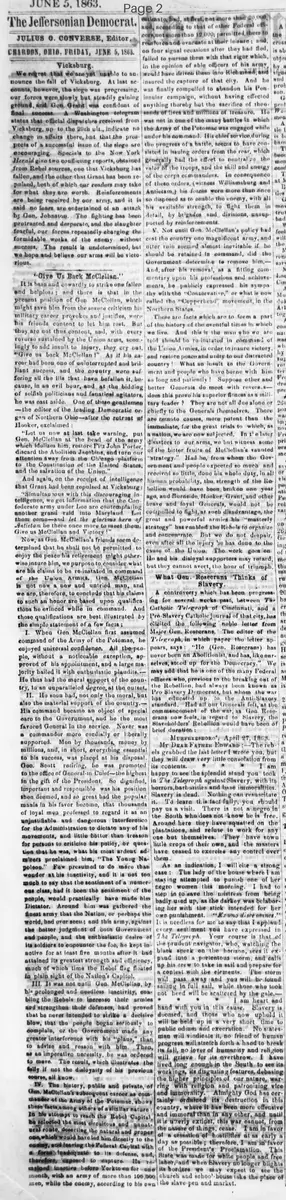
"Give Us Back McClellan."
It is base and cowardly to strike one fallen and helpless; and there is that in the present position of Gen. McClellan, which might save him from the severe criticism his military career provokes and justifies, were his friends content to let him rest. But they are not thus content, and, with every reverse sustained by the Union arms, seemingly to add insult to injury, they cry out, "Give us back McClellan!" As if his career had been one of uninterrupted and brilliant success, and the country were suffering all the ills that have befallen it, because, in an evil hour, and at the bidding of selfish politicians and fanatical agitators, he was cast aside. One of those gentlemen—the editor of the leading Democratic organ of Northern Ohio—after the retreat of Hooker, exclaimed:
"Let us now at last take warning. Put Gen. McClellan at the head of the army which idolizes him, restore Fitz John Porter, discard the Abolition Jacobins, and turn our attention away from the Chicago platform to the Constitution of the United States, and the salvation of the Union."
And again, on the receipt of intelligence that Grant had been repulsed at Vicksburg;
"Simultaneous with this discouraging intelligence, we get information that the Confederate army under Lee are contemplating another grand raid into Maryland. Let them come—and let the glorious hero of Antietam be there once more to meet them. Give us McClellan and Victory Now."
As Gen. McClellan's friends seem determined that he shall not be permitted to enjoy the peace his retirement might otherwise insure him, we purpose to consider what are his claims to be re-instated in command of the Union Armies. Gen. McClellan is not now a new and untried man, and we are, therefore, to conclude that his claims to such an honor are based upon qualifications he evinced while in command. And those qualifications are best illustrated by the simple statement of a few facts:
I. When Gen. McClellan first assumed command of the Army of the Potomac, he enjoyed universal confidence. All the people, without a noticeable exception, approved of his appointment, and a large majority hailed it with enthusiastic plaudits. He thus had the moral support of the country, in an unparalleled degree, at the outset.
II. He soon had not only the moral, but also the material support of the country. His command became an object of special care to the Government, and he the most favored General in the service. Never was commander more cordially or liberally supported. Men by thousands, money by millions, and, in short, everything essential to his success, was placed at his disposal. Gen. Scott retiring, he was promoted to the office of General-in-Chief—the highest in the gift of the President. So dignified, important and responsible was his position then deemed, and so great had the popular mania in his favor become, that thousands of loyal men professed to regard it as an unjustifiable and dangerous interference for the Administration to dictate any of his movements, and little better than treason for persons to criticize his policy, or question that he was, what his most ardent admirers proclaimed him, "The Young Napoleon." Few presumed to do more than wonder at his inactivity, and it is not too much to say that the sentiment of a numerous class, had it been the sentiment of the people, would practically have made him Dictator. Around him was gathered the finest army that the Nation, or perhaps the world, had ever seen; and this army, against the better judgment of both Government and people, and the enthusiastic desire of its soldiers to encounter the foe, he kept inactive for at least five months after it had attained its greatest strength and efficiency, much of which time the Rebel flag floated in plain sight of the Nation's Capitol.
III. It was not until Gen. McClellan, by his prolonged and needless inactivity, enabling the Rebels to increase their armies and strengthen their defenses, had proved that he never intended to strike a decisive blow, that the people began seriously to complain, or the Government made any greater interference with his "plans," than to advise and reason with him. Then, as an imperative necessity, he was ordered to move. The result, which illustrates the folly if not the disloyalty of his previous course, all know.
IV. The history, public and private, of Gen. McClellan's subsequent career as commander of the Army of the Potomac, shows these facts, among others of a similar nature: In his attempt to reach the Rebel Capital, he selected the most circuitous and unnatural route, deserting the natural and proper one, which would have led him directly to the city, and leaving the National Capital with a force inadequate to its defense, and, therefore, exposed to capture. He remained inactive before Yorktown for one month, with an army of more than 100,000 men, while the enemy, according to his own estimate had, at first, not more than 20,000 and, according to that of other Federal officers, not more than 12,000; permitted them to reinforce and evacuate at their leisure; and, on four signal occasions after they had fled, failed to pursue them with that vigor which, in the opinion of able officers of his army would have driven them into Richmond, and insured the capture of that city. And he was finally compelled to abandon his Peninsular campaign, without having effected anything thereby but the sacrifice of thousands of lives and millions of treasure. He was not in one of the many battles in which the Army of the Potomac was engaged while under his command. His chief service, during the progress of a battle, seems to have consisted in issuing orders from the rear, which generally had the effect to neutralize the valor of the troops, and the skill and energy of the corps commanders. In consequence of these orders, (witness Williamsburg and Antietam,) his forces were more than once so disposed as to enable the enemy, with all his available strength, to fight them in detail, by brigades and divisions, unsupported by reinforcements.
V. Not until Gen. McClellan's policy had cost the country one magnificent army, and utter ruin seemed almost inevitable if he should be retained in command, did the Government determine to remove him. And, after his removal, as a fitting commentary upon his professions and achievements, he publicly expressed his sympathy with the "Conservative" or what is now called the "Copperhead" movement, in the Northern States.
These are facts which are to form a part of the history of the eventful times in which we live. And this is the man who we are told should be re-instated in command of the Union Armies, in order to insure victory, and restore peace and unity to our distracted country! What an insult to the Government and people who have borne with him so long and patiently! Suppose other and better Generals do meet with reverses—does this prove his superior fitness as a military leader? They are not all due alone or chiefly to the Generals themselves. There are remote causes, more potent than the immediate, for the great trials to which, as a nation, we are now subjected. In the later disasters to our arms, we but witness some of the bitter fruits of McClellan's vaunted "strategy." Had he, from whom the Government and people expected so much and received so little, done his whole duty, in all human probability, the strength of the Rebellion would have been broken one year ago, and Burnside, Hooker, Grant, and other brave and loyal Generals, would not be compelled to fight, at such disadvantage, the great and powerful armies his "masterly strategy" has enabled the Rebels to organize and concentrate. But we do not despair even after all the injury he has done to the cause of the Union. The work goes on. He and his disloyal supporters may retard but they cannot avert, the hour of triumph.
It is base and cowardly to strike one fallen and helpless; and there is that in the present position of Gen. McClellan, which might save him from the severe criticism his military career provokes and justifies, were his friends content to let him rest. But they are not thus content, and, with every reverse sustained by the Union arms, seemingly to add insult to injury, they cry out, "Give us back McClellan!" As if his career had been one of uninterrupted and brilliant success, and the country were suffering all the ills that have befallen it, because, in an evil hour, and at the bidding of selfish politicians and fanatical agitators, he was cast aside. One of those gentlemen—the editor of the leading Democratic organ of Northern Ohio—after the retreat of Hooker, exclaimed:
"Let us now at last take warning. Put Gen. McClellan at the head of the army which idolizes him, restore Fitz John Porter, discard the Abolition Jacobins, and turn our attention away from the Chicago platform to the Constitution of the United States, and the salvation of the Union."
And again, on the receipt of intelligence that Grant had been repulsed at Vicksburg;
"Simultaneous with this discouraging intelligence, we get information that the Confederate army under Lee are contemplating another grand raid into Maryland. Let them come—and let the glorious hero of Antietam be there once more to meet them. Give us McClellan and Victory Now."
As Gen. McClellan's friends seem determined that he shall not be permitted to enjoy the peace his retirement might otherwise insure him, we purpose to consider what are his claims to be re-instated in command of the Union Armies. Gen. McClellan is not now a new and untried man, and we are, therefore, to conclude that his claims to such an honor are based upon qualifications he evinced while in command. And those qualifications are best illustrated by the simple statement of a few facts:
I. When Gen. McClellan first assumed command of the Army of the Potomac, he enjoyed universal confidence. All the people, without a noticeable exception, approved of his appointment, and a large majority hailed it with enthusiastic plaudits. He thus had the moral support of the country, in an unparalleled degree, at the outset.
II. He soon had not only the moral, but also the material support of the country. His command became an object of special care to the Government, and he the most favored General in the service. Never was commander more cordially or liberally supported. Men by thousands, money by millions, and, in short, everything essential to his success, was placed at his disposal. Gen. Scott retiring, he was promoted to the office of General-in-Chief—the highest in the gift of the President. So dignified, important and responsible was his position then deemed, and so great had the popular mania in his favor become, that thousands of loyal men professed to regard it as an unjustifiable and dangerous interference for the Administration to dictate any of his movements, and little better than treason for persons to criticize his policy, or question that he was, what his most ardent admirers proclaimed him, "The Young Napoleon." Few presumed to do more than wonder at his inactivity, and it is not too much to say that the sentiment of a numerous class, had it been the sentiment of the people, would practically have made him Dictator. Around him was gathered the finest army that the Nation, or perhaps the world, had ever seen; and this army, against the better judgment of both Government and people, and the enthusiastic desire of its soldiers to encounter the foe, he kept inactive for at least five months after it had attained its greatest strength and efficiency, much of which time the Rebel flag floated in plain sight of the Nation's Capitol.
III. It was not until Gen. McClellan, by his prolonged and needless inactivity, enabling the Rebels to increase their armies and strengthen their defenses, had proved that he never intended to strike a decisive blow, that the people began seriously to complain, or the Government made any greater interference with his "plans," than to advise and reason with him. Then, as an imperative necessity, he was ordered to move. The result, which illustrates the folly if not the disloyalty of his previous course, all know.
IV. The history, public and private, of Gen. McClellan's subsequent career as commander of the Army of the Potomac, shows these facts, among others of a similar nature: In his attempt to reach the Rebel Capital, he selected the most circuitous and unnatural route, deserting the natural and proper one, which would have led him directly to the city, and leaving the National Capital with a force inadequate to its defense, and, therefore, exposed to capture. He remained inactive before Yorktown for one month, with an army of more than 100,000 men, while the enemy, according to his own estimate had, at first, not more than 20,000 and, according to that of other Federal officers, not more than 12,000; permitted them to reinforce and evacuate at their leisure; and, on four signal occasions after they had fled, failed to pursue them with that vigor which, in the opinion of able officers of his army would have driven them into Richmond, and insured the capture of that city. And he was finally compelled to abandon his Peninsular campaign, without having effected anything thereby but the sacrifice of thousands of lives and millions of treasure. He was not in one of the many battles in which the Army of the Potomac was engaged while under his command. His chief service, during the progress of a battle, seems to have consisted in issuing orders from the rear, which generally had the effect to neutralize the valor of the troops, and the skill and energy of the corps commanders. In consequence of these orders, (witness Williamsburg and Antietam,) his forces were more than once so disposed as to enable the enemy, with all his available strength, to fight them in detail, by brigades and divisions, unsupported by reinforcements.
V. Not until Gen. McClellan's policy had cost the country one magnificent army, and utter ruin seemed almost inevitable if he should be retained in command, did the Government determine to remove him. And, after his removal, as a fitting commentary upon his professions and achievements, he publicly expressed his sympathy with the "Conservative" or what is now called the "Copperhead" movement, in the Northern States.
These are facts which are to form a part of the history of the eventful times in which we live. And this is the man who we are told should be re-instated in command of the Union Armies, in order to insure victory, and restore peace and unity to our distracted country! What an insult to the Government and people who have borne with him so long and patiently! Suppose other and better Generals do meet with reverses—does this prove his superior fitness as a military leader? They are not all due alone or chiefly to the Generals themselves. There are remote causes, more potent than the immediate, for the great trials to which, as a nation, we are now subjected. In the later disasters to our arms, we but witness some of the bitter fruits of McClellan's vaunted "strategy." Had he, from whom the Government and people expected so much and received so little, done his whole duty, in all human probability, the strength of the Rebellion would have been broken one year ago, and Burnside, Hooker, Grant, and other brave and loyal Generals, would not be compelled to fight, at such disadvantage, the great and powerful armies his "masterly strategy" has enabled the Rebels to organize and concentrate. But we do not despair even after all the injury he has done to the cause of the Union. The work goes on. He and his disloyal supporters may retard but they cannot avert, the hour of triumph.
What sub-type of article is it?
Military Affairs
Partisan Politics
What keywords are associated?
Mcclellan Criticism
Union Army Command
Civil War Strategy
Copperhead Movement
Peninsular Campaign
Antietam Battle
What entities or persons were involved?
Gen. Mcclellan
Gen. Hooker
Gen. Grant
Gen. Burnside
Fitz John Porter
Gen. Lee
Abolition Jacobins
Copperheads
Gen. Scott
Editorial Details
Primary Topic
Criticism Of General Mcclellan's Military Leadership And Calls For His Reinstatement
Stance / Tone
Strongly Critical Of Mcclellan And His Supporters
Key Figures
Gen. Mcclellan
Gen. Hooker
Gen. Grant
Gen. Burnside
Fitz John Porter
Gen. Lee
Abolition Jacobins
Copperheads
Gen. Scott
Key Arguments
Mcclellan Enjoyed Universal Confidence And Support But Remained Inactive For Months
His Peninsular Campaign Was Circuitous And Failed Due To Inactivity And Poor Pursuit
He Issued Orders From The Rear That Neutralized Troop Valor At Battles Like Antietam
His Removal Was Necessary After Costing A Magnificent Army
Supporters' Calls For Reinstatement Insult The Government And Ignore His Sympathy With Copperheads
Current Reverses Stem Partly From His Earlier Failures Enabling Rebel Strengthening