Thank you for visiting SNEWPapers!
Sign up free
Alexandria Daily Advertiser
Alexandria, Virginia
What is this article about?
Proceedings of the U.S. House of Representatives on March 26-27, covering motions on militia bill, public lands petitions and credit system resolution, Mississippi hospital aid, Senate messages, debate and passage of bill prohibiting British goods imports, appropriations bills for civil list, government support, military, and navy, and a resolution to abolish brigadier general office.
Clipping
OCR Quality
Full Text
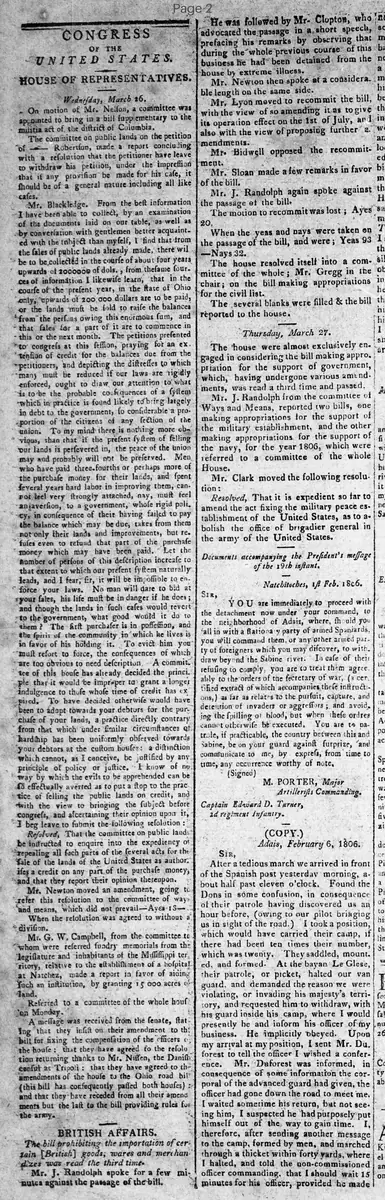
OF THE
UNITED STATES.
HOUSE OF REPRESENTATIVES.
Wednesday, March 26.
On motion of Mr. Nelson, a committee was appointed to bring in a bill supplementary to the militia act of the district of Columbia.
The committee on public lands on the petition of Robertson, made a report concluding with a resolution that the petitioner have leave to withdraw his petition, under the impression that if any provision be made for his case, it should be of a general nature including all like cases.
Mr. Blackledge. From the best information I have been able to collect; by an examination of the documents laid on our table as well as by conversation with gentlemen better acquainted with the subject than myself, I find that from the sales of public lands already made, there will be to be collected in the course of about four years upwards of 200,000 of dollars, from the same source. From sources of information I likewise learn, that in the course of the present year, in the state of Ohio only, upwards of 200,000 dollars are to be paid, or the lands must be sold to raise the balances from the persons owing this enormous sum, and that sales for a part of it are to commence in this or the next month. The petitions presented to Congress at this session, praying for an extension of credit for the balances due from the petitioners, and depicting the distresses to which many must be reduced if our laws are rigidly enforced, ought to draw our attention to what is to be the probable consequences of a system which in practice is found likely to bring largely in debt to the government, so considerable a proportion of the citizens of any section of the union. To my mind there is nothing more obvious, than that if the present system of selling our lands is persevered in, the peace of the union may and probably will not be preserved. Men who have paid three-fourths or perhaps more of the purchase money for their lands, and spent several years hard labor in improving them, cannot feel very strongly attached, nay, must feel an aversion, to a government, whose rigid policy, in consequence of their having failed to pay the balance which may be due, takes from them not only their lands and improvements, but refuses even to refund that part of the purchase money which may have been paid. Let the number of persons of this description increase to that extent to which our present system naturally leads, and I fear, Sir, it will be impossible to enforce your laws. No man will dare to bid at your sales, his life must be in danger if he does; and though the lands in such cases would revert to the government, what good would it do to them? The first purchaser is in possession, and the spirit of the community in which he lives is in favor of his holding it. To evict him you must resort to force, the consequences of which are too obvious to need description. A committee of this house has already decided the principle that it would be improper to grant a longer indulgence to those whose time of credit has expired. To have decided otherwise would have been to adopt towards your debtors for the purchase of your lands, a practice directly contrary from that which under similar circumstances of hardship has been uniformly observed towards your debtors at the custom houses: a distinction which cannot, as I conceive, be justified by any principle of policy or justice. I know of no way by which the evils to be apprehended can be so effectually averted as to put a stop to the practice of selling the public lands on credit, and with the view to bringing the subject before Congress, and ascertaining their opinion upon it, I beg leave to submit the following resolution:
Resolved, That the committee on public lands be instructed to enquire into the expediency of repealing all such parts of the several acts for the sale of the lands of the United States as authorize a credit on any part of the purchase money, and that they report their opinion thereupon.
Mr. Newton moved an amendment, going to refer this resolution to the committee of ways and means, which did not prevail—Ayes 18.
When the resolution was agreed to without a division.
Mr. G. W. Campbell, from the committee to whom were referred sundry memorials from the legislature and inhabitants of the Mississippi territory, relative to the establishment of a hospital at Natchez, made a report in favor of aiding such an institution, by granting 5000 acres of land.
Referred to a committee of the whole house on Monday.
A message was received from the senate, stating that they insist on their amendment to the bill for fixing the compensation of the clerks of the house: that they have agreed to the resolution returning thanks to Mr. Nissen, the Danish consul at Tripoli: that they have agreed to the amendments of the house to the Ohio road bill (this bill has consequently passed both houses): and that they have receded from all their amendments but the last to the bill providing rules for the army.
BRITISH AFFAIRS.
The bill prohibiting the importation of certain British goods, wares and merchandizes was read the third time.
Mr. J. Randolph spoke for a few minutes against the passage of the bill.
He was followed by Mr. Clopton, who advocated the passage in a short speech, prefacing his remarks by observing that business he had been detained from the house by extreme illness during the whole previous course of this business.
Mr. Newton then spoke at a considerable length on the same side.
Mr. Lyon moved to recommit the bill, with the view of so amending it as to give its operation effect on the 1st of July, and also with the view of proposing further amendments.
Mr. Bidwell opposed the recommittal.
Mr. Sloan made a few remarks in favor of the bill.
Mr. J. Randolph again spoke against the passage of the bill.
The motion to recommit was lost; Ayes 20.
When the yeas and nays were taken on the passage of the bill, and were—Yeas 93—Nays 32.
The house resolved itself into a committee of the whole; Mr. Gregg in the chair; on the bill making appropriations for the civil list.
The several blanks were filled & the bill reported to the house.
Thursday, March 27.
The house were almost exclusively engaged in considering the bill making appropriation for the support of government, which, having undergone various amendments, was read a third time and passed.
Mr. J. Randolph from the committee of Ways and Means, reported two bills, one making appropriations for the support of the military establishment, and the other making appropriations for the support of the navy, for the year 1806, which were referred to a committee of the whole House.
Mr. Clark moved the following resolution:
Resolved, That it is expedient so far to amend the act fixing the military peace establishment of the United States, as to abolish the office of brigadier general in the army of the United States.
What sub-type of article is it?
What keywords are associated?
What entities or persons were involved?
Where did it happen?
Domestic News Details
Primary Location
United States House Of Representatives
Event Date
Wednesday, March 26; Thursday, March 27
Key Persons
Outcome
resolution on public lands credit agreed to; bill prohibiting british goods imports passed (yeas 93, nays 32); ohio road bill passed both houses; bill for government support appropriations passed; military and navy appropriations bills reported; resolution on abolishing brigadier general office moved.
Event Details
House proceedings included appointment of committee for militia bill supplementary; report on Robertson's petition allowing withdrawal; Mr. Blackledge's speech on public lands sales credit system leading to resolution instructing committee to inquire into repealing credit provisions; report favoring 5000 acres for Natchez hospital referred; Senate messages on various bills; debate on British goods import prohibition bill with speeches by Randolph, Clopton, Newton, Lyon, Bidwell, Sloan, resulting in passage; committee on civil list appropriations; next day, government support appropriations bill passed after amendments; military and navy appropriations for 1806 reported; motion by Mr. Clark to amend military act abolishing brigadier general.