Thank you for visiting SNEWPapers!
Sign up free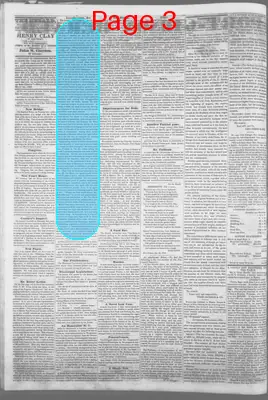
Editorial
February 8, 1844
Port Gibson Herald
Port Gibson, Claiborne County, Mississippi
What is this article about?
This editorial praises the U.S. system's peaceful political revolutions as a safeguard for the Republic, contrasting them with violent ones abroad. It criticizes the Democratic party's corruption under leaders like Martin Van Buren and James Buchanan, accusing them of demagoguery and inconsistency on policies like tariffs and banking, predicting their defeat.
Clipping
OCR Quality
98%
Excellent
Full Text
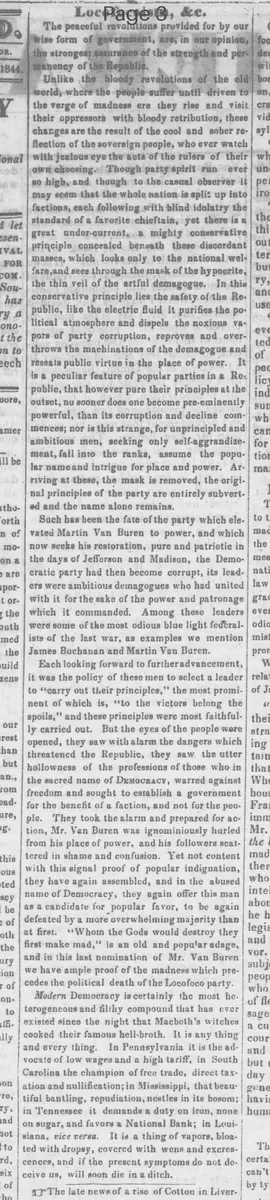
The peaceful revolutions provided for by our wise form of government, are, in our opinion, the strongest assurance of the strength and permanency of the Republic. Unlike the bloody revolutions of the old world, where the people suffer until driven to the verge of madness ere they rise and visit their oppressors with bloody retribution, these changes are the result of the cool and sober reflection of the sovereign people, who ever watch with jealous eye the acts of the rulers of their own choosing. Though party spirit run ever so high, and though to the casual observer it may seem that the whole nation is split up into factions, each following with blind idolatry the standard of a favorite chieftain, yet there is a great under-current, a mighty conservative principle concealed beneath these discordant masses, which looks only to the national welfare, and sees through the mask of the hypocrite, the thin veil of the artful demagogue. In this conservative principle lies the safety of the Republic, like the electric fluid it purifies the political atmosphere and dispels the noxious vapors of party corruption, reproves and overthrows the machinations of the demagogue and reseats public virtue in the place of power. It is a peculiar feature of popular parties in a Republic, that however pure their principles at the outset, no sooner does one become pre-eminently powerful, than its corruption and decline commences; nor is this strange, for unprincipled and ambitious men, seeking only self-aggrandizement, fall into the ranks, assume the popular name and intrigue for place and power. Arriving at these, the mask is removed, the original principles of the party are entirely subverted and the name alone remains. Such has been the fate of the party which elevated Martin Van Buren to power, and which now seeks his restoration, pure and patriotic in the days of Jefferson and Madison, the Democratic party had then become corrupt, its leaders were ambitious demagogues who had united with it for the sake of the power and patronage which it commanded. Among these leaders were some of the most odious blue light federalists of the last war, as examples we mention James Buchanan and Martin Van Buren. Each looking forward to further advancement, it was the policy of these men to select a leader to "carry out their principles," the most prominent of which is, "to the victors belong the spoils," and these principles were most faithfully carried out. But the eyes of the people were opened, they saw with alarm the dangers which threatened the Republic, they saw the utter hollowness of the professions of those who in the sacred name of Democracy, warred against freedom and sought to establish a government for the benefit of a faction, and not for the people. They took the alarm and prepared for action, Mr. Van Buren was ignominiously hurled from his place of power, and his followers scattered in shame and confusion. Yet not content with this signal proof of popular indignation, they have again assembled, and in the abused name of Democracy, they again offer this man as a candidate for popular favor, to be again defeated by a more overwhelming majority than at first. "Whom the Gods would destroy they first make mad," is an old and popular adage, and in this last nomination of Mr. Van Buren we have ample proof of the madness which precedes the political death of the Locofoco party. Modern Democracy is certainly the most heterogeneous and filthy compound that has ever existed since the night that Macbeth's witches cooked their famous hell-broth. It is any thing and every thing. In Pennsylvania it is the advocate of low wages and a high tariff, in South Carolina the champion of free trade, direct taxation and nullification; in Mississippi, that beautiful bantling, repudiation, nestles in its bosom; in Tennessee it demands a duty on iron, none on sugar, and favors a National Bank; in Louisiana, vice versa. It is a thing of vapors, bloated with dropsy, covered with wens and excrescences, and if the present symptoms do not deceive us, will soon die in a ditch.
What sub-type of article is it?
Partisan Politics
What keywords are associated?
Martin Van Buren
Democratic Party
Party Corruption
Partisan Politics
Locofoco Party
Political Demagogues
Republican Principles
What entities or persons were involved?
Martin Van Buren
James Buchanan
Democratic Party
Locofoco Party
Jefferson
Madison
Editorial Details
Primary Topic
Critique Of Democratic Party Corruption And Martin Van Buren
Stance / Tone
Strongly Anti Democratic Party And Anti Van Buren
Key Figures
Martin Van Buren
James Buchanan
Democratic Party
Locofoco Party
Jefferson
Madison
Key Arguments
Peaceful Revolutions Strengthen The Republic Through Sober Reflection
Conservative Principle Underlies National Welfare And Counters Demagoguery
Parties Corrupt Upon Gaining Power As Ambitious Men Subvert Principles
Democratic Party Corrupted From Jefferson Madison Era, Led By Demagogues Like Van Buren And Buchanan
'To The Victors Belong The Spoils' Policy Implemented
People Rejected Van Buren, Predicting Further Defeat
Modern Democracy Inconsistent On Policies Across States
Party Destined For Political Death