Thank you for visiting SNEWPapers!
Sign up free
Norfolk Gazette And Publick Ledger
Norfolk, Virginia
What is this article about?
On June 3, 1813, the U.S. House of Representatives received and referred to the Ways and Means Committee a Treasury report from Acting Secretary Wm. Jones detailing receipts, expenditures, loans, and financial estimates for 1813 and 1814 amid the War of 1812.
Merged-components note: Continuation of the Treasury report across pages 2 and 3.
Clippings
1 of 2
OCR Quality
Full Text
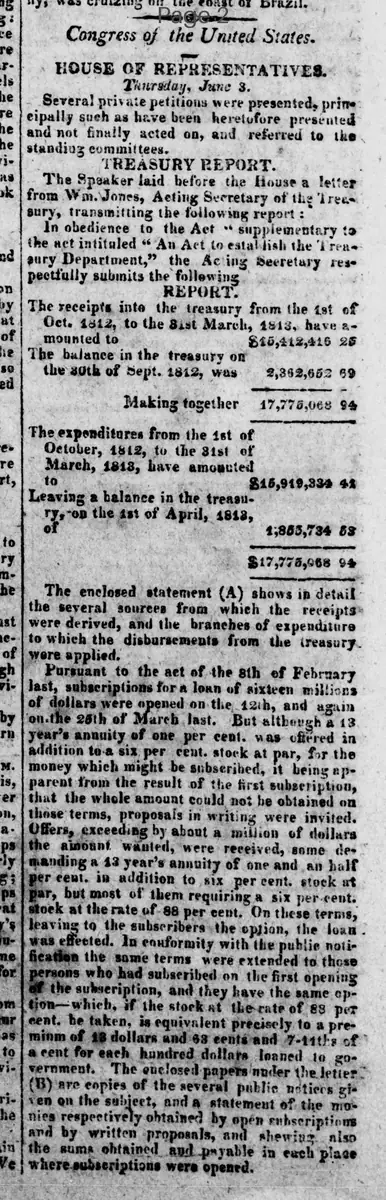
HOUSE OF REPRESENTATIVES.
Thursday, June 3.
Several private petitions were presented, principally such as have been heretofore presented and not finally acted on, and referred to the standing committees.
TREASURY REPORT.
The Speaker laid before the House a letter from Wm. Jones, Acting Secretary of the Treasury, transmitting the following report:
In obedience to the Act "supplementary to the act entitled "An Act to establish the Treasury Department," the Acting Secretary respectfully submits the following
REPORT.
The receipts into the treasury from the 1st of Oct. 1812, to the 31st March, 1813, have amounted to
$16,412,416 25
The balance in the treasury on the 30th of Sept. 1812, was
2,362,652 69
Making together
17,775,068 94
The expenditures from the 1st of October, 1812, to the 31st of March, 1813, have amounted to
$16,919,334 41
Leaving a balance in the treasury, on the 1st of April, 1813, of
$855,734 53
The enclosed statement (A) shows in detail the several sources from which the receipts were derived, and the branches of expenditures to which the disbursements from the treasury were applied.
Pursuant to the act of the 8th of February last, subscriptions for a loan of sixteen millions of dollars were opened on the 12th, and again on the 20th of March last. But although a 13 year's annuity of one per cent. was offered in addition to a six per cent. stock at par, for the money which might be subscribed, it being apparent from the result of the first subscription, that the whole amount could not be obtained on those terms, proposals in writing were invited. Offers, exceeding by about a million of dollars the amount wanted, were received, some demanding a 13 year's annuity of one and an half per cent. in addition to six per cent. stock at par, but most of them requiring a six per cent. stock at the rate of 88 per cent. On these terms, leaving to the subscribers the option, the loan was effected. In conformity with the public notification the same terms were extended to those persons who had subscribed on the first opening of the subscription, and they have the same option--which, if the stock at the rate of 88 per cent. be taken, is equivalent precisely to a premium of 18 dollars and 68 cents and 7-10ths of a cent for each hundred dollars loaned to government. The enclosed papers under the letter (B) are copies of the several public notices given on the subject, and a statement of the monies respectively obtained by open subscriptions and by written proposals, and showing also the sums obtained and payable in each place where subscriptions were opened.
Of that sum of sixteen millions of dollars obtained on loan, there was paid into the treasury, prior to the 1st of April, 1813, the sum of $13,050,737.50, which makes a part of the moneys received previously to that day as stated in the statement (A.)
The resources for the residue of the year 1813 consist of the following items, viz:
1. The remainder of the loan abovementioned $14,913,202.50
2. The sums payable on account of Customs and of the sales of Public lands, estimated at $9,320,000
3. The five millions of dollars in Treasury Notes, authorised by the act of Feb. 25, 1813 $5,000,000
Say Dollars 29,230,000
The expenses for the last nine months of the present year are calculated as followeth, viz:
1. Civil list, and all expenses of a civil nature both foreign and domestic $900,000
2. Payments on account of the principal and interest of the public debt, as per estimate (B) herewith 10,510,000
3. Expenses on account of the War and Navy Departments 17,820,000
$29,230,000
Of the sum of $1,865,734.68, remaining in the treasury on the first of April last, a small part may be considered as applicable to such extraordinary expenses already authorised, as may arise during the remainder of the year; and for the same object, the sum of one million of dollars authorised by an act of the state of Pennsylvania to be loaned to the United States, but which was not offered in time to be accepted as a part of the loan of sixteen millions, may be considered as a resource.
In this estimate the whole sum of five millions of dollars authorised to be issued in Treasury Notes, is taken as a part of the resources of the present year. But as it is not deemed eligible to increase the amount of Treasury Notes in circulation, and as three millions only of those authorised by the act of 1812 were issued in that year and are reimbursable in the course of the present year, it is respectfully suggested that in lieu of issuing two millions of the five millions authorised by the act of February, 1813, congress should authorise an additional loan for the same amount, it being made a condition of such loan that its terms should not be higher than those of the loan of sixteen millions already effected.
The provision already considered is for the service of the present year only; that which will be necessary for the year 1814 requires an early attention. It is difficult to estimate with accuracy the sum which will be received into the Treasury from the revenue as now established. During a state of war, the customs, at the present rate of duties, have been heretofore estimated to produce five millions of dollars. The additional tonnage-duty imposed upon foreign vessels by the act of the 1st of July, 1812, producing about $200,000 a year, is not included in that sum. It is believed that during the year 1814, a greater sum than five millions two hundred thousand dollars ought not to be relied upon as receivable into the Treasury from custom house duties. The sum arising from sale of public lands may be estimated at six hundred thousand dollars, making together $5,800,000.
The interest alone, on the public funded debt, on temporary loans, and on the treasury notes, which will become payable in that year, will amount to four millions four hundred thousand dollars. The other engagements on account of the principal of the funded debt, of temporary loans, and of treasury notes, which will become reimbursable in that year, amount to seven million one hundred and eighty thousand dollars, exceeding together, by more than five millions seven hundred thousand dollars, the estimated amount of the receipts into the treasury derived from the revenue as now established.
This view of the subject is sufficient to evince the necessity of a speedy and effectual provision for the service of that and the ensuing years: The mode and the extent to which this provision should be carried, have been heretofore suggested from this department to congress, and have received the consideration of that body. The expenses of the peace establishment of the United States, and the interest on the public debt, including that on the loans made for the prosecution of the war, are believed to be the least sum that ought, under any circumstances, to be raised within each year. Thereif, if the expenses of the peace establishment are taken as the sum necessary for the ordinary expenditure of the United States previously to the additional armaments made in the year 1812, with a view to an approaching state of war, and including the interest on the loans of the years 1812 and 1813, and also, of that which will probably be necessary in the year 1814, will amount, during that year, to eleven millions four hundred thousand dollars, viz:
The expenses of the peace establishment, exclusive of the additional force authorised by the acts passed during the year 1812, may be estimated at $7,000,000
The interest on the public debt during the year 1814, will be as follows; on old funded debt $2,100,000
On 6 per cent. stock of 1812, including temporary loans received in part of the loan of eleven millions which will remain unpaid in 1814 $1,000,000
On 6 per cent. stock of 1813 $1,090,000
On treasury notes which will be reimbursable in 1814; say on five million, at 5 and 2-5 per cent. $270,000
On the loan for the year 1814, interest payable within that year $400,000
$11,400,000
The revenue now established, being estimated to produce $8,800,000
Would leave to be raised, $5,600,000
To cover the above sum of $11,400,000
The internal taxes heretofore proposed, were estimated to produce $6,000,000
And the duty of 20 cents a bushel on salt imported, which though estimated heretofore at only $100,000 a year, during a state of war; yet, as the consumption considerably exceeds two millions of bushels, may be estimated to produce $600,000
Making the sum wanted $5,600,000
Although the taxes, if early laid, may be brought into operation in the commencement of the year 1814, yet, as they cannot be expected to have their full effect during that year, some auxiliary recourse will be required. This may be found in the sum of $1,500,000 dollars, which is the excess of the Sinking Fund for the present year, over the demands on that fund according to the existing engagements of the United States. This sum of $1,500,000 dollars may be carried to the Sinking Fund for the year 1814, and will be wanted in addition to the annual appropriation of $3,000,000 of dollars, to meet the engagements on account of the public debt which must be fulfilled during that year.
As reliance must be had upon a loan for the war-expenses of the year 1814, the laying of the internal taxes may be considered, with a view to that object, as essentially necessary; in the first place, to facilitate the obtaining of the loan, and 2dly, for procuring it on favorable terms. It is ascertained that the terms of the loan for the present year would have been more favorable if the taxes had been previously laid; and it is obvious enough, that by affording a security for the regular payment of the interest and the eventual reimbursement of the principal, more stable, and less liable to be weakened or cut off by the natural effects of war upon external commerce, than a revenue depending as that of the United States now does almost wholly upon such external commerce, capitalists will advance with the greater readiness and at a lower rate of interest the funds necessary for the prosecution of the war.
Public confidence will be ensured, and the means afforded of preserving the public credit unimpaired—a measure of the utmost importance in a country like ours, where, from the lightness of the demands made upon the people during the continuance of peace, the extraordinary expenses of a state of war can be supplied only by a resort to that credit.
The resources of the country are ample, and if the means now proposed, and those heretofore recommended from this department, are adopted, it is believed they may be fairly and fully brought into action. All which is respectfully submitted.
W. JONES,
Acting Secretary of the Treasury.
Treasury Department, June 2, 1813.
The report was read and referred to the committee of Ways and Means.
What sub-type of article is it?
What keywords are associated?
What entities or persons were involved?
Domestic News Details
Event Date
Thursday, June 3, 1813
Key Persons
Outcome
the report was read and referred to the committee of ways and means.
Event Details
Several private petitions were presented and referred to standing committees. The Speaker laid before the House a letter from Acting Secretary of the Treasury Wm. Jones transmitting a detailed report on treasury receipts ($16,412,416.25 from Oct. 1, 1812 to Mar. 31, 1813), balance ($2,362,652.69 on Sept. 30, 1812), expenditures ($16,919,334.41), leaving a balance of $855,734.53 on April 1, 1813. The report covers a $16 million loan effected at terms including 6% stock at 88% or with annuity premiums, with $13,050,737.50 paid by April 1. Estimates for remainder of 1813 include loan remainder, customs, public lands, and treasury notes totaling $29,230,000 against matching expenses for civil, debt, war, and navy. Suggestions include authorizing additional loan instead of issuing more treasury notes and provisions for 1814 including internal taxes to support loans and maintain public credit.