Thank you for visiting SNEWPapers!
Sign up free
Gazette Of The United States, & Philadelphia Daily Advertiser
Philadelphia, Philadelphia County, Pennsylvania
What is this article about?
In a continuation of his letter to Mr. B. Wynkoop, Dr. William Currie argues that the 1797 Philadelphia yellow fever epidemic originated from foreign contagion imported via ships like the Amelia and sans-culottes privateer from the West Indies, not local effluvia from damaged coffee, citing historical spread and specific circumstances leading to the first cases.
Clipping
OCR Quality
Full Text
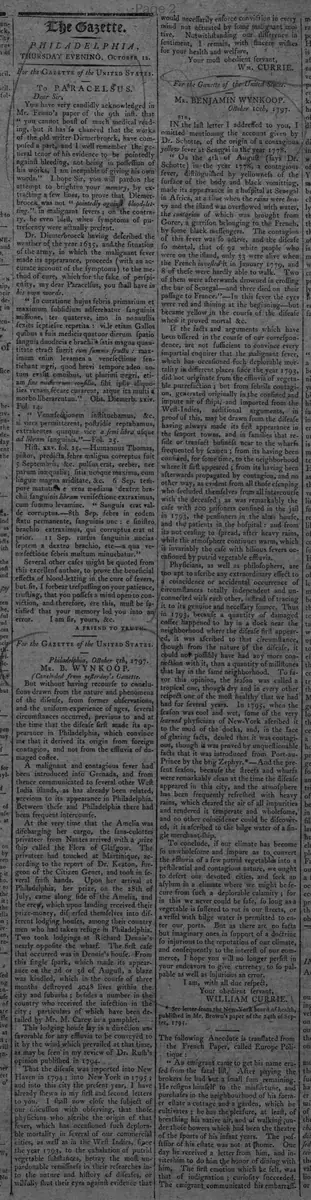
Philadelphia, October 5th, 1797.
MR. B. WYNKOOP.
(Concluded from yesterday's Gazette.)
But without having recourse to conclusions drawn from the nature and phenomena of the disease, from former observations, and the uniform experience of ages, several circumstances occurred, previous to and at the time that the disease first made its appearance in Philadelphia, which convince me that it derived its origin from foreign contagion, and not from the effluvia of damaged coffee.
A malignant and contagious fever had been introduced into Grenada, and from thence communicated to several other West India islands, as has already been related, previous to its appearance in Philadelphia. Between these and Philadelphia there had been frequent intercourse.
At the very time that the Amelia was discharging her cargo, the sans-culottes privateer from Nantes arrived with a prize ship called the Flora of Glasgow. The privateer had touched at Martinique, according to the report of Dr. Kean, surgeon of the Citizen Genet, and took in several fresh hands. Upon her arrival at Philadelphia, her prize, on the 28th of July, came alongside of the Amelia, and the crew, which upon landing received their prize-money, dispersed themselves into different lodging houses, among their countrymen who had taken refuge in Philadelphia. Two took lodgings at Richard Dennie's nearly opposite the wharf. The first case that occurred was in Dennie's house. From this single spark, which made its appearance on the 2d or 3d of August, a blaze was kindled, which in the course of three months destroyed 4048 lives within the city and suburbs; besides a number in the country who received the infection in the city; particulars of which have been detailed by Mr. M. Carey in a pamphlet.
This lodging house lay in a direction unfavorable for any effluvia to be conveyed to it by the wind which prevailed at that time, as may be seen in my review of Dr. Rush's opinion published in 1794.
That the disease was imported into New Haven in 1794; into New York in 1795; and into this city the present year, I have already shown in my first and second letters to you. I shall now close the subject of our discussion with observing, that those physicians who ascribe the origin of that fever, which has occasioned such deplorable mortality in several of our commercial cities, as well as in the West Indies, since the year 1793, to the exhalation of putrid vegetable substances, betray the most unpardonable remissness in their researches into the nature and history of diseases, or wilfully shut their eyes against evidence that would necessarily enforce conviction in every mind not actuated by some malignant motive. Notwithstanding our difference in sentiment, I remain, with sincere wishes for your health and welfare,
Your most obedient servant,
WM. CURRIE.
What sub-type of article is it?
What themes does it cover?
What keywords are associated?
What entities or persons were involved?
Letter to Editor Details
Author
Wm. Currie
Recipient
Mr. B. Wynkoop
Main Argument
the philadelphia fever of 1797 originated from foreign contagion imported via ships from the west indies, not from local effluvia of damaged coffee, as evidenced by the timing of ship arrivals, spread from grenada, and the first cases among crew lodging nearby.
Notable Details
- malignant fever introduced to grenada and west india islands
- sans-culottes privateer from nantes arrived with prize flora of glasgow on july 28
- crew lodged at richard dennie's house
- first case on august 2d or 3d
- 4048 lives lost in three months per mr. m. carey's pamphlet
- critique of dr. rush's 1794 opinion
- disease imported to new haven 1794, new york 1795