Thank you for visiting SNEWPapers!
Sign up free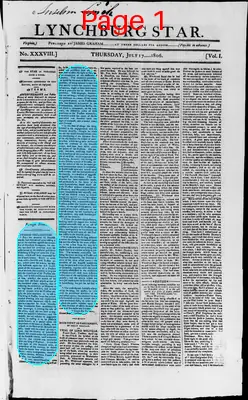
Lynchburg Star
Lynchburg, Virginia
What is this article about?
The King of Sweden issues a declaration viewing Prussian troops' forcible occupation of Lauenburg as an act of hostility, orders an embargo on Prussian vessels in Swedish ports, and reaffirms protection of British Hanoverian possessions amid coalition against Napoleon.
Clipping
OCR Quality
Full Text
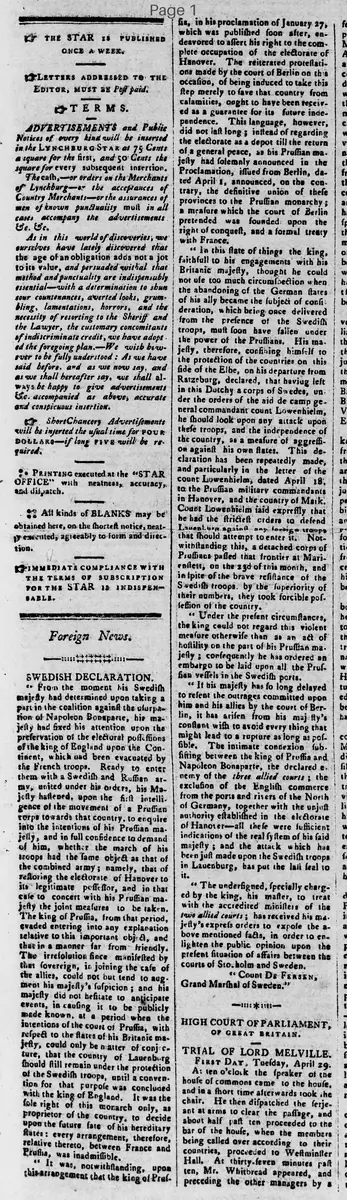
SWEDISH DECLARATION.
From the moment his Swedish
majesty had determined upon taking a
part in the coalition against the usurpa-
tion of Napoleon Bonaparte, his ma-
jesty had fixed his attention upon the
preservation of the electoral possessions
of the king of England upon the Con-
tinent, which had been evacuated by
the French troops. Ready to enter
them with a Swedish and Russian ar-
my, united under his orders, his Ma-
jesty hastened, upon the first intelli-
gence of the movement of a Prussian
corps towards that country, to enquire
into the intentions of his Prussian ma-
jesty, and in full confidence to demand
of him, whether the march of his
troops had the same object as that of
the combined army; namely, that of
restoring the electorate of Hanover to
its legitimate power, and in that
case to concert with his Prussian ma-
jesty the joint measures to be taken.
The king of Prussia, from that period,
evaded entering into any explanation
relative to this important object, and
there in a manner far from friendly.
The irresolution since manifested by
that sovereign, in joining the cause of
the allies, could not but tend to aug-
ment his majesty's suspicion; and his
majesty did not hesitate to anticipate
events, in causing it to be publicly
made known, at a period when the
intentions of the court of Prussia, with
respect to the affairs of his Britannic ma-
jesty, could only be matter of conjec-
ture, that the country of Lauenburg
should still remain under the protection
of the Swedish troops, until a conven-
tion for that purpose was concluded
with the king of England. It was the
sole right of this monarch only, as
proprietor of the country, to decide
upon the future fate of his hereditary
states: every arrangement, therefore,
relative thereto, between France and
Prussia, was inadmissible.
"It was, notwithstanding, upon
this arrangement that the king of Prus-
sia, in his proclamation of January 27,
which was published soon after, en-
deavored to assert his right to the com-
plete occupation of the electorate of
Hanover. The reiterated protesta-
tions made by the court of Berlin on this
occasion, of being induced to take this
step merely to save that country from
calamities, ought to have been received
as a guarantee for its future inde-
pendence. This language, however,
did not last long; instead of regarding
the electorate as a deposit till the return
of a general peace, as his Prussian ma-
jesty had solemnly announced in the
Proclamation, issued from Berlin, da-
ted April 1, announced, on the con-
trary, the definitive union of these
provinces to the Prussian monarchy;
a measure which the court of Berlin
pretended was founded upon the
right of conquest, and a formal treaty
with France.
"In this state of things the king,
faithful to his engagements with his
Britannic majesty, thought he could
not use too much circumspection when
the abandoning of the German states
of his ally became the subject of consi-
deration, which being once delivered
from the presence of the Swedish
troops, must soon have fallen under
the power of the Prussians. His ma-
jesty, therefore, confining himself to
the protection of the countries on this
side of the Elbe, on his departure from
Ratzeburg, declared, that having left
in this Duchy a corps of Swedes, un-
der the orders of the aid-de-camp ge-
neral commandant count Lowenhielm,
he should look upon any attack upon
these troops, and the independence of
the country, as a measure of aggres-
sion against his own states. This de-
claration has been repeatedly made,
and particularly in the letter of the
count Lowenhielm, dated April 18,
to the Prussian military commandants
in Hanover, and the country of Mecklenburg. Count Lowenhielm said expressly that
he had the strictest orders to defend
Lauenburg against any foreign troops
that should attempt to enter it. Not-
withstanding this, a detached corps of
Prussians passed that frontier at Mari-
stadt, on the 22d of this month, and
in spite of the brave resistance of the
Swedish troops, by the superiority of
their numbers, they took forcible pos-
session of the country.
"Under the present circumstances,
the king could not regard this violent
measure otherwise than as an act of
hostility on the part of his Prussian ma-
jesty; consequently he has ordered an
embargo to be laid upon all the Prus-
sian vessels in the Swedish ports.
"If his majesty has so long delayed
to resent the outrages committed upon
him and his allies by the court of Ber-
lin, it has arisen from his majesty's
constant wish to avoid every thing that
might lead to a rupture as long as pos-
sible. The intimate connexion sub-
sisting between the king of Prussia and
Napoleon Bonaparte, the declared e-
emy of the three allied courts; the
exclusion of the English commerce
from the ports and rivers of the North
of Germany, together with the unjust
authority established in the electorate
of Hanover--all these were sufficient
indications of the real system of his said
majesty; and the attack which has
been just made upon the Swedish troops
in Lauenburg, has put the last seal to
it.
"The undersigned, specially charg-
ed by the king, his master, to treat
with the accredited ministers of the
two allied courts; has received his ma-
jesty's express orders to expose the a-
bove mentioned facts, in order to en-
lighten the public opinion upon the
present situation of affairs between the
courts of St. Petersburg and Sweden.
"Count D'Eg-Fersen,
Grand Marshal of Sweden."
What sub-type of article is it?
What keywords are associated?
What entities or persons were involved?
Where did it happen?
Foreign News Details
Primary Location
Lauenburg
Event Date
22d Of This Month (April)
Key Persons
Outcome
prussian troops took forcible possession of lauenburg despite swedish resistance; embargo ordered on all prussian vessels in swedish ports; declaration of hostility.
Event Details
The King of Sweden, committed to the coalition against Napoleon, sought to protect British Hanoverian possessions. Suspecting Prussian intentions, he protected Lauenburg with Swedish troops. Despite warnings, Prussians occupied Lauenburg on April 22, leading to the embargo and viewing it as an act of hostility.