Thank you for visiting SNEWPapers!
Sign up free
Literary
March 2, 1868
The Daily Dispatch
Richmond, Virginia
What is this article about?
Narrator loses way in stormy woods on October 17th, finds shelter at robbers' den, sees apparition of wife Berenice who saves him from murder by distracting him at the moment she faints in Italy. Escapes and alerts police; house deserted.
Clipping
OCR Quality
95%
Excellent
Full Text
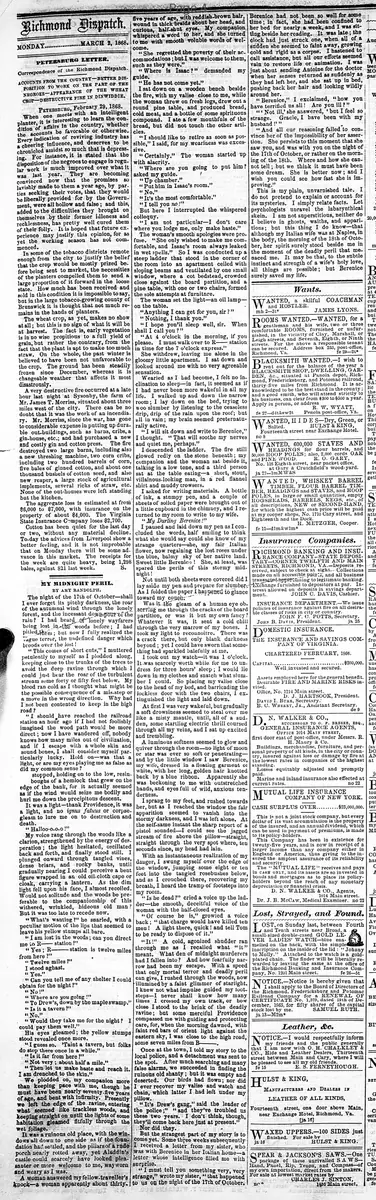
MY MIDNIGHT PERIL
BY AMY RANDOLPH.
The night of the 17th of October—shall I ever forget its pitchy darkness, the roar of the autumnal wind through the lonely forest, and the incessant down-pour of the rain? I had heard of lonely wayfarers being lost in the woods before; I had pitied them; but now I fully realized the vague terror, the undefined danger which broods over the lost!
"This comes of short cuts," I muttered petulantly to myself as I plodded along, keeping close to the trunks of the trees to avoid the deep ravine through which I could just hear the roar of the turbulent stream some forty or fifty feet below. My blood ran cold as I thought what might be the possible consequence of a mis-step or a move in the wrong direction. Why had I not been contented to keep in the high road?
"I should have reached the railroad station an hour ago if I had not foolishly imagined the wood path would be more direct; now I have wandered off, nobody knows how many miles out of civilization, and if I escape with a whole skin and sound bones, I shall consider myself particularly lucky. Hold on—was that a light, or are my eyes playing me as false as did my common sense?"
I stopped, holding on to the low, resinous boughs of a hemlock that grew on the edge of the bank, for it actually seemed as if the wind would seize me bodily and hurl me down the precipitous descent.
It was a light—thank Providence, it was a light, and no ignis fatuus or corpse-gleam to lure me on to destruction and death.
"Halloo-o-o!"
My voice rang through the woods like a clarion, strengthened by the energy of desperation; the light hesitated, oscillated back and forth, and finally stood still. I plunged onward through tangled vines, dense briars, and rocky banks, until gradually nearing I could perceive a bent figure wrapped in an old oil-cloth cape or cloak, carrying a lantern. As the dim light fell upon his face, I almost recoiled. Would not solitude and the woods be preferable to the companionship of this withered, wrinkled, hideous old man?
But it was too late to recede now.
"What's wanting?" he snarled, with a peculiar motion of the lips that seemed to leave his yellow stumps all bare.
"I am lost in the woods; can you direct me to R—station?"
"Yes; R—station is twelve miles from here."
"Twelve miles?"
I stood aghast.
"Yes."
"Can you tell me of any shelter I could obtain for the night?"
"No!"
"Where are you going?"
"To Drew's, down by the maple swamp."
"Is it a tavern?"
"No."
"Would they take me for the night? I could pay them well."
His eyes gleamed; the yellow stumps stood revealed once more.
"I guess so. Taint a tavern, but folks do stop there once in a while."
"Is it far from here?"
"Not very; about half a mile."
"Then let us make haste and reach it. I am drenched to the skin."
We plodded on, my companion more than keeping pace with me, though he must have been nearly seventy-five years of age, and bent with infirmity. Presently we left the edge of the ravine, entering what seemed like trackless woods, and keeping straight on until the lights of some habitation gleamed fitfully through the wet foliage.
It was a ruinous old place, with the windows all down to one side as if the foundation had settled, and the pillars of a rude porch nearly rotted away, yet Aladdin's castle could scarcely have looked pleasanter or more welcome to me, wayworn and weary as I was.
A woman answered my fellow-traveller's knock—woman apparently about thirty-five years of age, with reddish-brown hair, wound in thick braids about her head, and curious, half-shut eyes. My companion whispered a word to her, and she turned to me with smooth, voluble words of welcome.
"She regretted the poverty of their accommodations; but I was welcome to them, such as they were."
"Where is Isaac?" demanded my guide.
"He has not come yet."
I sat down on a wooden bench beside the fire, with my valise close to me, while the woman threw on fresh logs, drew out a round pine table, and produced bread, cold meat, and a bottle of some spirituous compound. I ate a few mouthfuls of the bread, but did not touch the other articles.
"I should like to retire as soon as possible," I said, for my weariness was excessive.
"Certainly." The woman started up with alacrity.
"Where are you going to put him?" asked my guide.
"Up chamber."
"Put him in Isaac's room."
"No."
"It's the most comfortable."
"I tell you no!"
But here I interrupted the whispered colloquy.
"I am not particular—I don't care where you lodge me, only make haste."
The woman's smooth apologies were profuse. "She only wished to make me comfortable, and Isaac's room always leaked in wet spells." So I was conducted up a steep ladder that stood in the corner of the room into an apartment ceiled with sloping beams and ventilated by one small window, where a cot bedstead, crowded close against the board partition, and a pine table, with one or two chairs, formed the sole attempts at furniture.
The woman set the light—an oil lamp—on the table.
"Anything I can get for you, sir?"
"Nothing. I thank you."
"I hope you'll sleep well, sir. When shall I call you?"
"At 4 o'clock in the morning, if you please. I must walk over to R—station in time for the 7 o'clock express."
She withdrew, leaving me alone in the gloomy little apartment. I sat down and looked around me with no very agreeable sensation. Wearied as I had become, I felt no inclination to sleep—in fact, it seemed as if I had never been more wakeful in all my life. I walked up and down the narrow room; I lay down on the bed, trying to woo slumber by listening to the ceaseless drip, drip of the rain upon the roof; but all in vain; my brain seemed preternaturally active.
"I will sit down and write to Berenice," I thought. "That will soothe my nerves and quiet me, perhaps."
I descended the ladder. The fire still glowed redly on the stone beneath; my companion and the woman sat beside it, talking in a low tone, and a third person sat at the table eating—a short, stout, villainous-looking man, in a red flannel shirt and muddy trowsers.
I asked for writing materials. A bottle of ink, a stumpy pen, and a couple of sheets of soiled paper were brought out of a little cupboard in the chimney, and I returned to my room to write to my wife.
"My Darling Berenice!"
I paused and laid down my pen as I concluded the words, half smiling to think what she would say could she know of my strange quarters—she, my fair Italian flower, now regaining the lost roses under the blue, balmy sky of her native land. Sweet little Berenice! She, at least, was spared the perils of this stormy midnight!
Not until both sheets were covered did I lay aside my pen and prepare for slumber. As I folded the paper I happened to glance toward my couch:
Was it the gleam of a human eye observing me through the cracks of the board partition, or was it but my own fancy? Whatever it was, it sent a cold chill through the very marrow of my bones. I took my light to reconnoitre. There was a crack there, but only blank darkness beyond; yet I could have sworn that something had sparkled balefully at me.
I took out my watch—it was 1 o'clock. It was scarcely worth while for me to undress for three hours' sleep; I would lie down in my clothes and snatch what slumber I could. So placing my valise close to the head of my bed, and barricading the lockless door with the two chairs, I extinguished the light and laid down.
At first I was very wakeful, but gradually a soft drowsiness seemed to steal over me like a misty mantle, until, all of a sudden, some startling electric thrill coursed through all my veins, and I sat up excited and trembling.
A luminous softness seemed to glow and quiver through the room—no light of moon or star was ever so soft or penetrating—and by the little window I saw Berenice, my wife, dressed in a floating garment of white, with her long, golden hair knotted back by a blue ribbon. Apparently she was beckoning to me with outstretched hands, and eyes full of wild, anxious tenderness.
I sprang to my feet, and rushed towards her, but as I reached the window the fair apparition seemed to vanish into the stormy darkness, and I was left alone. At the self-same instant the sharp report of a pistol sounded—I could see the jagged stream of fire above the pillow—straight, straight through the very spot where, ten seconds since, my head had lain.
With an instantaneous realization of my danger, I swung myself over the edge of the window, jumping some eight or ten feet into the tangled rosebushes below, and as I crouched there, recovering my breath, I heard the tramp of footsteps into my room.
"Is he dead?" cried a voice up the ladder—the smooth, deceitful voice of the woman with the half-closed eyes.
"Of course he is," growled a voice back; "that charge would have killed ten men! A light there, quick! and tell Tom to be ready to dispose of it."
"It!" A cold, agonized shudder ran through me as I recalled what "it" meant. What den of midnight murderers had I fallen into? And how fearfully narrow had been my escape. With a speed that only mortal terror and deadly peril can give, I rushed through the woods, now illumined by a faint glimmer of starlight. I knew not what impulse guided my footsteps—I never shall know how many times I crossed my own track, or how close I stood to the brink of the deadly ravine; but some merciful Providence compassed me with guiding and protecting care, for, when the morning dawned, with faint red bars of orient light against the eastern sky, I was close to the high road; some seven miles from B—.
Once at the town, I told my story to the local police, and a detachment was sent to the spot. After much searching and many false alarms, we succeeded in finding the ruinous old shanty; but it was empty and deserted. Our birds had flown; nor did I ever recover my valise and watch and chain, which latter I had left under my pillow.
"It's Drew's gang," said the leader of the police; "and they've troubled us these two years. I don't think, though, they'll come back here just at present."
Nor did they.
But the strangest part of my story is to come yet. Some three weeks subsequently I received a letter from my sister, who was with Berenice in her Italian home—a letter whose intelligence filled me with surprise.
"I must tell you something very, very strange," wrote my sister, "that happened to us on the night of the 17th of October. Berenice had not been so well for some time: in fact, she had been confined to her bed for nearly a week, and I was sitting beside her reading. It was late; the clock had just struck one, when all of a sudden she seemed to faint away, growing cold and rigid as a corpse. I hastened to call assistance, but all our efforts seemed vain to restore life or animation. I was just about sending Antoine for the doctor when her senses returned as suddenly as they had left her, and she sat up in bed, pushing back her hair and looking wildly around her.
"Berenice," I exclaimed, "how you have terrified us all! Are you ill?"
"Not ill," she answered, "but I feel so strange. Gracie, I have been with my husband!"
And all our reasoning failed to convince her of the impossibility of her assertion. She persists to this moment that she saw you, and was with you on the night of the 17th of October, or rather on the morning of the 18th. Where and how she cannot tell; but we think it must have been some dream. She is better now; and I wish you could see how fast she is improving."
This is my plain, unvarnished tale. I do not pretend to explain or account for its mysteries. I simply relate facts. Let psychologists unravel the labyrinthical skein. I am not superstitious, neither do I believe in ghosts, wraiths, and apparitions; but this thing I do know—that although my Italian wife was at Naples, in the body, the morning of the 18th of October, her spirit surely stood beside me in the moment of the deadly peril that menaced me. It may be that, to the subtle instinct and strength of a wife's holy love, all things are possible; but Berenice surely saved my life.
BY AMY RANDOLPH.
The night of the 17th of October—shall I ever forget its pitchy darkness, the roar of the autumnal wind through the lonely forest, and the incessant down-pour of the rain? I had heard of lonely wayfarers being lost in the woods before; I had pitied them; but now I fully realized the vague terror, the undefined danger which broods over the lost!
"This comes of short cuts," I muttered petulantly to myself as I plodded along, keeping close to the trunks of the trees to avoid the deep ravine through which I could just hear the roar of the turbulent stream some forty or fifty feet below. My blood ran cold as I thought what might be the possible consequence of a mis-step or a move in the wrong direction. Why had I not been contented to keep in the high road?
"I should have reached the railroad station an hour ago if I had not foolishly imagined the wood path would be more direct; now I have wandered off, nobody knows how many miles out of civilization, and if I escape with a whole skin and sound bones, I shall consider myself particularly lucky. Hold on—was that a light, or are my eyes playing me as false as did my common sense?"
I stopped, holding on to the low, resinous boughs of a hemlock that grew on the edge of the bank, for it actually seemed as if the wind would seize me bodily and hurl me down the precipitous descent.
It was a light—thank Providence, it was a light, and no ignis fatuus or corpse-gleam to lure me on to destruction and death.
"Halloo-o-o!"
My voice rang through the woods like a clarion, strengthened by the energy of desperation; the light hesitated, oscillated back and forth, and finally stood still. I plunged onward through tangled vines, dense briars, and rocky banks, until gradually nearing I could perceive a bent figure wrapped in an old oil-cloth cape or cloak, carrying a lantern. As the dim light fell upon his face, I almost recoiled. Would not solitude and the woods be preferable to the companionship of this withered, wrinkled, hideous old man?
But it was too late to recede now.
"What's wanting?" he snarled, with a peculiar motion of the lips that seemed to leave his yellow stumps all bare.
"I am lost in the woods; can you direct me to R—station?"
"Yes; R—station is twelve miles from here."
"Twelve miles?"
I stood aghast.
"Yes."
"Can you tell me of any shelter I could obtain for the night?"
"No!"
"Where are you going?"
"To Drew's, down by the maple swamp."
"Is it a tavern?"
"No."
"Would they take me for the night? I could pay them well."
His eyes gleamed; the yellow stumps stood revealed once more.
"I guess so. Taint a tavern, but folks do stop there once in a while."
"Is it far from here?"
"Not very; about half a mile."
"Then let us make haste and reach it. I am drenched to the skin."
We plodded on, my companion more than keeping pace with me, though he must have been nearly seventy-five years of age, and bent with infirmity. Presently we left the edge of the ravine, entering what seemed like trackless woods, and keeping straight on until the lights of some habitation gleamed fitfully through the wet foliage.
It was a ruinous old place, with the windows all down to one side as if the foundation had settled, and the pillars of a rude porch nearly rotted away, yet Aladdin's castle could scarcely have looked pleasanter or more welcome to me, wayworn and weary as I was.
A woman answered my fellow-traveller's knock—woman apparently about thirty-five years of age, with reddish-brown hair, wound in thick braids about her head, and curious, half-shut eyes. My companion whispered a word to her, and she turned to me with smooth, voluble words of welcome.
"She regretted the poverty of their accommodations; but I was welcome to them, such as they were."
"Where is Isaac?" demanded my guide.
"He has not come yet."
I sat down on a wooden bench beside the fire, with my valise close to me, while the woman threw on fresh logs, drew out a round pine table, and produced bread, cold meat, and a bottle of some spirituous compound. I ate a few mouthfuls of the bread, but did not touch the other articles.
"I should like to retire as soon as possible," I said, for my weariness was excessive.
"Certainly." The woman started up with alacrity.
"Where are you going to put him?" asked my guide.
"Up chamber."
"Put him in Isaac's room."
"No."
"It's the most comfortable."
"I tell you no!"
But here I interrupted the whispered colloquy.
"I am not particular—I don't care where you lodge me, only make haste."
The woman's smooth apologies were profuse. "She only wished to make me comfortable, and Isaac's room always leaked in wet spells." So I was conducted up a steep ladder that stood in the corner of the room into an apartment ceiled with sloping beams and ventilated by one small window, where a cot bedstead, crowded close against the board partition, and a pine table, with one or two chairs, formed the sole attempts at furniture.
The woman set the light—an oil lamp—on the table.
"Anything I can get for you, sir?"
"Nothing. I thank you."
"I hope you'll sleep well, sir. When shall I call you?"
"At 4 o'clock in the morning, if you please. I must walk over to R—station in time for the 7 o'clock express."
She withdrew, leaving me alone in the gloomy little apartment. I sat down and looked around me with no very agreeable sensation. Wearied as I had become, I felt no inclination to sleep—in fact, it seemed as if I had never been more wakeful in all my life. I walked up and down the narrow room; I lay down on the bed, trying to woo slumber by listening to the ceaseless drip, drip of the rain upon the roof; but all in vain; my brain seemed preternaturally active.
"I will sit down and write to Berenice," I thought. "That will soothe my nerves and quiet me, perhaps."
I descended the ladder. The fire still glowed redly on the stone beneath; my companion and the woman sat beside it, talking in a low tone, and a third person sat at the table eating—a short, stout, villainous-looking man, in a red flannel shirt and muddy trowsers.
I asked for writing materials. A bottle of ink, a stumpy pen, and a couple of sheets of soiled paper were brought out of a little cupboard in the chimney, and I returned to my room to write to my wife.
"My Darling Berenice!"
I paused and laid down my pen as I concluded the words, half smiling to think what she would say could she know of my strange quarters—she, my fair Italian flower, now regaining the lost roses under the blue, balmy sky of her native land. Sweet little Berenice! She, at least, was spared the perils of this stormy midnight!
Not until both sheets were covered did I lay aside my pen and prepare for slumber. As I folded the paper I happened to glance toward my couch:
Was it the gleam of a human eye observing me through the cracks of the board partition, or was it but my own fancy? Whatever it was, it sent a cold chill through the very marrow of my bones. I took my light to reconnoitre. There was a crack there, but only blank darkness beyond; yet I could have sworn that something had sparkled balefully at me.
I took out my watch—it was 1 o'clock. It was scarcely worth while for me to undress for three hours' sleep; I would lie down in my clothes and snatch what slumber I could. So placing my valise close to the head of my bed, and barricading the lockless door with the two chairs, I extinguished the light and laid down.
At first I was very wakeful, but gradually a soft drowsiness seemed to steal over me like a misty mantle, until, all of a sudden, some startling electric thrill coursed through all my veins, and I sat up excited and trembling.
A luminous softness seemed to glow and quiver through the room—no light of moon or star was ever so soft or penetrating—and by the little window I saw Berenice, my wife, dressed in a floating garment of white, with her long, golden hair knotted back by a blue ribbon. Apparently she was beckoning to me with outstretched hands, and eyes full of wild, anxious tenderness.
I sprang to my feet, and rushed towards her, but as I reached the window the fair apparition seemed to vanish into the stormy darkness, and I was left alone. At the self-same instant the sharp report of a pistol sounded—I could see the jagged stream of fire above the pillow—straight, straight through the very spot where, ten seconds since, my head had lain.
With an instantaneous realization of my danger, I swung myself over the edge of the window, jumping some eight or ten feet into the tangled rosebushes below, and as I crouched there, recovering my breath, I heard the tramp of footsteps into my room.
"Is he dead?" cried a voice up the ladder—the smooth, deceitful voice of the woman with the half-closed eyes.
"Of course he is," growled a voice back; "that charge would have killed ten men! A light there, quick! and tell Tom to be ready to dispose of it."
"It!" A cold, agonized shudder ran through me as I recalled what "it" meant. What den of midnight murderers had I fallen into? And how fearfully narrow had been my escape. With a speed that only mortal terror and deadly peril can give, I rushed through the woods, now illumined by a faint glimmer of starlight. I knew not what impulse guided my footsteps—I never shall know how many times I crossed my own track, or how close I stood to the brink of the deadly ravine; but some merciful Providence compassed me with guiding and protecting care, for, when the morning dawned, with faint red bars of orient light against the eastern sky, I was close to the high road; some seven miles from B—.
Once at the town, I told my story to the local police, and a detachment was sent to the spot. After much searching and many false alarms, we succeeded in finding the ruinous old shanty; but it was empty and deserted. Our birds had flown; nor did I ever recover my valise and watch and chain, which latter I had left under my pillow.
"It's Drew's gang," said the leader of the police; "and they've troubled us these two years. I don't think, though, they'll come back here just at present."
Nor did they.
But the strangest part of my story is to come yet. Some three weeks subsequently I received a letter from my sister, who was with Berenice in her Italian home—a letter whose intelligence filled me with surprise.
"I must tell you something very, very strange," wrote my sister, "that happened to us on the night of the 17th of October. Berenice had not been so well for some time: in fact, she had been confined to her bed for nearly a week, and I was sitting beside her reading. It was late; the clock had just struck one, when all of a sudden she seemed to faint away, growing cold and rigid as a corpse. I hastened to call assistance, but all our efforts seemed vain to restore life or animation. I was just about sending Antoine for the doctor when her senses returned as suddenly as they had left her, and she sat up in bed, pushing back her hair and looking wildly around her.
"Berenice," I exclaimed, "how you have terrified us all! Are you ill?"
"Not ill," she answered, "but I feel so strange. Gracie, I have been with my husband!"
And all our reasoning failed to convince her of the impossibility of her assertion. She persists to this moment that she saw you, and was with you on the night of the 17th of October, or rather on the morning of the 18th. Where and how she cannot tell; but we think it must have been some dream. She is better now; and I wish you could see how fast she is improving."
This is my plain, unvarnished tale. I do not pretend to explain or account for its mysteries. I simply relate facts. Let psychologists unravel the labyrinthical skein. I am not superstitious, neither do I believe in ghosts, wraiths, and apparitions; but this thing I do know—that although my Italian wife was at Naples, in the body, the morning of the 18th of October, her spirit surely stood beside me in the moment of the deadly peril that menaced me. It may be that, to the subtle instinct and strength of a wife's holy love, all things are possible; but Berenice surely saved my life.
What sub-type of article is it?
Prose Fiction
Vision Or Dream
What themes does it cover?
Love Romance
Death Mortality
Religious
What keywords are associated?
Midnight Peril
Lost In Woods
Apparition Vision
Wife Saves Life
Robbers Den
Supernatural Intervention
Providence
October Storm
What entities or persons were involved?
By Amy Randolph.
Literary Details
Title
My Midnight Peril
Author
By Amy Randolph.
Key Lines
A Luminous Softness Seemed To Glow And Quiver Through The Room—No Light Of Moon Or Star Was Ever So Soft Or Penetrating—And By The Little Window I Saw Berenice, My Wife, Dressed In A Floating Garment Of White, With Her Long, Golden Hair Knotted Back By A Blue Ribbon. Apparently She Was Beckoning To Me With Outstretched Hands, And Eyes Full Of Wild, Anxious Tenderness.
Her Spirit Surely Stood Beside Me In The Moment Of The Deadly Peril That Menaced Me. It May Be That, To The Subtle Instinct And Strength Of A Wife's Holy Love, All Things Are Possible; But Berenice Surely Saved My Life.
It Was A Light—Thank Providence, It Was A Light, And No Ignis Fatuus Or Corpse Gleam To Lure Me On To Destruction And Death.
"Gracie, I Have Been With My Husband!"
What Den Of Midnight Murderers Had I Fallen Into? And How Fearfully Narrow Had Been My Escape.