Thank you for visiting SNEWPapers!
Sign up free
The New Hampshire Gazette And Historical Chronicle
Portsmouth, Greenland, Rockingham County, New Hampshire
What is this article about?
Major Thomas Adams reports on British military campaign in Bengal from July to September 1763, defeating forces of Nabob Casim Ali Cawn in several engagements, capturing artillery and forcing retreat to Patna, with detailed casualties and ordnance seized.
Clipping
OCR Quality
Full Text
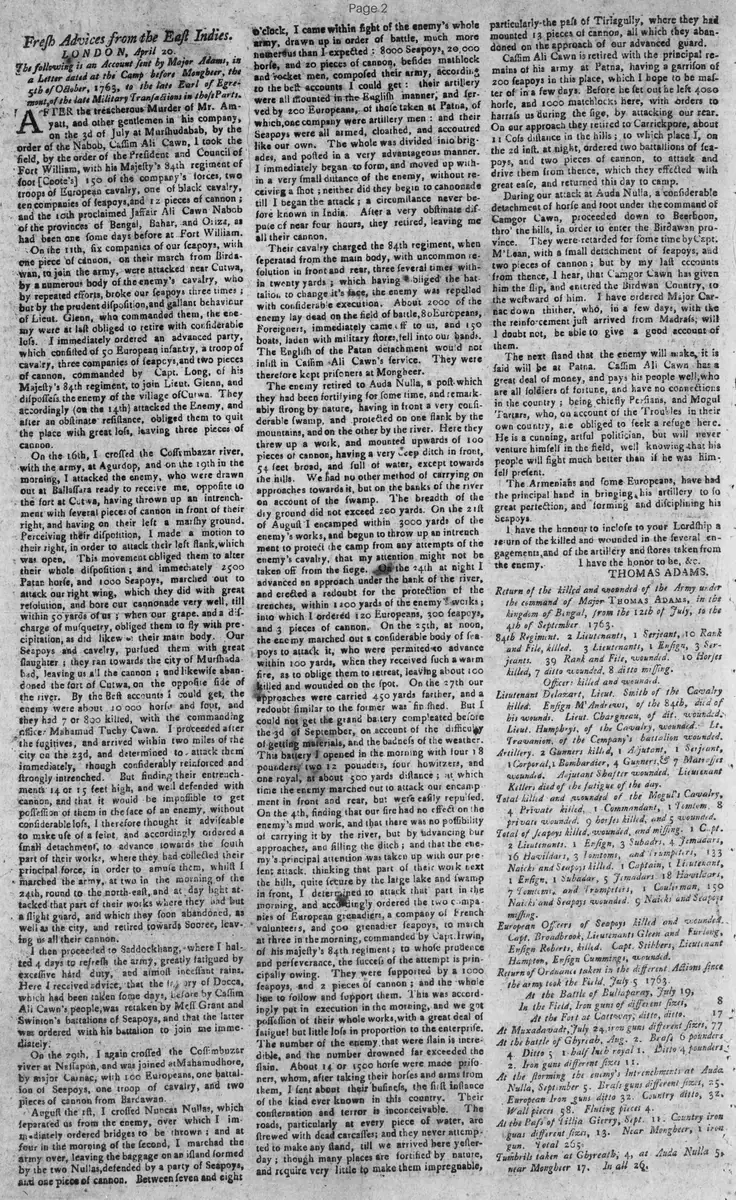
The following is an Account Sent by Major Adams, in a Letter dated at the Camp before Mongheer, the 5th of October, 1763, to the late Earl of Egremont
AFTER the treacherous Murder of Mr. Amyatt, and other gentlemen in his company, on the 3d of July at Murshidabad, by the order of the Nabob, Caim Ali Cawn, I took the field, by the order of the President and Council of Fort William, with his Majesty's 84th regiment of foot [Coote's] 1200 of the company's forces, two troops of European cavalry, one of black cavalry, ten companies of seapoys, and 12 pieces of cannon; and the 10th proclaimed Jaffair Ali Cawn Nabob of the provinces of Bengal, Bahar, and Orixa, as had been done some days before at Fort William.
On the 11th, six companies of our seapoys, with one piece of cannon, on their march from Burdwan, to join the army, were attacked near Cutwa, by a numerous body of the enemy's cavalry, who by repeated efforts, broke our seapoys three times; but by the prudent disposition and gallant behaviour of Lieut. Glenn, who commanded them, the enemy were at last obliged to retire with considerable loss. I immediately ordered an advanced party, which consisted of 200 European infantry, a troop of cavalry, three companies of seapoys, and two pieces of cannon, commanded by Capt. Long, of his Majesty's 84th regiment, to join Lieut. Glenn, and accordingly (on the 14th) attacked the Enemy, and after an obstinate resistance, obliged them to quit the place with great loss, leaving three pieces of cannon.
On the 16th, I crossed the Cossimbazar river with the army, at Agurdip, and on the 19th in the morning, I attacked the enemy, who were drawn out at Ballara ready to receive me, opposite to the fort at Cutwa, having thrown up an intrenchment with several pieces of cannon in front of their right, and having on their left a marshy ground. Perceiving their disposition, I made a motion to their right, in order to attack their left flank, which was open. This movement obliged them to alter their whole disposition; and immediately 2500 Patan horse, and 1000 Seapoys, marched out to attack our right wing, which they did with great resolution, and bore our cannonade very well, till within 20 yards of us; when our grape and a discharge of musquetry, obliged them to fly with precipitation, as did likewise their main body. Our Seapoys and cavalry, pursued them with great slaughter; they ran towards the city of Murshidabad, leaving us all the cannon; and likewise abandoned the fort of Cutwa, on the opposite side of the river. By the best accounts I could get, the enemy were about 30,000 horse and foot, and they had 7 or 800 killed, with the commanding officer Mahamud Tucky Cawn. I proceeded after the fugitives, and arrived within two miles of the city on the 23d, and determined to attack them immediately, though considerably reinforced and strongly intrenched. But finding their entrenchments 14 or 15 feet high, and well defended with cannon, and that it would be impossible to get possession of them in the space of an enemy, without considerable loss. I therefore thought it advisable to make use of a feint, and accordingly ordered a small detachment, to advance towards the south part of their works, where they had collected their principal force, in order to amuse them, whilst I marched the army, at two in the morning of the 24th, round to the north-east, and at day light attacked that part of their works where they had but a light guard, and which they soon abandoned, as well as the city, and retired towards Sooty, leaving us all their cannon.
I then proceeded to Saddockjung, where I halted 4 days to refresh the army, greatly fatigued by excessive hard duty and almost incessant rains. Here I received advice, that the fort of Dacca, which had been taken some days before by Casim Ali Cawn's people, was retaken by Mr. Grant and Swinton's battalions of Seapoys, and that the latter was ordered with his battalion to join me immediately.
On the 29th, I again crossed the Cossimbazar river at Rajahmahal, and was joined at Mahamudpur, by major Carnac; with 100 Europeans, one battalion of Seapoys, one troop of cavalry, and two pieces of cannon from Rajahmahal. August the 1st. I crossed Nuddia Nullas, which separated us from the enemy, over which I immediately ordered bridges to be thrown; and at four in the morning of the second, I marched the army over, leaving the baggage on an island formed by the two Nullas, defended by a party of Seapoys, and one piece of cannon. Between seven and eight o'clock, I came within sight of the enemy's whole army, drawn up in order of battle, much more numerous than I expected: 8000 Seapoys, 20,000 horse, and 20 pieces of cannon, besides matchlock men, to the best accounts I could get: their artillery and rocket men, composed their army, according to the best accounts. I could get: their artillery and rocket men, composed their army, according to the best accounts. Their guns were all mounted in the English manner, and served by 200 Europeans, of those taken at Patna, of which one company were artillery men: and their Seapoys were all armed, cloathed, and accoutred like our own. The whole was divided into brigades, and posted in a very advantageous manner.
I immediately began to form, and moved up within a very small distance of the enemy, without receiving a shot; neither did they begin to cannonade till I began the attack: a circumstance never before known in India. After a very obstinate dispute of near four hours, they retired, leaving me all their cannon.
Their cavalry charged the 84th regiment, when separated from the main body, with uncommon resolution in front and rear, three several times within twenty yards; which having obliged the battalion to change it's face, the enemy was repelled with considerable execution. About 2000 of the enemy lay dead on the field of battle, 80 Europeans, Foreigners, immediately came over to us, and 150 boats, laden with military stores, fell into our hands.
The English of the Patna detachment would not enlist in Casim Ali Cawn's service. They were therefore kept prisoners at Mongheer.
The enemy retired to Auda Nulla, a post which they had been fortifying for some time, and remarkably strong by nature, having in front a very considerable swamp, and protected on one flank by the mountains, and on the other by the river. Here they threw up a work, and mounted upwards of 100 pieces of cannon, having a very deep ditch in front, 54 feet broad, and full of water, except towards the hills. We had no other method of carrying on approaches towards it, but on the banks of the river on account of the swamp. The breadth of the dry ground did not exceed 200 yards. On the 21st of August I encamped within 3000 yards of the enemy's works, and begun to throw up an intrenchment to protect the camp from any attempts of the enemy's cavalry, that my attention might not be taken off from the siege. On the 24th at night I advanced an approach under the bank of the river, and erected a redoubt for the protection of the trenches, within 1800 yards of the enemy's works; into which I ordered 120 Europeans, 300 seapoys, and 3 pieces of cannon. On the 25th, at noon, the enemy marched out a considerable body of seapoys to attack it, who were permitted to advance within 100 yards, when they received such a warm fire, as to oblige them to retreat, leaving about 100 killed and wounded on the spot. On the 27th our approaches were carried 450 yards farther, and a redoubt similar to the former was finished. But I could not get the grand battery completed before the 3d of September, on account of the difficulty of getting materials, and the badness of the weather. This battery I opened in the morning with four 18 pounders, two 12 pounders, four howitzers, and one royal, at about 200 yards distance; at which time the enemy marched out to attack our encampment in front and rear, but were easily repulsed.
On the 4th, finding that our fire had no effect on the enemy's mud work, and that there was no possibility of carrying it by the river, but by advancing our approaches, and filling the ditch; and that the enemy's principal attention was taken up with our present attack, thinking that part of their work next the hills, quite secure by the large lake and swamp in front, I determined to attack that part in the morning, and accordingly ordered the two companies of European grenadiers, a company of French volunteers, and 200 grenadier seapoys, to march at three in the morning, commanded by Capt. Irwin, of his majesty's 84th regiment; to whose prudence and perseverance, the success of the attempt is principally owing. They were supported by a 1000 line to follow and support them. This was accordingly put in execution in the morning, and we got possession of their whole works, with a great deal of fatigue, but little loss in proportion to the enterprise.
The number of the enemy, that were slain is incredible, and the number drowned far exceeded the slain. About 14 or 15000 horse were made prisoners, whom, after taking their horses and arms from them, I sent about their business, the first instance of the kind ever known in this country. Their consternation and terror is inconceivable. The roads, particularly at every piece of water, are strewed with dead carcases; and they never attempted to make any stand, till we arrived here yesterday; though many places are fortified by nature, and require very little to make them impregnable, particularly the pass of Tiriagully, where they had mounted 13 pieces of cannon, all which they abandoned on the approach of our advanced guard.
Casim Ali Cawn is retired with the principal remains of his army at Patna, having a garrison of 200 seapoys in this place, which I hope to be master of in a few days. Before he set out he left 4000 horse, and 10000 matchlocks here, with orders to harass us during the siege, by attacking our rear. On our approach they retired to Carrickpore, about 11 cos distance in the hills; to which place I, on the 2d inst. at night, ordered two battalions of seapoys, and two pieces of cannon, to attack and drive them from thence, which they effected with great ease, and returned this day to camp.
During our attack at Auda Nulla, a considerable detachment of horse and foot under the command of Camgor Cawn, proceeded down to Beerbhoom, through the hills, in order to enter the Burdwan province. They were retarded for some time by Capt. M'Lean, with a small detachment of seapoys, and two pieces of cannon; but by my last accounts from thence, I hear, that Camgor Cawn has given him the slip, and entered the Burdwan Country, to the westward of him. I have ordered Major Carnac down thither, who, in a few days, with the reinforcement just arrived from Madras, will I doubt not, be able to give a good account of them.
The next stand that the enemy will make it is said will be at Patna. Caim Ali Cawn has a great deal of money, and pays his people well; who are all soldiers of fortune, and have no connections in the country; being chiefly Persians, and Mogul Tartars, who, on account of the Troubles in their own country, are obliged to seek a refuge here.
He is a cunning, artful politician, but will never venture himself in the field, well knowing that his people will fight much better than if he was himself present.
The Armenians and some Europeans, have had the principal hand in bringing his artillery, to so great perfection, and forming and disciplining his Seapoys.
I have the honour to enclose to your Lordship a return of the killed and wounded in the several engagements, and of the artillery and stores taken from the enemy.
I have the honor to be, &c.
THOMAS ADAMS
Return of the killed and wounded of the Army under the command of Major Thomas Adams, in the kingdom of Bengal, from the 12th of July, to the 4th of September, 1763.
84th Regiment. 2 Lieutenants, 1 Serjeant, 10 Rank and File, killed. 3 Lieutenants, 1 Ensign, 3 Serjeants, 39 Rank and File, wounded. 10 Horses killed. 7 ditto wounded. 8 ditto missing.
Officers killed and wounded.
Lieutenant Delazart: Lieut. Smith of the Cavalry killed. Ensign M'Andrews, of the Said, died of his wounds. Lieut. Charpneau, of ditto wounded. Lieut. Humphrys, of the Cavalry wounded. Lt. Trevannion of the Company's 1st battalion wounded.
Artillery. 6 Gunners killed. 1 Adjutant, 1 Serjeant, 1 Corporal, 1 Bombardier, 4 Gunners, & 7 Matrosses wounded. Adjutant Shafer wounded. Lieutenant Kellers died of the fatigue of the day.
Total killed and wounded of the Mogul Cavalry.
4 Privates killed. 1 Commandant, 1 Timium, 8 privates wounded. 9 horses killed and 1 wounded.
Total of Seapoys killed wounded and missing: 1 Capt, 12 Lieutenants, 1 Ensign, 3 Subadars, 4 Jemadars, 16 Havildars, 10 Tomtoms, and Trumpeters, 133 Naicks and Seapoys killed. 1 Captain, 1 Lieutenant, 7 Tomtoms and Trumpeters, 1 Coully man, 150 Naicks and Seapoys wounded. 1 Ensign, 1 Subadar, 5 Jemadars, 18 Havildars, Naicks and Seapoys wounded.
European Officers of Seapoys killed and wounded missing
Capt. Broadbrook: Lieutenants Glenn and Furlong. Ensign Roberts. killed. Capt. Stubbers. Lieutenant Hamilton, Ensign Cummings. wounded.
Return of Ordnance taken in the different Actions since the army took the Field July 5 1763.
2 At the Battle of Ballara, July 19;
In the Field: Iron guns of different sizes: 8
At the Fort at Cutwa, ditto, ditto: 17
At Murshidabad. July 24, iron guns different sizes, 77
At the battle of Gheriah: Aug: 2. Brass 6 pounders 6. Ditto 1 half inch royal 1. Ditto 2 pounders 2
At the Storming the enemy's Intrenchments at Auda Nulla: September 5. Brass guns different sizes, 25. European Iron guns ditto 32: Country ditto; 32.
At the Pass of Tiriagully: Gheriah: Sept 12: Country iron Wall pieces. 58. Flatting pieces 4:
guns different sizes, 13. Near Mongheer, 11 iron guns 13. Tumbrils taken at Gheriah: 4, at Auda Nulla 5 gun. Total 265 in near Mongheer 17. In all 282
What sub-type of article is it?
What keywords are associated?
What entities or persons were involved?
Where did it happen?
Foreign News Details
Primary Location
Bengal
Event Date
July To September 1763
Key Persons
Outcome
british casualties: approx. 2 officers and 10 rank/file killed in 84th regt., various wounded across units; enemy: 700-800 killed at ballara, 2000 at gheriah, incredible numbers slain and drowned at auda nulla, 14-15000 horse prisoners; captured 282 pieces of ordnance; casim ali cawn retreated to patna.
Event Details
Major Adams led British and Company forces against Casim Ali Cawn following murder of Mr. Amyatt; proclaimed Jaffair Ali Cawn Nabob; engagements at Cutwa (July 11-14), Ballara (July 19), Murshidabad (July 24), Gheriah (Aug 2), Auda Nulla siege and storm (Aug 21-Sept 4), with victories, captures, and pursuit; enemy detachments to Beerbhoom repelled.