Thank you for visiting SNEWPapers!
Sign up free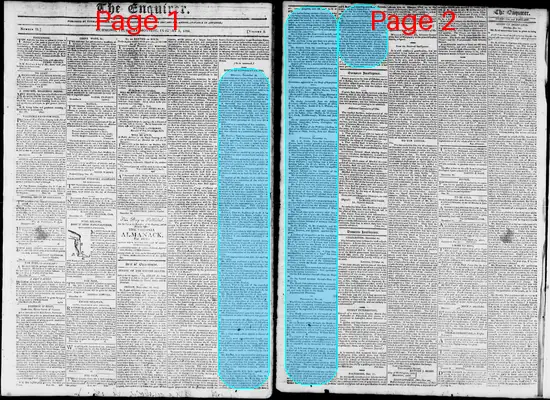
The Enquirer
Richmond, Henrico County, Virginia
What is this article about?
U.S. House of Representatives proceedings from December 23-26, covering memorials on port defenses and university site, reports on foreign aggressions and defense funding, contested elections in Georgia and South Carolina, lighthouse bill, and resolution for William Eaton's services, with debates and votes.
Merged-components note: Continuation of the House of Representatives proceedings report across pages, based on sequential reading order and matching content.
Clippings

1 of 2
OCR Quality
Full Text
Monday, December 23.
A memorial was received from the mayor and common council of New-York, requesting the attention of Congress to the taking efficient measures for placing the port and harbour of New-York in a state of defence, which was referred to the committee appointed relative to the defence of our ports and harbours.
A memorial from the Philadelphia Chamber of Commerce and Manufactures, relative to piers in the river Delaware was referred to the Committee of Commerce and Manufactures.
A memorial was presented from Samuel Blodget, representing that subscriptions for an university in Washington have already been made to the number of 18,000, and a sum received amounting to 50,000 dols. and requesting Congress to designate the Site with the lots or lands that may be intended therefor, and to grant such other patronage as they may think proper.
Referred to a committee of five members.
A message from the President, with communications relative to the territory of Michigan, was referred to a committee of five members.
Mr. Dawson, from the committee appointed on that part of the President's message which relates to aggressions committed by the vessels of foreign nations, &c. made a report in part, submitting two letters received from the Secretary of the navy, and three resolutions, in substance as follows:
1. That a sum not exceeding 150,000 dols. be appropriated to cause our ports and harbours to be protected.
2. That a sum not exceeding 250,000 dols. be appropriated, to cause to be built a number of gun-boats, not exceeding 50, for the protection of our ports and harbours.
3. That a sum not exceeding 660,000 dols. be appropriated to enable the President of the U. States to cause to be built six line of battle Ships.
On motion of Mr. Dawson these resolutions were referred to a committee of the whole on the state of the union.
Mr. Dawson observed, that in the year 1797 Congress passed an act relative to certain balances due by several of the states to the U. S. by which those states were enabled to discharge the balances by expending a part thereof in the defence of their ports and harbours. He understood that one state had made an appropriation to this object: but it was not known what was the issue of the appropriation, or what had been done by other states. That the subject might be elucidated, he offered the following resolution:
Resolved, That the President of the U. S. be requested to inform this House, whether any, and what measures, have been taken by the States indebted to the U.S. to discharge the balances due, under the provisions of the act of the twenty-third of June, 1797, entitled an act for the further defence of the ports and harbours of the U. States.
The House immediately took up the resolution and agreed to it: and the Speaker appointed a committee of two members to present it to the President.
Mr. Crowninshield--having obtained leave, submitted, from the Committee of Commerce and Manufactures, a bill to provide for light houses in Long-Island Sound, and to declare Roxbury in Mass. a port of delivery, which was referred to a committee of the whole on Wednesday.
The bill appropriates 6,000 dols. for erecting light houses.
Mr. M'Creery presented a petition from the inspectors of Baltimore, praying for an increase of compensation, which was referred to the Secretary of the Treasury.
Mr. Gregg, from the Committee on the public lands, reported on the petition of George R. Clark, that the prayer of the petition ought not to be granted, in which report the House without debate concurred.
On motion of Mr. Findley,
Resolved, That in the case of the contested election in the state of Georgia, the memorialist and sitting member shall, if they desire it, be heard by counsel at the bar of the House.
Mr. Mead waived the exercise of this right, & Mr. J. Clay intimated a desire of Mr. Spalding to the same effect: when the House resolved itself into a committee of the whole--Mr. Dawson in the chair--on the report of the Committee of Elections in this case; on which a debate ensued which occupied nearly the residue of the sitting.
Mr. Findley explained concisely some of the circumstances on which the report was grounded.
He was followed by Mr. Mead, who, without going into a wide detail of facts, or discussion of principle, noticed briefly a variety of facts and several principles and precedents which he thought invalidated the conclusion of the report.
Mr. J. Clay made a short speech in favour of the report.
Mr. Early went at considerable length into the principle implicated in the report, with the view of shewing that it was unfounded, and that it did not belong to the House, without violating the constitutional powers of the states, to set aside returns made in conformity to their laws.
Mr. Bidwell, in an argumentative and logical speech, defended the principle contained in the report, and contended that the constitutional power of investigating the returns, made by State officers, resided in the House, who might, according to the evidence adduced, affirm or set them aside.
Mr. Sloan and Mr. Ellis spoke against, and Mr. J. Clay in favour of the report.
After a few replicatory remarks from Mr. Bidwell and Mr. Mead, Mr. Kelly said, he still entertained some doubts on the subject, represented that other engagements had precluded his paying that attention to the subject which it merited, and moved that the committee should rise.
The committee rose--report of progress--House adjourned.
HOUSE OF REPRESENTATIVES.
Monday, December 23.
The House proceeded in the consideration of the report of the committee of elections on the petition of Mr. Marion, contesting the election of Mr. Huger.
Mr. Huger called for the reading of the testimony, which being read—
Mr. Lowndes moved to postpone the further consideration thereof, to the first Monday in January next.
Mr. Elmer hoped the motion would not prevail. The committee had not had time to examine the papers, and he trusted the House would not agree to postpone until January.
Mr. Randolph said, if gentlemen were not prepared to decide, he hoped they would recommit.
Mr. Lowndes withdrew his motion for postponement.
Mr. Huger then moved to recommit the report, with instructions to the committee to report the testimony at large.
Mr. Randolph hoped the motion would not prevail. The House had already spent too much time on this subject. He trusted the report would be taken up and decided on.
After some further conversation, the question on recommitting was put and negatived.
The House then proceeded to the consideration of the report, and after debate, agreed to the same.
Mr. Bidwell, from the committee appointed to wait on the President, reported that the President would communicate the information requested.
A message from the Senate informed the House that the Senate had passed a bill entitled "An act to amend the act, entitled 'An act to regulate the collection of duties on imports and tonnage.'"
The House then adjourned till Wednesday.
Wednesday, December 25.
The House met pursuant to adjournment.
Mr. Merrick, from the committee of elections, made a report on the contested election in the Georgia district, recommending that Mr. Spalding be declared entitled to his seat.
The report was ordered to lie on the table.
Mr. Newton, from the committee of commerce and manufactures, made a report on the petition of the Baltimore hatters, recommending that they have leave to withdraw their petition.
The report was concurred in.
Bills were read and passed in the usual manner.
The House then resolved itself into a committee of the whole on the state of the union, Mr. Varnum in the chair, on the bill from the Senate, entitled "An act to amend the act, entitled 'An act to regulate the collection of duties on imports and tonnage.'"
After some time spent therein, Mr. Varnum reported the bill with amendments, which were concurred in.
The House adjourned till Thursday.
Thursday, December 26.
The bill for the relief of Edward Toppan and others, after undergoing consideration in committee of the whole, was, without amendment, ordered to be engrossed for a third reading tomorrow.
The House concurred in the report of the committee of claims on the petition of the late crew of the frigate Philadelphia, which is adverse thereto.
On the motion of Mr. Bidwell, the House resolved itself into a committee of the whole—Mr. Gregg in the chair—on the report of the select committee to whom had been recommitted the resolution respecting William Eaton, Esq.
The report of the select committee recommends the amendment of the original resolution, so as to confer a medal, instead of a sword; and to so amend it, as to recognize the taking of Derne.
On the first amendment, to confer a medal, instead of a sword, a debate ensued, in which the amendment was advocated by Mr. Bidwell, and opposed by Messrs. J. Clay and J. Randolph; when the question was taken, and the amendment carried—Ayes 56—Noes 54.
The second amendment was agreed to without a division. The committee rose and reported their agreement to the report of the select committee.
The House immediately took into consideration the report of the committee of the whole.
Mr. J. Clay called for the yeas and nays on agreeing to the first amendment, substituting a medal in lieu of a sword. On agreeing to which further debate arose—Messrs. J. Clay, Jackson and J. Randolph opposing, and Messrs. Varnum, Elmer, and Kelly supporting it.
When the Yeas and Nays being taken, the amendment was carried—Yeas 58—Nays 53.
The other amendment passed without a division.
Mr. Stanton moved further to amend the resolution by adding the following words: "By which achievement he has shown himself capable of uniting information with talent, reflection with experience, & stratagem with bravery."
This amendment was disagreed to—Yeas 1; Nays 101; the mover alone voting for it.
Mr. Smilie expressed his regret that on a subject, that so eminently called for unanimity, and on which there was no difference of opinion as to the meritorious services of Mr. Eaton, there should be such a diversity with regard to the proper tribute to be bestowed. Considering it highly desirable that the resolution, before it received a final vote, should be so modified as to unite the varying opinions in the House, he moved a recommittal of it to a select committee.
In this motion the House concurred; Ayes 57; Noes 55; when the resolution was recommitted to the same committee to which it had been previously referred.
What sub-type of article is it?
What keywords are associated?
What entities or persons were involved?
Where did it happen?
Domestic News Details
Primary Location
Washington
Event Date
Monday, December 23 To Thursday, December 26
Key Persons
Outcome
memorials referred to committees; defense resolutions referred to committee of the whole; resolution on state balances agreed; lighthouse bill referred; baltimore petition referred; clark petition denied; georgia election debate adjourned; marion vs. huger report agreed; spalding seat recommended; hatters petition withdrawn; duties bill amended and concurred; toppan bill ordered engrossed; philadelphia crew petition denied; eaton resolution amended to medal, recognizing derne, and recommitted.
Event Details
The House received and referred memorials from New-York on port defense, Philadelphia on Delaware piers, and Samuel Blodget on Washington university site; President's message on Michigan territory referred; Mr. Dawson reported on foreign aggressions with resolutions for appropriations on port protection, gun-boats, and ships, referred to committee of whole; resolution on 1797 act balances agreed and sent to President; lighthouse bill for Long-Island Sound submitted and referred; Baltimore inspectors' petition referred; George R. Clark petition denied; Georgia contested election hearing allowed, debate on report adjourned; separate debate on Marion vs. Huger election, report agreed; Senate bill on duties amended; Spalding entitled to seat per report; Baltimore hatters allowed to withdraw; Toppan relief bill advanced; Philadelphia crew petition denied; debate and amendments on William Eaton resolution, substituting medal for sword and adding Derne recognition, then recommitted.