Thank you for visiting SNEWPapers!
Sign up free
The New Hampshire Gazette And Historical Chronicle
Portsmouth, Greenland, Rockingham County, New Hampshire
What is this article about?
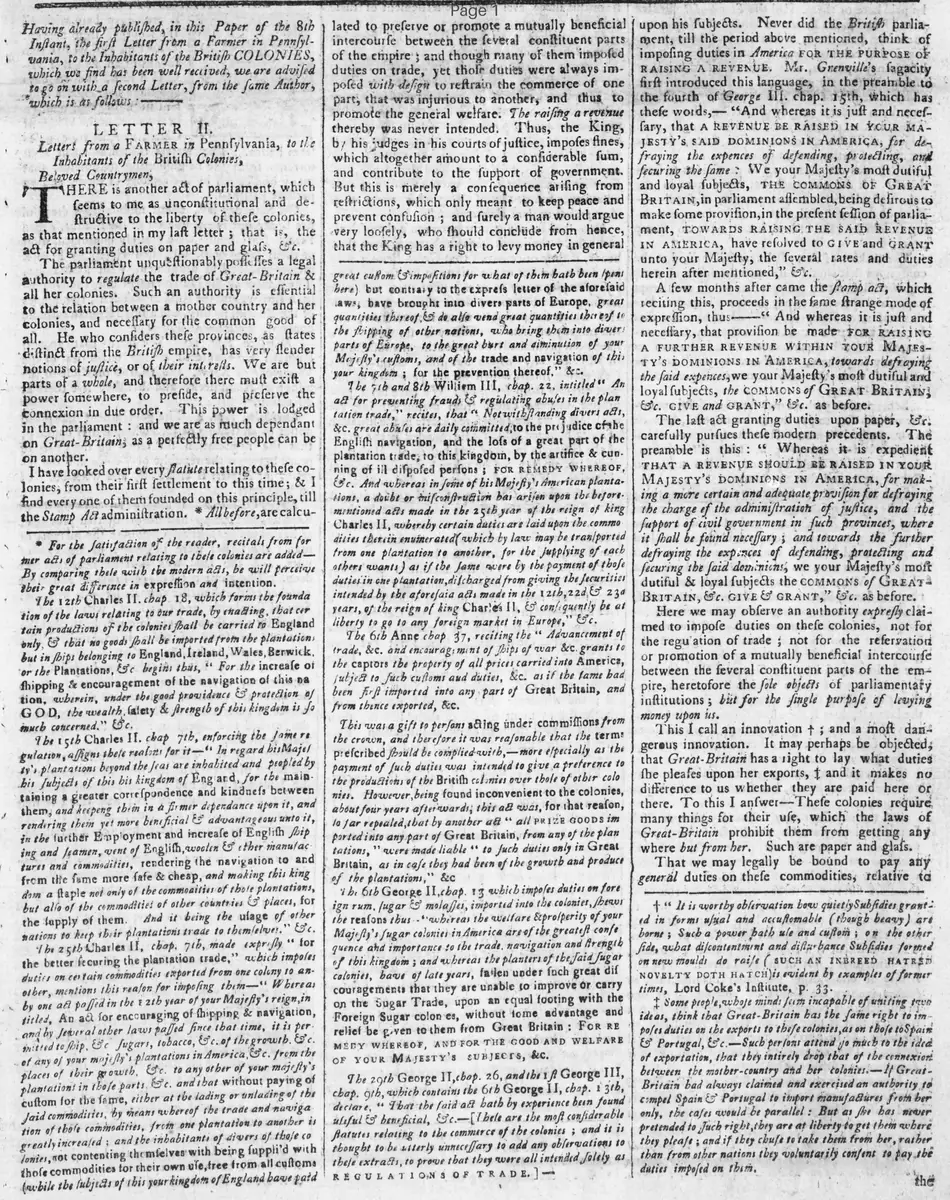
The second letter from 'A Farmer in Pennsylvania' argues that the Townshend Act imposing duties on paper, glass, and other imports for revenue is unconstitutional, akin to the Stamp Act, as it taxes colonies without consent, violating their liberties while Parliament regulates trade.
Merged-components note: This is a clear continuation of the same 'Letters from a Farmer in Pennsylvania' across pages 1 and 2, forming a single logical letter.
Clippings
1 of 2
OCR Quality
Full Text
Which we find has been well received, we are advised to go on with a second Letter, from the same Author;
which is as follows :--
LETTER II.
Letters from a FARMER in Pennsylvania, to the Inhabitants of the British Colonies,
Beloved Countrymen
HERE is another act of parliament, which seems to me as unconstitutional and destructive to the liberty of these colonies,
as that mentioned in my last letter ; that is, the act for granting duties on paper and glass, &c.
The parliament unquestionably possesses a legal authority to regulate the trade of Great-Britain &
all her colonies. Such an authority is essential to the relation between a mother country and her
colonies, and necessary for the common good of all. He who considers these provinces, as states
distinct from the British empire, has very slender notions of justice, or of their interest. We are but
parts of a whole, and therefore there must exist a power somewhere, to preside, and preserve the
connexion in due order. This power is lodged in the parliament : and we are as much dependant
on Great-Britain; as a perfectly free people can be on another.
I have looked over every Statute relating to these colonies; from their first settlement to this time; & I
find every one of them founded on this principle, till the Stamp Act administration. * All before, are calcul-
* For the satisfaction of the reader, recitals from former acts of parliament relating to these colonies are added--
By comparing these with the modern acts, he will perceive their great difference in expression and intention.
The 12th Charles II. chap. 18, which forms the foundation of the laws relating to our trade, by enjoining, that certain productions of the colonies shall be carried to England only. & that no goods shall be imported from the plantations
or the Plantations, &c begin thus, " For the increase of
shipping & encouragement of the navigation of this nation,
wherein, under the good providence & protection of
GOD, the wealth, safety & strength of this kingdom is so
much concerned." c.
The 15th Charles II. chap 7th, enforcing the same regulation, assigns these reasons for it--" In regard his Majesty
his subjects of this his kingdom of England, for the main-
taining a greater correspondence and kindness between
them, and keeping them in a firmer dependance upon it, and
for the further Employment and increase of English shipping
and seamen, vent of English,woolen & other manu-
factures and commodities, rendering the navigation to and
from the same more safe & cheap, and making this king-
dom a staple not only of the commodities of those plantations.
but also of the commodities of other countries places, for
the supply of them. And it being the usage of other nations to keep their plantations trade to themselves." &c.
gulation, assigns these reasons for it--" In regard his Majesty
the 25th Charles II, chap. 7th, made expressly " for
the better securing the plantation trade," which imposes
duties on certain commodities exported from one colony to an-
other, mentions this reason for imposing them--" Whereas.
: by one act passed in the 12th year of your Majesty's reign.in
, and by several other laws passed since that time, it is per.
firled. An act for encouraging of shipping & navigation.
. of any of your majesty's plantations in America, &c: from the
mitted to ship. &c" sugars, tobacco, &c. of the growth, &c.
places of their growth, &c: to any other of your majesty's
plantations in those parts, &c. and that without paying of
custom for the same, either at the lading or unlading of the
said commodities; by means whereof the trade and naviga-
greatly increased ; and the inhabitants of divers of those co-
ton of those commodities, from one plantation to another is
greatly increased ; and the inhabitants of divers of those co-
lonies,not contenting themselves'with being supplied with
those commodities for their own use,free from all customs
nf this kingdom of England have taken
lated to preserve or promote a mutually beneficial
intercourse between the several constituent parts
of the empire : and though many of them imposed
duties on trade, yet those duties were always im-
posed with design to restrain the commerce of one
part, that was injurious to another, and thus to
promote the general welfare. The raising revenue
thereby was never intended. Thus, the King,
by his judges in his courts of justice, imposes fines,
which altogether amount to a considerable sum,
and contribute to the support of government.
But this is merely a consequence arising from
restrictions, which only meant to keep peace and
prevent confusion : and surely a man would argue
very loosely, who should conclude from hence,
that the King has a right to levy money in general
upon his subjects. Never did the British parlia-
ment, till the period above mentioned, think of
imposing duties in America FOR THE PURPOSE OF
RAISING A REVENUE. Mr. Grenville's sagacity
first introduced this language, in the preamble to
the fourth of George III. chap. 12th, which has
these words,-- "And whereas it is just and neces-
Sary, that A REVENUE BE RAISED IN YOUR MA-
JESTY's SAID DOMINIONS IN AMERICA, for de-
fraying the expences of defending, protecting, and
securing the same : We your Majesty's most dutiful
and loyal subjects, THE COMMONS OF GREAT
BrITAIN, in parliament assembled, being desirous to
make some provision,in the present session of parlia-
MENT, TOWARDS RAISING.THE SAID REVENUE
IN AMERICA, haVe refolVed tO GIVEand GRANT
unto your Majesty, the several rates and duties
herein after mentioned," &c.
A few months after came the stamp act, which
reciting this, proceeds in the same strange mode of
expression, thus---." And whereas it is just and
necessary, that provision be made For RAISING
A FURTHER REVENUE WITHIN YOUR MAJES-
TY's DOMINIONS IN AMERICA, towards defraying
the said expences, we your Majesty's most dutiful and
loyal subjects, the CoMMoNs OF GREAT-BRITAIN
&c. GIVe and GRANT," &c. as before.
The last act granting duties upon paper, &c.
carefully pursues these modern precedents. The
preamble is this : ". Whereas it is 'expedient
THAT A REVENUE SHOULD BE RAISED INYOUR
MajEsTY's DoMInIOnS In AMERiCA, for mak-
ing a more certain and adequate provision for defraying
the charge of the administration of justice, and the
support of civil government in such provinces, where
it shall be found necessary ; and towards the further
defraying the expences of defending, protecting and
securing the said dominions, we your Majesty's most
dutiful & loyal subjects the coMMoNs OF GREAT
Britain, &c. Give & Grant," &c. as before.
Here we may observe an authority expressly clai-
med to impose duties on these colonies, not for
the regulation of trade ; not for the reservation
or promotion of a mutually beneficial intercourse
between the several constituent parts of the em-
pire, heretofore the sole objects of parliamentary
institutions; but for the single purpose of levying
money upon us.
This I call an innovation ; and a most dan-
gerous innovation. It may perhaps be objected:
that Great-Britain has a right to lay what duties
she pleases upon her exports, I and it makes no
difference to us whether they are paid here or
there. To this I answer--These colonies require
many things for their use, which the laws of
Great-Britain prohibit them from getting, any
where but from her. Such are paper and glass.
That we may legally be bound to pay any
general duties on these commodities, relative to
"s It is worthy observation how quietlySubsidies grant-
ed in forms usual and accustomable (though heavy) are
borne ; Such a power hath use and custom ; on the other
side, what discontentment and disturbance Subsidies formed
on neW Mould: do rai'e( sUCH AN INBREED HATRED
NOVELTY DOTH HATCH)is evident by examples of former
times, Lord Coke's Institute, P. 33.
I Some people whose minds seem incapable of uniting two
ideas, think that Great-Britain has the same right to im-
pose duties on the exports to these colonies,as on those toSpain
& Portugal, &c.-Such persons attend so much to the idea
of exportation. that they entirely drop that of the connexion
between the mother-country and her colonies.--If Great-
Britain had always claimed and exercised an authority to
compel Spain & Portugal to import manufactures from her
only. the cases would be parallel : But as she has never
pretended to such right, they are at liberty to get them where
they please : and if they choose to take them from her, rather
than from other nations they voluntarily consent to pay the
duties imposed on them.
the regulation of trade, is granted ; but we being obliged, by her laws to take them from Great-Britain, any special duties imposed on their exportation to us ONLY with intention to raise any revenue from us ONLY, are as much taxes upon us as those imposed by the Stamp-Act.
What is the difference in substance and right, whether the same sum is raised upon us by the rates mentioned in the Stamp-Act, on the use of the paper, or by these duties on the importation of it. It is nothing but the edition of a former book, with a new title page.
Suppose the duties were made payable in Great-Britain?
It signifies nothing to us whether they are to be paid here or there. Had the Stamp-Act directed that all the paper should be landed at Florida, and the duties paid there, before it was brought to the British colonies, would the Act have raised less money upon us, or have been less destructive of our rights ? By no means : For as we were under a necessity of using the paper, we should have been under a necessity of paying the duties.
Thus, in the present case, a like necessity will subject us, if this act continues in force, to the payment of duties now imposed.
Why was the Stamp-Act so pernicious to freedom ? It did not enact that every man in the colony should buy a certain quantity of paper.-- No ! It only directed, that no instrument of writing should be valid in law, if not made on stamped paper, &c.
The makers of that act knew full well. that the confusions that would arise upon the disuse of writings would compel the colonies to use the stamped paper, and therefore to pay the taxes imposed. For this reason the Stamp-Act was said to be a law that WOULD Execute ITself. For the very same reason, the last Act of parliament, if it is granted to have any force here, "will execute itself," and be attended with the very same consequences to American liberty.
Some persons perhaps may say this act lays us under no necessity to pay the duties imposed, because we may ourselves manufacture the articles on which they are laid whereas by the Stamp-Act no instrument of writing could be good, unless made on British paper, and that too stamped.
Such an objection amounts to no more than this ; that the injury resulting to these colonies, from the total disuse of British paper and glass, will not be so afflicting as that which would · have resulted from the total disuse of writing among them; for by that means even the Stamp-Act might have been eluded. Why then was it universally detested by them as slavery itself ? Because it presented to these devoted provinces nothing but a choice of calamities, each of which was unworthy of freemen to bear. But is no injury a violation of right but the greatest injury ? If the eluding the. payment of the duties imposed by the Stamp-Act would have subjected us to a more dreadful inconvenience, than the eluding the payment of those imposed by the late Act, does it therefore follow that the last is no violation of our rights, though it is calculated for the same purpose the other was,that is, to raise money upon us without our consent.
This would be making right to consist not in an exemption from injury, but from a certain degree of injury.
But the objectors may further say, that we shall sustain no injury at all by the disuse of British paper and glass. We might not, if we could make as much as we want.-But can any man, acquainted with America, believe this possible ? I am told there are but two or three glass-houses on this continent, and but very few paper mills ; and suppose more should be erected, a long course of years must elapse before they can be brought to perfection.
This continent is a country of planters, farmers; and fishermen ; not of manufacturers. The difficulty of establishing particular manufactures in such a country are almost insuperable. For one manufacture is connected with others in such a manner, that it may be said to be impossible to establish one or two without establishing several others. The. experience of many nations may convince us of this truth.
Inexpressible therefore must be our distress in evading the late acts, by the disuse of British paper and glass. Nor will this be the extent of our misfortune, if we admit the legality of that act.
Great-Britain has prohibited the manufacturing iron and steel in these colonies ; without any objection being made to her right of doing it. The like right she must have to prohibit any other manufacture among us.--Thus she is possessed of an undisputed precedent on that point. This authority they will say is founded on the original intention of settling these colonies : that is. that she should manufacture for them, and that they should supply her with materials. The equity of this policy, she will also say, has been universally acknowledged by the colonies, who never have made the least objection to statutes for that purpose, and will further appear by the mutual benefits flowing from this usage, ever since the settlement of these colonies.
Our great advocate, Mr. Pitt, in his speeches on the debates concerning the repeal of the stamp-act, acknowledged that Great-Britain could restrain our manufactures. His words are these-- .This kingdom, as the supreme governing and legislative power, has ALWAYS bound the colonies by her regulations and restrictions in trade, in navigation, in MANUFACTURES, in every thing except that of taking their money out of their pockets without their consent." Again," We may bind their trade, confine their manufactures, and exercise every power whatsoever, except that of taking their money out of their pockets without their consent."
Here then let my countrymen rouse themselves, and behold the inevitable ruin hanging over their heads, if they once admit that Great-Britain may lay duties, on her exportations to us, for the purpose of levying money on us only. She then will have nothing to do but to lay those duties on the articles which she prohibits us to manufacture, and the tragedy of American liberty is finished. We have been prohibited from procuring manufactures, in all cases, any where but from Great-Britain ( excepting linens which we are permitted to import directly from Ireland ) : We have been prohibited, in some cases, from manufacturing for ourselves ; we are therefore exactly in the situation of a city besieged,which is surrounded by the works of the besiegers in every part but one. If that is closed up, no step can be taken but to surrender at discretion. If Great-Britain can order us to come to her for necessaries we want, and can order us to pay what taxes she pleases, before we take them away, or when we have them here, we are as abject slaves as France and Poland can show in wooden shoes; and with uncombed hair.
Perhaps the nature of the necessities of the dependent states, caused by the policy of a governing one, for her own benefit, may be elucidated by a fact mentioned in history. When the Carthaginians were possessed of the island of Sardinia, they made a decree, that the Sardinians should not get corn any other way than from the Carthaginians. Then by imposing any duties they would, they drained from the miserable Sardinians any sums they pleased ; and whenever that oppressed people made the least movement to assert their liberty, their tyrants starved them to death or submission. This may be called the most perfect kind of political necessity.
From what has been said. I think this uncontrovertible conclusion may be deduced--That when a ruling state obliges a dependent state to take certain commodities from her alone, it is implied in the nature of that obligation, & is essentially requisite to give it the least degree of justice : and is inseparably united with it, in order to preserve any share of freedom to the dependent state -that those commodities should never be loaded with duties for the sole purpose of levying money on the dependent state.
The place of paying the duties, imposed by the late act, appears to me therefore to be totally immaterial.-The single question is, whether the parliament can legally impose duties to be paid by the people of these colonies only, for the Sole purpose of raising a revenue, on commodities which she obliges us to take from her alone !Or,in other words; whether the parliament can legally take money out of our pockets without our consent ?
If they can, our boasted liberty is but Vox et praeterea nihil.
A FARMER.
* It is thought, that very few things can be mentioned. which are more necessary for us in the Northern colonies, than Glass,to keep our houses warm in the severe winters.
" The peasants of France wear wooden shoes : and the vassals of Poland are remarkable for matted hair, which never can be combed.
A sound and nothing else.
What sub-type of article is it?
What themes does it cover?
What keywords are associated?
What entities or persons were involved?
Letter to Editor Details
Author
A Farmer
Recipient
The Inhabitants Of The British Colonies
Main Argument
the act granting duties on paper, glass, and similar imports for revenue purposes is unconstitutional and destructive to colonial liberty, equivalent to direct taxation without representation, as it exploits parliament's trade regulation authority to levy money solely on the colonies.
Notable Details
- references pre-stamp act statutes emphasizing trade regulation over revenue
- quotes preambles from stamp act and townshend act
- cites william pitt's speeches on colonial restrictions
- analogies to besieged city and carthaginian control of sardinia