Thank you for visiting SNEWPapers!
Sign up free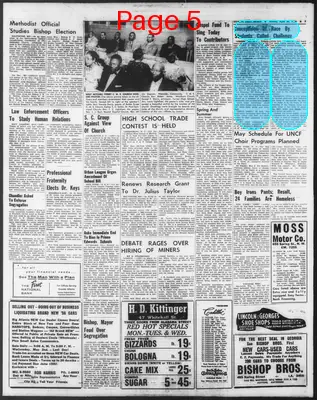
Atlanta Daily World
Atlanta, Fulton County, Georgia
What is this article about?
At Bennett College's 30th Home Making Institute in Greensboro, N.C., speakers including Dr. Joseph Himes, Dr. George Mitchell, and Rev. Charles M. Jones discuss racial myths, the need for Negro integration and unity, land tenure security, and segregation's immoral impact on society and children.
Clipping
OCR Quality
Full Text
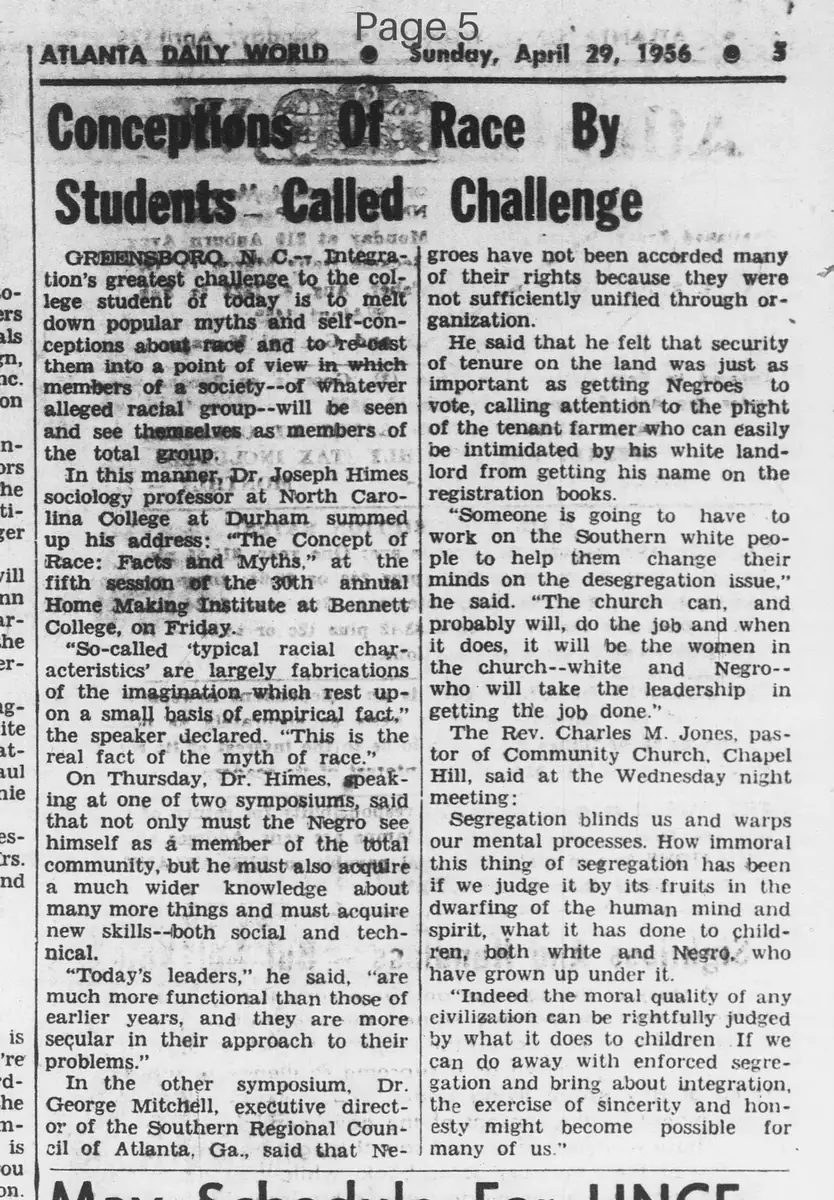
GREENSBORO, N.C.- Integration's greatest challenge to the college student of today is to melt down popular myths and self-conceptions about race and to re-cast them into a point of view in which members of a society--of whatever alleged racial group--will be seen and see themselves as members of the total group.
In this manner, Dr. Joseph Himes, sociology professor at North Carolina College at Durham summed up his address: "The Concept of Race: Facts and Myths." at the fifth session of the 30th annual Home Making Institute at Bennett College, on Friday.
"So-called 'typical racial characteristics' are largely fabrications of the imagination -which rest upon a small basis of empirical fact." the speaker declared. "This is the real fact of the myth of race."
On Thursday, Dr. Himes, speaking at one of two symposiums, said that not only must the Negro see himself as a member of the total community, but he must also acquire a much wider knowledge about many more things and must acquire new skills--both social and technical.
"Today's leaders," he said, "are much more functional than those of earlier years, and they are more secular in their approach to their problems."
In the other symposium, Dr. George Mitchell, executive director of the Southern Regional Council of Atlanta, Ga., said that Negroes have not been accorded many of their rights because they were not sufficiently unified through organization.
He said that he felt that security of tenure on the land was just as important as getting Negroes to vote, calling attention to the plight of the tenant farmer who can easily be intimidated by his white landlord from getting his name on the registration books.
"Someone is going to have to work on the Southern white people to help them change their minds on the desegregation issue," he said. "The church can, and probably will, do the job and when it does, it will be the women in the church--white and Negro-- who will take the leadership in getting the job done."
The Rev. Charles M. Jones, pastor of Community Church, Chapel Hill, said at the Wednesday night meeting:
Segregation blinds us and warps our mental processes. How immoral this thing of segregation has been if we judge it by its fruits in the dwarfing of the human mind and spirit, what it has done to children, both white and Negro, who have grown up under it.
"Indeed the moral quality of any civilization can be rightfully judged by what it does to children. If we can do away with enforced segregation and bring about integration, the exercise of sincerity and honesty might become possible for many of us."
What sub-type of article is it?
What themes does it cover?
What keywords are associated?
What entities or persons were involved?
Where did it happen?
Story Details
Key Persons
Location
Bennett College, Greensboro, N.C.
Event Date
30th Annual Home Making Institute (Wednesday To Friday)
Story Details
Dr. Joseph Himes addresses myths of racial characteristics and the need for broader community integration and skills among Negroes. Dr. George Mitchell discusses lack of Negro unity, importance of land tenure, and role of church women in desegregation. Rev. Charles M. Jones condemns segregation's immoral effects on minds and children.