Thank you for visiting SNEWPapers!
Sign up free
Editorial
September 4, 1956
Madison County Democrat
London, Madison County, Ohio
What is this article about?
Editorial endorses U.S. Chamber of Commerce resolution for parcel post (fourth-class mail) rates to fully cover costs, including subsidies from other agencies, as praised by Postmaster General and matching 1955 Hoover Commission recommendation, ensuring users pay without penalizing others.
Clipping
OCR Quality
98%
Excellent
Full Text
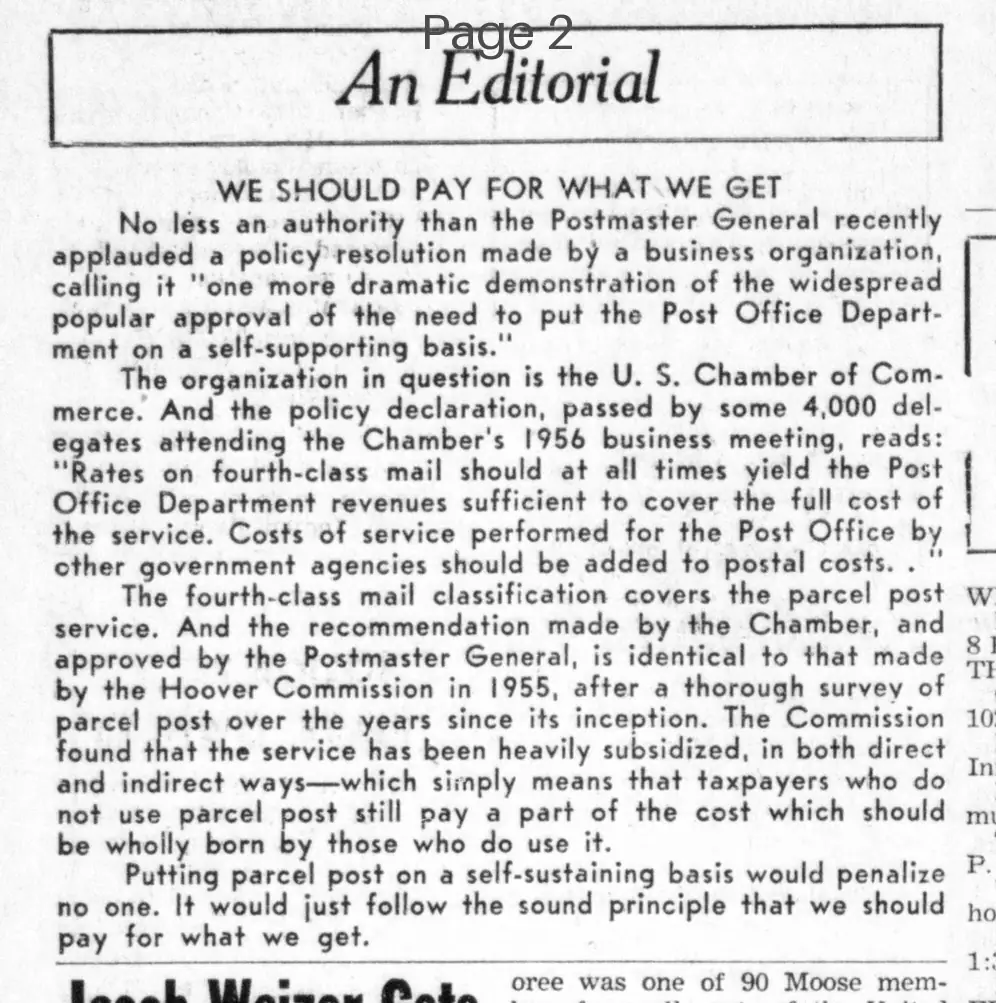
An Editorial
WE SHOULD PAY FOR WHAT WE GET
No less an authority than the Postmaster General recently applauded a policy resolution made by a business organization, calling it "one more dramatic demonstration of the widespread popular approval of the need to put the Post Office Department on a self-supporting basis."
The organization in question is the U. S. Chamber of Commerce. And the policy declaration, passed by some 4,000 delegates attending the Chamber's 1956 business meeting, reads:
"Rates on fourth-class mail should at all times yield the Post Office Department revenues sufficient to cover the full cost of the service. Costs of service performed for the Post Office by other government agencies should be added to postal costs."
The fourth-class mail classification covers the parcel post service. And the recommendation made by the Chamber, and approved by the Postmaster General, is identical to that made by the Hoover Commission in 1955, after a thorough survey of parcel post over the years since its inception. The Commission found that the service has been heavily subsidized, in both direct and indirect ways--which simply means that taxpayers who do not use parcel post still pay a part of the cost which should be wholly borne by those who do use it.
Putting parcel post on a self-sustaining basis would penalize no one. It would just follow the sound principle that we should pay for what we get.
WE SHOULD PAY FOR WHAT WE GET
No less an authority than the Postmaster General recently applauded a policy resolution made by a business organization, calling it "one more dramatic demonstration of the widespread popular approval of the need to put the Post Office Department on a self-supporting basis."
The organization in question is the U. S. Chamber of Commerce. And the policy declaration, passed by some 4,000 delegates attending the Chamber's 1956 business meeting, reads:
"Rates on fourth-class mail should at all times yield the Post Office Department revenues sufficient to cover the full cost of the service. Costs of service performed for the Post Office by other government agencies should be added to postal costs."
The fourth-class mail classification covers the parcel post service. And the recommendation made by the Chamber, and approved by the Postmaster General, is identical to that made by the Hoover Commission in 1955, after a thorough survey of parcel post over the years since its inception. The Commission found that the service has been heavily subsidized, in both direct and indirect ways--which simply means that taxpayers who do not use parcel post still pay a part of the cost which should be wholly borne by those who do use it.
Putting parcel post on a self-sustaining basis would penalize no one. It would just follow the sound principle that we should pay for what we get.
What sub-type of article is it?
Economic Policy
What keywords are associated?
Parcel Post
Postal Rates
Self Supporting Post Office
Fourth Class Mail
Hoover Commission
U. S. Chamber Of Commerce
What entities or persons were involved?
Postmaster General
U. S. Chamber Of Commerce
Hoover Commission
Editorial Details
Primary Topic
Self Sustaining Parcel Post Rates
Stance / Tone
Supportive Of Full Cost Recovery For Postal Services
Key Figures
Postmaster General
U. S. Chamber Of Commerce
Hoover Commission
Key Arguments
Fourth Class Mail Rates Should Cover Full Cost Of Service
Costs From Other Government Agencies Should Be Added To Postal Costs
Parcel Post Has Been Heavily Subsidized By Taxpayers
Recommendation Identical To Hoover Commission's 1955 Findings
Policy Follows Principle Of Paying For What One Gets