Thank you for visiting SNEWPapers!
Sign up free
Alexandria Advertiser And Commercial Intelligencer
Alexandria, Virginia
What is this article about?
New York Evening Post publishes John Wood's defense of Aaron Burr's suppression of a biased history of John Adams' administration, detailing Wood's rushed compilation from partisan sources like the Aurora and Callender, admitting its inaccuracies. Includes commentary on political intrigue and another suppression attempt on Wood's pamphlet.
Clipping
OCR Quality
Full Text
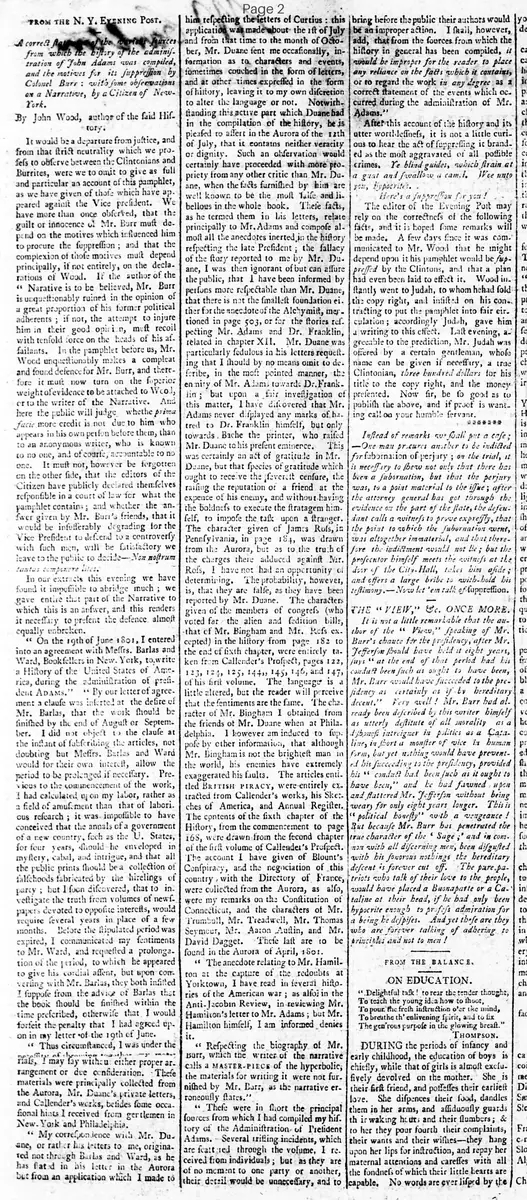
A correct state, postscript, or sources from which the history of the administration of John Adams was compiled, and the motives for its suppression by Colonel Burr: with some observations on a Narrative, by a Citizen of New-York.
By John Wood, author of the said History.
It would be a departure from justice, and from that strict neutrality which we profess to observe between the Clintonians and Burrites, were we to omit to give as full and particular an account of this pamphlet, as we have given of those which have appeared against the Vice President. We have more than once observed, that the guilt or innocence of Mr. Burr must depend on the motives which influenced him to procure the suppression; and that the complexion of those motives must depend principally, if not entirely, on the declarations of Wood. If the author of the 'Narrative' is to be believed, Mr. Burr is unquestionably ruined in the opinion of a great proportion of his former political adherents; if not, the attempt to injure him in their good opinion, must recoil with tenfold force on the heads of his assailants. In the pamphlet before us, Mr. Wood unquestionably makes a complete and sound defence for Mr. Burr, and therefore it must now turn on the superior weight of evidence to be attached to Wood, or to the writer of the Narrative. And here the public will judge, whether prima facie more credit is not due to him who appears in his own person before them, than to an anonymous writer, who is known to no one, and of course, accountable to no one. It must not, however be forgotten on the other side, that the editors of the Citizen have publicly declared themselves responsible in a court of law for what the pamphlet contains: and whether the answer given by Mr. Burr's friends, that it would be insufferably degrading for the Vice President to descend to a controversy with such men, will be satisfactory we leave to the public to decide--Non nostrum tantas componere lites.
In our extracts this evening we have found it impossible to abridge much: we gave entire that part of the Narrative to which this is an answer, and this renders it necessary to present the defence, almost equally unbroken.
On the 19th of June last, I entered into an agreement with Messrs. Barlas and Ward, Booksellers in New-York, to write a History of the United States of America, during the administration of President Adams. By our letter of agreement a clause was inserted at the desire of Mr. Barlas, that the work should be finished by the end of August or September. I did not object to the clause at the instant of subscribing the articles, not doubting but Messrs. Barlas and Ward would for their own interest, allow the period to be prolonged if necessary. Previous to the commencement of the work, I had calculated upon my labor, rather as a field of amusement than that of laborious research: it was impossible to have conceived that the annals of a government of a new country, such as the U. States, for four years, should be enveloped in mystery, cabal, and intrigue, and that all the public prints should be a collection of falsehoods fabricated by the hirelings of party; but I soon discovered, that to investigate the truth from volumes of newspapers devoted to opposite interests, would require several years in place of a few months. Before the stipulated period was expired, I communicated my sentiments to Mr. Ward, and requested a prolongation of the period, to which he appeared to give his cordial assent, but soon conversing with Mr. Barlas, they both insisted I suppose from the advice of Barlas that the book should be finished within the time prescribed, otherwise that I would forfeit the penalty that I had agreed upon in my letter of the 19th of June.
Thus circumstanced, I was under the necessity of thronging materials, I may say without either proper arrangement or due consideration. These materials were principally collected from the Aurora, Mr. Duane's private letters, and Callender's works, besides some occasional hints I received from gentlemen in New-York and Philadelphia.
My correspondence with Mr. Duane, or rather his letters to me, originated not through Barlas and Ward, as he has stated in his letter in the Aurora but from an application which I made to him respecting the letters of Curtius: this application was made about the 1st of July and from that time to the month of October, Mr. Duane sent me occasionally, information as to characters and events, sometimes couched in the form of letters, and at other times expressed in the form of history, leaving it to my own discretion to alter the language or not. Notwithstanding this active part which Duane had in the compilation of the history, he is pleased to assert in the Aurora of the 12th of July, that it contains neither veracity or dignity. Such an observation would certainly have proceeded with more propriety from any other critic than Mr. Duane, when the facts furnished by him are well known to be the most false and libellous in the whole book. These facts, as he termed them in his letters, relate principally to Mr. Adams and compose almost all the anecdotes inserted in the history respecting the late President: the fallacy of the story reported to me by Mr. Duane, I was then ignorant of but can assure the public, that I have been informed by persons more respectable than Mr. Duane, that there is not the smallest foundation either for the anecdote of the Alchymist, mentioned in page 503, or for the stories respecting Mr. Adams and Dr. Franklin, related in chapter XII. Mr. Duane was particularly sedulous in his letters requesting that I should by no means omit to describe, in the most pointed manner, the enmity of Mr. Adams towards Dr. Franklin: but upon a fair investigation of this matter, I have discovered that Mr. Adams never displayed any marks of hatred to Dr. Franklin himself, but only towards, Bache the printer, who raised Mr. Duane to his present eminence. This was certainly an act of gratitude in Mr. Duane, but that species of gratitude which ought to receive the severest censure, the raising the reputation of a friend at the expense of his enemy, and without having the boldness to execute the stratagem himself, to impose the task upon a stranger.
The character given of James Ross, in Pennsylvania, in page 184, was drawn from the Aurora, but as to the truth of the charges there adduced against Mr. Ross, I have not had an opportunity of determining. The probability, however, is, that they are false, as they have been reported by Mr. Duane. The characters given of the members of congress (who voted for the alien and sedition bills, that of Mr. Bingham and Mr. Ross excepted) in the history from page 182 to the end of sixth chapter, were entirely taken from Callender's Prospect, pages 122, 123, 124, 125, 144, 145, 146, and 147, of his first volume. The language is a little altered, but the reader will perceive that the sentiments are the same. The character of Mr. Bingham I obtained from the friends of Mr. Duane when at Philadelphia. I however am induced to suppose by other information, that although Mr. Bingham is not the brightest man in the world, his enemies have extremely exaggerated his faults. The articles entitled BRITISH PIRACY, were entirely extracted from Callender's works, his Sketches of America, and Annual Register. The contents of the sixth chapter of the History, from the commencement to page 165, were drawn from the second chapter of the first volume of Callender's Prospect. The account I have given of Blount's Conspiracy, and the negociation of this country, with the Directory of France, were collected from the Aurora, as also, were my remarks on the Constitution of Connecticut. and the characters of Mr. Trumbull. Mr. Treadwell, Mr. Thomas Seymour, Mr. Aaron Austin, and Mr. David Dagget. These last are to be found in the Aurora of April, 1801.
The anecdote relating to Mr. Hamilton at the capture of the redoubts at Yorktown, I have read in several histories of the American war: as also in the Anti-Jacobin Review, in reviewing Mr. Hamilton's letter to Mr. Adams: but Mr. Hamilton himself, I am informed denies it.
Respecting the biography. of Mr. Burr, which the writer of the narrative calls a MASTER-PIECE of the hyperbolic; the materials for writing it were not furnished by Mr. Burr, as the narrative erroneously states.
These were in short the principal sources from which I had compiled my history of the Administration of President Adams. - Several trifling incidents, which are scattered through the volume. I received from individuals; but as they are of no moment to one party or another, their detail would be unnecessary, and to bring before the public their authors would be an improper action. I shall, however, add. that from the sources. from which the history in general has been compiled, it would be improper for the reader to place any reliance on the facts which it contains, or to regard the work in any degree as a correct statement of the events which occurred during the administration of Mr. Adams."
* After this account of the history and its utter worthlessness. it is not a little curious to hear the act of suppressing it branded as the most aggravated of all possible crimes, Ye blind guides, which strain at a gnat and swallow a camel. Woe unto you, hypocrites.
Here's a suppression for you!
The editor of the Evening Post may rely on the correctness of the following facts, and it is hoped some remarks will be made. A few days since it was communicated to Mr. Wood that he might depend upon it his pamphlet would be suppressed by the Clintons, and that a plan had even been laid to effect it. Wood instantly went to Judah, to whom he had sold the copy right, and insisted on his contracting to put the pamphlet into fair circulation: accordingly Judah, gave him a writing to this effect. Last evening, agreeable to the prediction, Mr. Judah was offered by a certain gentleman, whose name can be given if necessary, a true Clintonian, three hundred dollars for his title to the copy right, and the money presented. Now sir, be so good as to publish the above, and if proof is wanting call on your humble servant.
Instead of remarks we shall put a case ;
-One man procures another to be indicted for subornation of perjury : on the trial, it is necessary to show not only that there has been a subornation, but that the perjury was, to a point material to the issue; after the attorney general has got through the evidence on the part of the State, the defendant calls a witness to prove expressly, that the point to which the subornation went, was altogether immaterial, and that therefore the indictment could not lie: but the prosecutor himself meets the witness at the door of the City-Hall, takes him aside : and offers a large bribe to withhold his testimony.-Nor let 'em talk of suppression.
THE "VIEW," &c. ONCE MORE.
It is not a little remarkable that the author of the " View," Speaking of Mr. Burr's chance for the presidency, after Mr. Jefferson should have held it eight years, says " at the end of that period had his conduct been such as ought to have been, Mr. Burr would have succeeded to the presidency as certainly as if by hereditary descent." Very well!! Mr. Burr had already been described by this writer himself as utterly destitute of all morality as a dishonest intriguing in politics as a Catiline, in short a monster of vice in human form, but yet nothing would have prevented his succeeding to the presidency, provided his " conduct had been such as it ought to have been," and he had fawned upon and flattered Mr. Jefferson without being weary for only eight years longer. This is "political honesty" with a vengeance !
But because Mr. Burr has penetrated the true character of the ' Sage ;' and in common with all discerning men, been disgusted with his sonorous nothings the hereditary descent is forever cut off. :The pure patriots who talk of their love to the people, would have placed a Buonaparte or a Cataline at their head, if he had only been hypocrite enough to profess admiration for a being he despises. And yet those are they who are forever talking of adhering to principles and not to men !
What sub-type of article is it?
What themes does it cover?
What keywords are associated?
What entities or persons were involved?
Where did it happen?
Story Details
Key Persons
Location
New York, Philadelphia, Pennsylvania, Connecticut
Event Date
19th Of June Last, 1st Of July, Month Of October, 12th Of July, April 1801
Story Details
John Wood defends Aaron Burr's suppression of his hastily compiled, partisan history of John Adams' administration, sourced from biased materials like the Aurora and Callender's works, admitting its falsehoods and lack of reliability; includes accounts of political maneuvering and hypocrisy in suppressing Wood's own pamphlet.