Thank you for visiting SNEWPapers!
Sign up free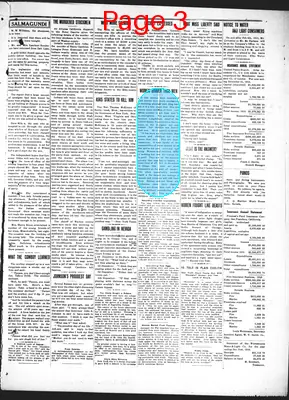
Story
February 14, 1911
Daily Independent
Elko, Elko County, Nevada
What is this article about?
Herbert Longfellow, chief of the US Volunteer Life Saving corps, asserts that women and children are more heroic and impulsive in rescuing lives during emergencies than men, who hesitate due to responsibilities.
Clipping
OCR Quality
98%
Excellent
Full Text
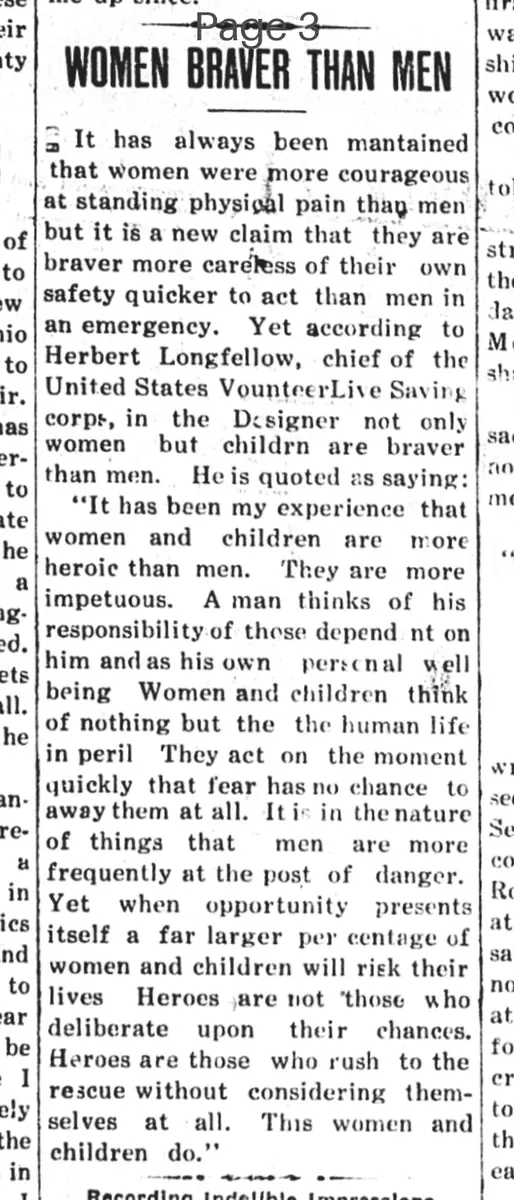
WOMEN BRAVER THAN MEN
It has always been maintained that women were more courageous at standing physical pain than men but it is a new claim that they are braver more careless of their own safety quicker to act than men in an emergency. Yet according to Herbert Longfellow, chief of the United States Volunteer Life Saving corps, in the Designer not only women but children are braver than men. He is quoted as saying:
"It has been my experience that women and children are more heroic than men. They are more impetuous. A man thinks of his responsibility of those dependent on him and as his own personal well being. Women and children think of nothing but the human life in peril. They act on the moment quickly that fear has no chance to away them at all. It is in the nature of things that men are more frequently at the post of danger. Yet when opportunity presents itself a far larger percentage of women and children will risk their lives. Heroes are not those who deliberate upon their chances. Heroes are those who rush to the rescue without considering themselves at all. This women and children do."
It has always been maintained that women were more courageous at standing physical pain than men but it is a new claim that they are braver more careless of their own safety quicker to act than men in an emergency. Yet according to Herbert Longfellow, chief of the United States Volunteer Life Saving corps, in the Designer not only women but children are braver than men. He is quoted as saying:
"It has been my experience that women and children are more heroic than men. They are more impetuous. A man thinks of his responsibility of those dependent on him and as his own personal well being. Women and children think of nothing but the human life in peril. They act on the moment quickly that fear has no chance to away them at all. It is in the nature of things that men are more frequently at the post of danger. Yet when opportunity presents itself a far larger percentage of women and children will risk their lives. Heroes are not those who deliberate upon their chances. Heroes are those who rush to the rescue without considering themselves at all. This women and children do."
What sub-type of article is it?
Curiosity
Heroic Act
What themes does it cover?
Bravery Heroism
Moral Virtue
What keywords are associated?
Women Bravery
Heroism
Life Saving
Gender Differences
Emergency Response
What entities or persons were involved?
Herbert Longfellow
Story Details
Key Persons
Herbert Longfellow
Story Details
Herbert Longfellow claims women and children act more heroically in emergencies, rushing to rescue without hesitation, unlike men who consider personal risks and responsibilities.