Thank you for visiting SNEWPapers!
Sign up free
Story
February 4, 1875
Knoxville Journal
Knoxville, Marion County, Iowa
What is this article about?
Seeds buried for over 1,500 years in the ancient mines of Laurium, Greece, were discovered and germinated, revealing a lost species of the Glaucium plant described by Pliny and Dioscorides but unknown to modern science.
Clipping
OCR Quality
98%
Excellent
Full Text
Discovery of a Lost Plant.
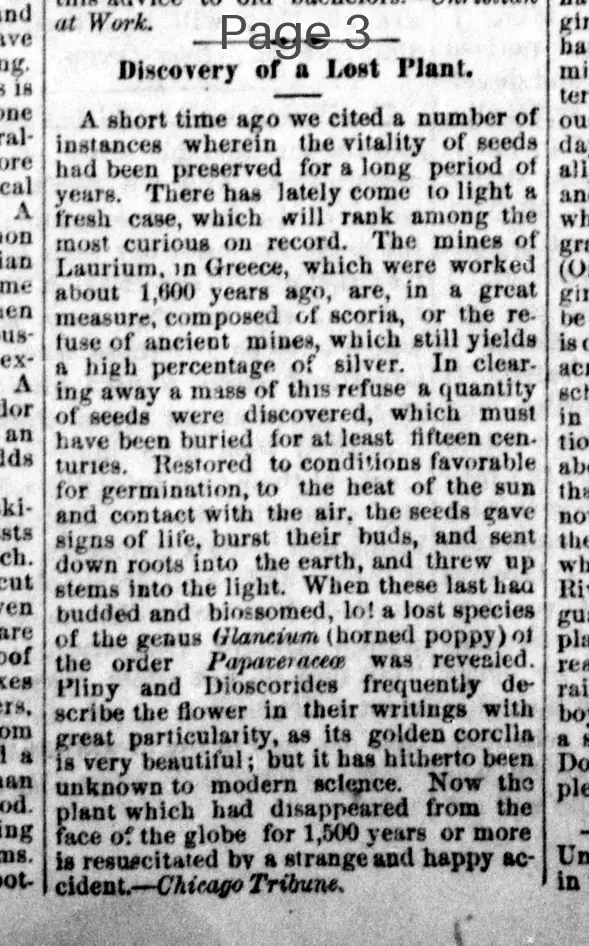
A short time ago we cited a number of instances wherein the vitality of seeds had been preserved for a long period of years. There has lately come to light a fresh case, which will rank among the most curious on record. The mines of Laurium, in Greece, which were worked about 1,600 years ago, are, in a great measure, composed of scoria, or the refuse of ancient mines, which still yields a high percentage of silver. In clearing away a mass of this refuse a quantity of seeds were discovered, which must have been buried for at least fifteen centuries. Restored to conditions favorable for germination, to the heat of the sun and contact with the air, the seeds gave signs of life, burst their husks, and sent down roots into the earth, and threw up stems into the light. When these last had budded and blossomed, lo! a lost species of the genus Glaucium (horned poppy) of the order Papaveraceae was revealed.
Pliny and Dioscorides frequently describe the flower in their writings with great particularity, as its golden corolla is very beautiful; but it has hitherto been unknown to modern science. Now the plant which had disappeared from the face of the globe for 1,500 years or more is resuscitated by a strange and happy accident.—Chicago Tribune.
A short time ago we cited a number of instances wherein the vitality of seeds had been preserved for a long period of years. There has lately come to light a fresh case, which will rank among the most curious on record. The mines of Laurium, in Greece, which were worked about 1,600 years ago, are, in a great measure, composed of scoria, or the refuse of ancient mines, which still yields a high percentage of silver. In clearing away a mass of this refuse a quantity of seeds were discovered, which must have been buried for at least fifteen centuries. Restored to conditions favorable for germination, to the heat of the sun and contact with the air, the seeds gave signs of life, burst their husks, and sent down roots into the earth, and threw up stems into the light. When these last had budded and blossomed, lo! a lost species of the genus Glaucium (horned poppy) of the order Papaveraceae was revealed.
Pliny and Dioscorides frequently describe the flower in their writings with great particularity, as its golden corolla is very beautiful; but it has hitherto been unknown to modern science. Now the plant which had disappeared from the face of the globe for 1,500 years or more is resuscitated by a strange and happy accident.—Chicago Tribune.
What sub-type of article is it?
Curiosity
Extraordinary Event
What themes does it cover?
Nature
Recovery
Triumph
What keywords are associated?
Lost Plant
Ancient Seeds
Laurium Mines
Glaucium
Germination
Papaveraceae
What entities or persons were involved?
Pliny
Dioscorides
Where did it happen?
Mines Of Laurium, In Greece
Story Details
Key Persons
Pliny
Dioscorides
Location
Mines Of Laurium, In Greece
Event Date
Buried For At Least Fifteen Centuries; Discovered Lately
Story Details
Ancient seeds from Greek mines, buried for over 1,500 years, germinate and reveal a lost species of Glaucium (horned poppy), previously known only from ancient descriptions by Pliny and Dioscorides.