Thank you for visiting SNEWPapers!
Sign up free
The National Intelligencer And Washington Advertiser
Washington, District Of Columbia
What is this article about?
The U.S. House of Representatives passes a bill reducing the naval establishment, saving approximately 1.9 million dollars annually and leading to the sale of excess vessels worth up to 2 million dollars. Failed attempts to renew the Sedition law and prohibit commerce with France are noted, highlighting a shift toward peace and fiscal restraint post-Presidential election.
Clipping
OCR Quality
Full Text
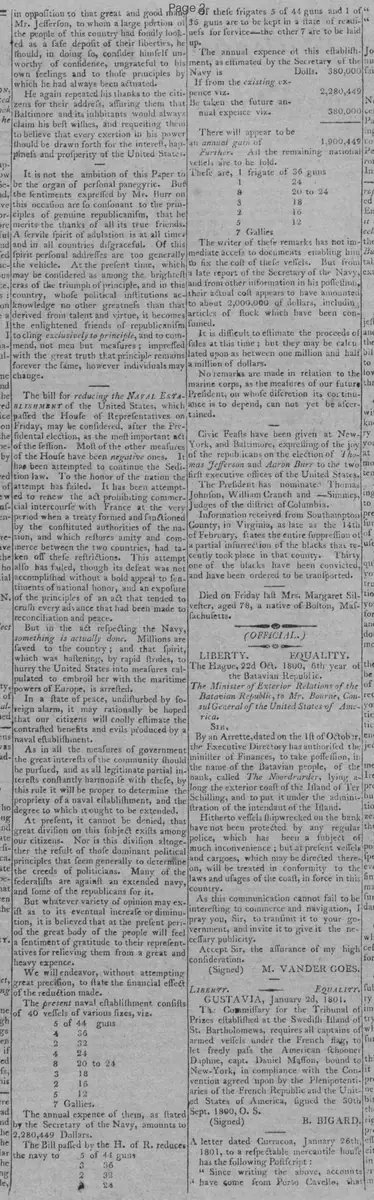
But in the act respecting the Navy, something is actually done. Millions are saved to the country; and that spirit, which was hastening, by rapid strides, to hurry the United States into measures calculated to embroil her with the maritime powers of Europe, is arrested.
In a state of peace, undisturbed by foreign alarm, it may rationally be hoped that our citizens will coolly estimate the contrasted benefits and evils produced by a naval establishment.
As in all the measures of government the great interests of the community should be pursued, and as all legitimate partial interests constantly harmonize with these, by this rule it will be proper to determine the propriety of a naval establishment, and the degree to which it ought to be extended.
At present, it cannot be denied, that great division on this subject exists among our citizens. Nor is this division altogether the result of those dominant political principles that seem generally to determine the creeds of politicians. Many of the federalists are against an extended navy, and some of the republicans for it.
But whatever variety of opinion may exist as to its eventual increase or diminution, it is believed that at the present period the great body of the people will feel a sentiment of gratitude to their representatives for relieving them from a great and heavy expense.
We will endeavor, without attempting great precision, to state the financial effect of the reduction made.
The present naval establishment consists of 40 vessels of various sizes, viz.
5 of 44 guns
4 of 36 guns
2 of 32 guns
4 of 24 guns
8 of 20 to 24 guns
3 of 18 guns
2 of 16 guns
5 of 12 guns
7 Gallies.
The annual expense of them, as stated by the Secretary of the Navy, amounts to 2,280,449 Dollars.
The Bill passed by the H. of R. reduces the navy to
5 of 44 guns
4 of 36 guns
1 of 32 guns
3 of 24 guns
Of these frigates 5 of 44 guns and 1 of 36 guns are to be kept in a state of readiness for service—the other 7 are to be laid up.
The annual expense of this establishment, as estimated by the Secretary of the Navy is
Dolls. 380,000
If from the existing expense viz.
2,280,449
Be taken the future annual expense viz.
380,000
There will appear to be an annual gain of 1,900,449
Further.
All the remaining national vessels are to be sold.
These are, 1 frigate of 36 guns
1 of 24 guns
8 of 20 to 24 guns
3 of 18 guns
2 of 16 guns
5 of 12 guns
7 Gallies
The writer of these remarks has not immediate access to documents enabling him to fix the cost of these vessels. But from a late report of the Secretary of the Navy, and from other information in his possession, their actual cost appears to have amounted to about 2,000,000 of dollars, including articles of stock which have been consumed.
It is difficult to estimate the proceeds of sales at this time; but they may be calculated upon as between one million and half a million of dollars.
No remarks are made in relation to the marine corps, as the measures of our future President, on whose discretion its continuance is to depend, can not yet be ascertained.
What sub-type of article is it?
What keywords are associated?
What entities or persons were involved?
Where did it happen?
Domestic News Details
Primary Location
United States
Event Date
Passed The House Of Representatives On Friday, After The Presidential Election
Key Persons
Outcome
annual savings of 1,900,449 dollars; sale of remaining vessels estimated at 500,000 to 1,000,000 dollars; reduction from 40 vessels to 13, with 7 laid up
Event Details
The House of Representatives passes bill reducing naval establishment from 40 vessels to 13 frigates, with most laid up or sold; failed attempts to renew Sedition law and prohibit commerce with France; promotes peace and fiscal relief amid public division on naval policy