Thank you for visiting SNEWPapers!
Sign up free
The Atlanta Inquirer
Atlanta, Fulton County, Georgia
What is this article about?
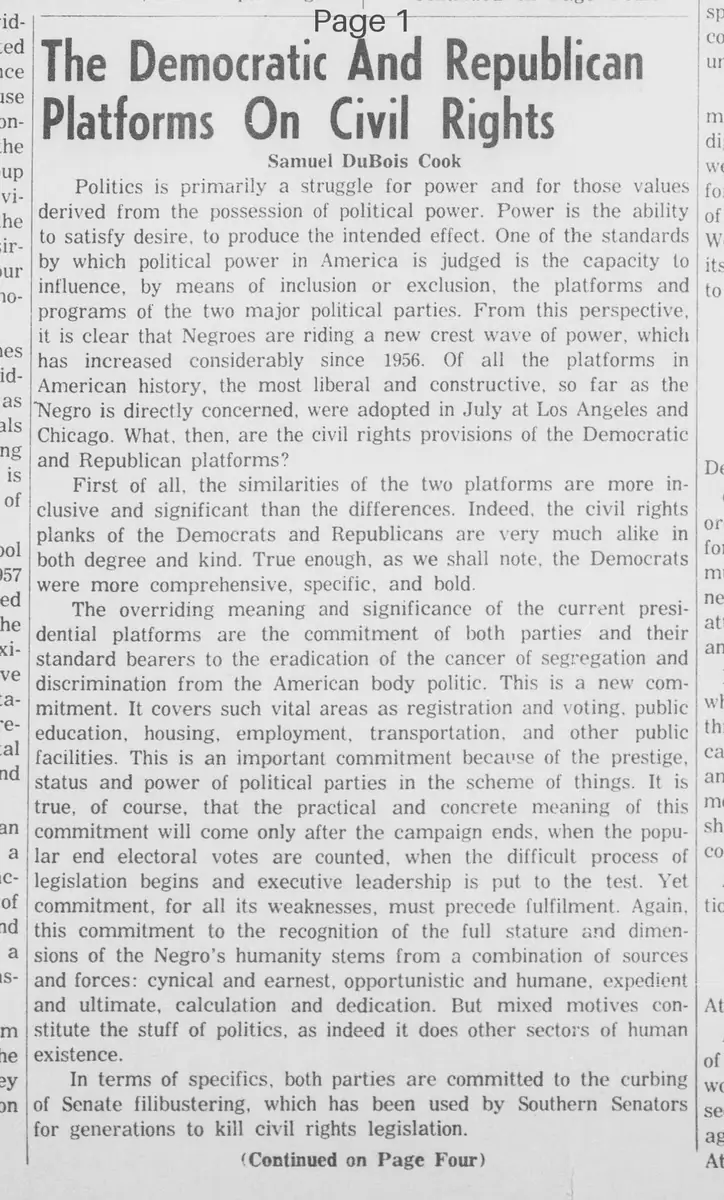
Samuel DuBois Cook analyzes the civil rights planks in the 1960 Democratic and Republican platforms, highlighting their similarities in committing to end segregation and discrimination, with Democrats offering more specific measures like eliminating literacy tests and a 1963 desegregation target.
Merged-components note: Continuation of the Democratic and Republican platforms on civil rights story from page 1 to page 4.
Clippings
1 of 2
OCR Quality
Full Text
Samuel DuBois Cook
Politics is primarily a struggle for power and for those values derived from the possession of political power. Power is the ability to satisfy desire, to produce the intended effect. One of the standards by which political power in America is judged is the capacity to influence, by means of inclusion or exclusion, the platforms and programs of the two major political parties. From this perspective, it is clear that Negroes are riding a new crest wave of power, which has increased considerably since 1956. Of all the platforms in American history, the most liberal and constructive, so far as the Negro is directly concerned, were adopted in July at Los Angeles and Chicago. What, then, are the civil rights provisions of the Democratic and Republican platforms?
First of all, the similarities of the two platforms are more inclusive and significant than the differences. Indeed, the civil rights planks of the Democrats and Republicans are very much alike in both degree and kind. True enough, as we shall note, the Democrats were more comprehensive, specific, and bold.
The overriding meaning and significance of the current presidential platforms are the commitment of both parties and their standard bearers to the eradication of the cancer of segregation and discrimination from the American body politic. This is a new commitment. It covers such vital areas as registration and voting, public education, housing, employment, transportation, and other public facilities. This is an important commitment because of the prestige, status and power of political parties in the scheme of things. It is true, of course, that the practical and concrete meaning of this commitment will come only after the campaign ends, when the popular end electoral votes are counted, when the difficult process of legislation begins and executive leadership is put to the test. Yet commitment, for all its weaknesses, must precede fulfilment. Again, this commitment to the recognition of the full stature and dimensions of the Negro's humanity stems from a combination of sources and forces: cynical and earnest, opportunistic and humane, expedient and ultimate, calculation and dedication. But mixed motives constitute the stuff of politics, as indeed it does other sectors of human existence.
In terms of specifics, both parties are committed to the curbing of Senate filibustering, which has been used by Southern Senators for generations to kill civil rights legislation.
Democratic and Republican
Platforms on Civil Rights
Both parties promise vigorous enforcement of the right to vote.
Both parties have thrown their weight behind the Supreme Court's desegregation decision (involving public schools) of 1954, and promise assistance to school districts in order to help them comply with that decision.
Both parties pledge the prohibition of discrimination in all housing financed or subsidized by the Federal government.
Both parties sustain anew the right of citizens to protest in order to make their wishes known and to correct injustices.
Both parties favor the establishment of a federal commission on equal job opportunities.
Both parties are committed to giving the Attorney General authority to bring certain civil rights suits on behalf of individuals who claim that their constitutional rights have been denied.
What are some of the differences? We here come to those points that make the Democratic platform stronger and more inclusive.
Whereas the Republicans favor legislation to make the completion of six primary grades evidence of literacy for the purpose of voting, the Democrats promise the elimination of literacy test.
Whereas the Republicans, like the Democrats, promise to ban discrimination in federally related employment (in both Federal agencies and industries doing work under Federal contract), the Democrats call for an FEPC.
Perhaps the biggest difference between the two platforms deals with desegregation of public education. The Republicans set no target date. But the Democrats say they believe "that every school district
affected by the Supreme Court's school desegregation decision should
submit a plan providing for at least first-step compliance by 1963,
the 100th anniversary of the Emancipation Proclamation."
Another significant difference is that the Democrats promise enactment of the now-famous Part III provision, which was dropped from the Civil Rights Acts of 1957 and 1960. This provision would give the Attorney General the authority to institute suits for individuals claiming that their civil rights have been violated. It includes not only the fields of voting and school desegregation, but also any other constitutional rights.
In one provision, the Republicans are more liberal. They promise legislation to end discrimination by labor unions.
What do party platforms mean? What is their significance? In the evaluation of party platforms, people often make opposite errors. Some assume that political parties mean everything they say; others assume that they mean nothing they say. Both groups are wrong, for they express only a half-truth. Platforms are important because many of their promises have been enacted into law. But there has never been an instance in which all their promises have become public policy. We cannot predict with accuracy which promises will be kept and which will not.
With reference to the civil rights planks, there is ground for both pessimism and optimism. History teaches that, for almost a century, countless promises of political parties to Negroes were buried in the awful cemetery of human hopes. And the Civil Rights Acts of 1957 and 1960 were limited primarily to the field of voting.
Some Negroes have been moved so deeply by the excellent civil rights planks of both parties that their enthusiasm blinds their realism. They say that no matter who wins the presidential election, Negroes will win. But, if history and experience are relevant, it is equally true, if not more true, that no matter who wins on November 8, Negroes will lose. Yet pessimism does not exhaust the field of possibility. Times change. Politicians come and go. Negroes are on the move. Politics is essentially unpredictable. Recent movements and events give ground for a measure of optimism. Nevertheless, even this optimism must be tempered with realism. Negroes will have to contend with fierce, clever and desperate opposition to their progress in law and administration. The translation of these civil rights proposals into public philosophy, legislation and the administration of justice will depend upon a variety of powerful and conflicting forces: habits, impact and consequences of the presidential contest of power itself, the composition and organization of Congress, legislative bargaining, the leadership and devotion of the next president and perhaps the next vice president, the cooperation between Republicans and Democrats in the legislative branch, cooperation between Capitol Hill and the White House, the intensity and manipulation of the opponents of civil rights, the skill, intelligence and determination of Negroes and their allies, and the always important accidents of history. One cannot predict with precision the product of these political processes and combinations. Appreciation of the perspective of history and the mystery and suspense of the drama of politics counsels enlightened hope and intelligent labors. But it, above all, suggests that the Negro should not sow overconfident seeds in order to reap a harvest of bitter disappointments and a crop of cynical despair.
What sub-type of article is it?
What themes does it cover?
What keywords are associated?
What entities or persons were involved?
Where did it happen?
Story Details
Key Persons
Location
Los Angeles, Chicago
Event Date
July 1960
Story Details
Samuel DuBois Cook compares the civil rights planks of the 1960 Democratic and Republican platforms, emphasizing their shared commitments to ending segregation in voting, education, housing, and employment, while noting Democratic proposals for eliminating literacy tests, a 1963 desegregation target, and broader Attorney General powers.