Thank you for visiting SNEWPapers!
Sign up free
Edwardsville Spectator
Edwardsville, Madison County, Illinois
What is this article about?
In 1819, US frigate Macedonian under Capt. Downs navigated South American coast, avoided Peruvian blockade per Chilean request, monitored Lord Cochrane's plundering, assisted lightning-struck merchant ship Two Catharines at St. Blaz, and aimed to protect US commerce. (214 chars)
Clipping
OCR Quality
Full Text
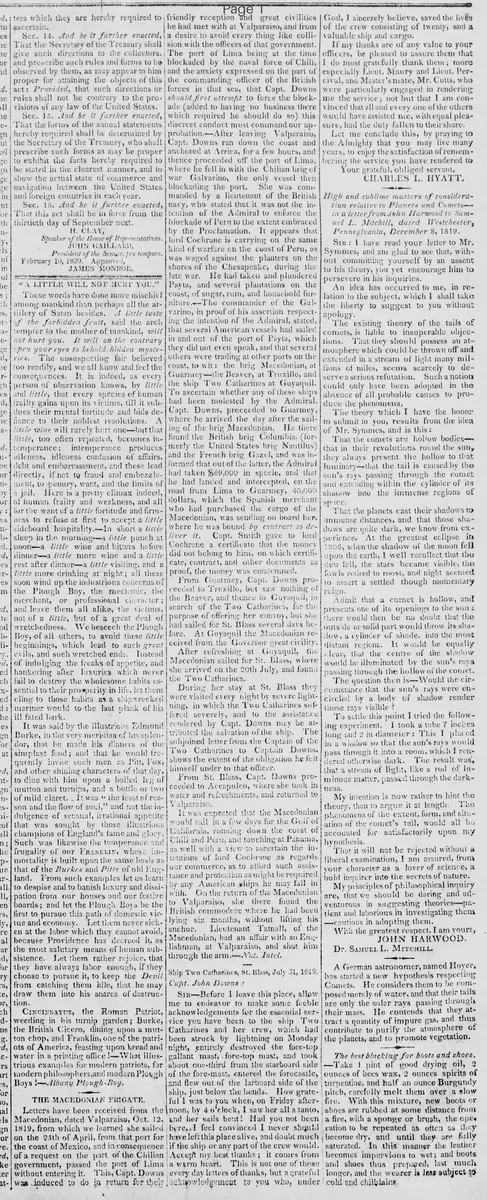
Letters have been received from the Macedonian, dated Valparaiso, Oct. 12, 1819, from which we learned she sailed on the 25th of April, from that port for the coast of Mexico, and in consequence of a request on the part of the Chilian government, passed the port of Lima without entering it. This, Capt. Downs was induced to do in return for their friendly reception and great civilities he had met with at Valparaiso, and from a desire to avoid every thing like collision with the officers of that government. The port of Lima being at the time blockaded by the naval force of Chili, and the anxiety expressed on the part of the commanding officer of the British forces in that sea, that Capt. Downs should first attempt to force the blockade (added to having no business there which required he should do so) this discreet conduct must command our approbation.
—After leaving Valparaiso, Capt. Downs ran down the coast and anchored at Arica, for a few hours, and thence proceeded off the port of Lima, where he fell in with the Chilian brig of war Galvarino, the only vessel then blockading the port. She was commanded by a lieutenant of the British navy, who stated that it was not the intention of the Admiral to enforce the blockade of Peru to the extent embraced by the Proclamation. It appears that lord Cochrane is carrying on the same kind of warfare on the coast of Peru, as was waged against the planters on the shores of the Chesapeake, during the late war. He had taken and plundered Payta, and several plantations on the coast, of sugar, rum, and household furniture.
—The commander of the Galvarino, in proof of his assertion respecting the intention of the Admiral, stated, that several American vessels had sailed in and out of the port of Payta, which they did not even speak, and that several others were trading at other ports on the coast, to wit: the brig Macedonian, at Guarmey—the Beaver, at Truxillo, and the ship Two Catharines at Guayaquil.
To ascertain whether any of these ships had been molested by the Admiral, Capt. Downs, proceeded to Guarmey, where he arrived the day after the sailing of the brig Macedonian. He there found the British brig Columbia. (formerly the United States brig Nautilus) and the French brig Gazel, and was informed that out of the latter, the Admiral had taken $69,000 in specie, and that he had landed and intercepted, on the road from Lima to Guarmey, 40,000 dollars, which the Spanish merchant who had purchased the cargo of the Macedonian, was sending on board her, where he was bound by contract to deliver it. Capt. Smith gave to lord Cochrane a certificate that the money did not belong to him, on which certificate, contract, and other documents as proof, the money was condemned.
From Guarmey, Capt. Downs proceeded to Truxillo, but saw nothing of the Beaver, and thence to Guayaquil, in search of the Two Catharines, for the purpose of offering her convoy, but she had sailed for St. Blaz several days before. At Guayaquil the Macedonian received from the Governor great civility. After refreshing at Guayaquil, the Macedonian sailed for St. Blaz, where she arrived on the 20th July, and found the Two Catharines.
During her stay at St. Blaz they were visited every night by severe lightning, in which the Two Catharines suffered severely, and to the assistance rendered by Capt. Downs may be attributed the salvation of the ship. The subjoined letter from the Captain of the Two Catharines to Captain Downs, shows the extent of the obligation he felt himself under to that officer.
From St. Blaz, Capt. Downs proceeded to Acapulco, where she took in water and refreshments, and returned to Valparaiso.
It was expected that the Macedonian would sail in a few days for the Gulf of California, running down the coast of Chili and Peru, and touching at Panama, as well with a view to ascertain the intentions of lord Cochrane as regards our commerce, as to afford such assistance and protection as might be required by any American ships he may fall in with. On the return of the Macedonian to Valparaiso, she there found the British commodore where he had been lying six months, without lifting his anchor. Lieutenant Tatnall, of the Macedonian, had an affair with an Englishman, at Valparaiso, and shot him through the arm.—N. Y. Intel.
Ship Two Catharines, St. Blaz, July 31, 1819.
Capt. John Downs:
SIR—Before I leave this place, allow me to endeavor to make some feeble acknowledgements for the essential service you have been to the ship Two Catharines and her crew, which had been struck by lightning on Monday night, entirely destroyed the fore-top gallant mast, fore-top mast, and took about one-third from the starboard side of the fore-mast, entered the forecastle, and flew out of the larboard side of the ship, just below the bends. How grateful I was to you when, on Friday afternoon, by 4 o'clock, I saw her all a taunto, and her sails bent! Had you not been here, I feel convinced I never should have left this place alive, and doubt much if the ship or any part of the crew would.
Accept my best thanks; it comes from a warm heart. This is not one of those every day letters of thanks, but a grateful acknowledgement to you who, under God, I sincerely believe, saved the lives of the crew consisting of twenty, and a valuable ship and cargo.
If my thanks are of any value to your officers, be pleased to assure them that I do most gratefully thank them; more especially Lieut. Maury and Lieut. Percival, and Master's mate, Mr. Cutts, who were particularly engaged in rendering me the service; not but that I am convinced that all and every one of the others would have assisted me, with equal pleasure, had the duty fallen to their share.
Let me conclude this, by praying to the Almighty that you may live many years, to enjoy the satisfaction of remembering the service you have rendered to
Your grateful, obliged servant,
CHARLES L. HYATT.
What sub-type of article is it?
What keywords are associated?
What entities or persons were involved?
Where did it happen?
Foreign News Details
Primary Location
Coast Of Peru
Event Date
April To October 1819
Key Persons
Outcome
lord cochrane plundered payta and plantations; $69,000 taken from french brig gazel but $40,000 intercepted from spanish merchant condemned based on documents; two catharines struck by lightning but saved with assistance from macedonian; no other casualties reported
Event Details
The US frigate Macedonian, under Capt. Downs, sailed from Valparaiso in April 1819 for Mexico coast, bypassing blockaded Lima at Chilean request. Encountered Chilean brig Galvarino; learned of lax blockade enforcement and Cochrane's plundering raids similar to Chesapeake. Visited Arica, off Lima, Guarmey (found British and French brigs, learned of seizures), Truxillo, Guayaquil (offered convoy to Two Catharines, received civility from governor), St. Blaz (assisted lightning-damaged Two Catharines), and Acapulco before returning to Valparaiso. Expected to sail for Gulf of California to protect US commerce from Cochrane. Lt. Tatnall shot an Englishman in arm at Valparaiso.