Thank you for visiting SNEWPapers!
Sign up free
Editorial
March 28, 1840
The Connecticut Observer, And New York Congregationalist
Hartford, Hartford County, Connecticut
What is this article about?
An editorial rejects a letter advocating women's right to preach, citing biblical commands for women to remain silent in church due to creation order and deception in Eden. It distinguishes church from other settings, upholds male leadership for order, and notes inspiration's end limits female prophecy.
Clipping
OCR Quality
98%
Excellent
Full Text
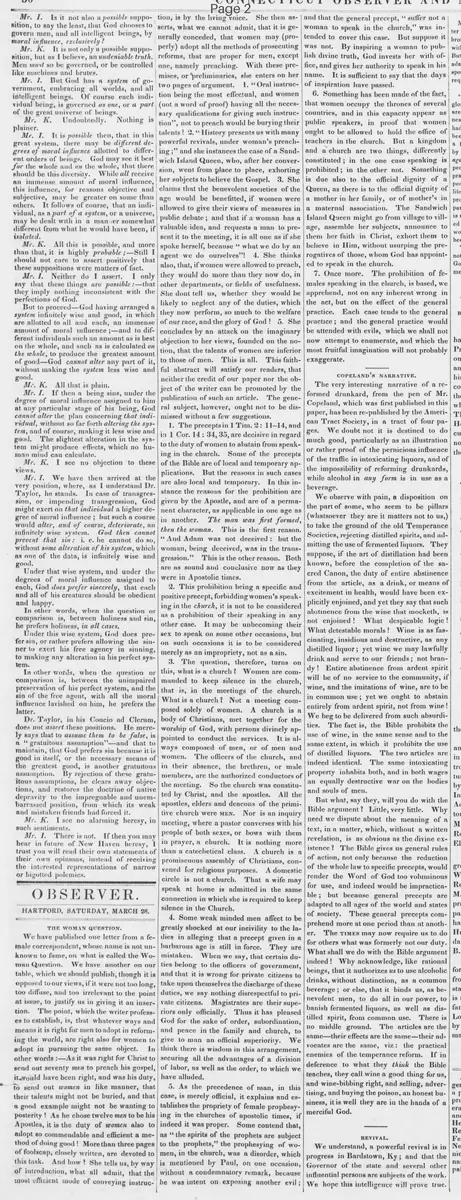
THE WOMAN QUESTION.
We have published one letter from a female correspondent, whose name is not unknown to fame, on what is called the Woman Question. We have another on our table, which we should publish, though it is opposed to our views, if it were not too long, too diffuse, and too irrelevant to the point at issue, to justify us in giving it an insertion. The point, which the writer professes to establish, is, that whatever ways and means it is right for men to adopt in reforming the world, are right also for women to adopt in pursuing the same object. In other words:—As it was right for Christ to send out seventy men to preach his gospel, it would have been right, and was his duty, to send out women in like manner, that their talents might not be buried, and that a good example might not be wanting to posterity! As he chose twelve men to be his Apostles, it is the duty of women also to adopt so commendable and efficient a method of doing good! More than three pages of foolscap, closely written, are devoted to this task. And how? She tells us, by way of introduction, what all admit, that the most efficient mode of conveying instruction, is by the living voice. She then asserts, what we cannot admit, that it is generally conceded, that women may (properly) adopt all the methods of prosecuting reforms, that are proper for men, except one, namely preaching. With these premises, or preliminaries, she enters on her two pages of argument. 1. "Oral instruction being the most effectual, and women (not a word of proof) having all the necessary qualifications for giving such instruction", not to preach would be burying their talents! 2. "History presents us with many powerful revivals, under woman's preaching;" and she instances the case of a Sandwich Island Queen, who, after her conversion, went from place to place, exhorting her subjects to believe the Gospel. 3. She claims that the benevolent societies of the age would be benefitted, if women were allowed to give their views of measures in public debate; and that if a woman has a valuable idea, and requests a man to present it to the meeting, it is all one as if she spoke herself, because "what we do by an agent we do ourselves"! 4. She thinks also, that, if women were allowed to preach, they would do more than they now do, in other departments, or fields of usefulness. She dont tell us, whether they would be likely to neglect any of the duties, which they now perform, so much to the welfare of our race, and the glory of God! 5. She concludes by an attack on the imaginary objection to her views, founded on the notion, that the talents of women are inferior to those of men. This is all. This faithful abstract will satisfy our readers, that neither the credit of our paper nor the object of the writer can be promoted by the publication of such an article. The general subject, however, ought not to be dismissed without a few suggestions.
1. The precepts in 1 Tim. 2: 11-14, and in 1 Cor. 14: 34, 35. are decisive in regard to the duty of women to abstain from speaking in the church. Some of the precepts of the Bible are of local and temporary applications. But the reasons in such cases are also local and temporary. In this instance the reasons for the prohibition are given by the Apostle, and are of a permanent character, as applicable in one age as in another. The man was first formed, then the woman. This is the first reason. "And Adam was not deceived: but the woman, being deceived, was in the transgression." This is the other reason. Both are as sound and conclusive now as they were in Apostolic times.
2. This prohibition being a specific and positive precept, forbidding women's speaking in the church, it is not to be considered as a prohibition of their speaking in any other case. It may be unbecoming their sex to speak on some other occasions, but on such occasions it is to be considered merely as an impropriety, not as a sin.
3. The question, therefore, turns on this, what is a church? Women are commanded to keep silence in the church, that is, in the meetings of the church. What is a church? Not a meeting composed solely of women. A church is a body of Christians, met together for the worship of God, with persons divinely appointed to conduct the services. It is always composed of men, or of men and women. The officers of the church, and in their absence, the brethren, or male members, are the authorized conductors of the meeting. So the church was constituted by Christ, and the apostles. All the apostles, elders and deacons of the primitive church were MEN. Nor is an inquiry meeting, where a pastor converses with his people of both sexes, or bows with them in prayer, a church. It is nothing more than a catechetical class. A church is a promiscuous assembly of Christians, convened for religious purposes. A domestic circle is not a church. That a wife may speak at home is admitted in the same connection in which she is required to keep silence in the Church.
4. Some weak minded men affect to be greatly shocked at our incivility to the ladies in alleging that a precept given in a barbarous age is still in force. They are mistaken. When we say, that certain duties belong to the officers of government, and that it is wrong for private citizens to take upon themselves the discharge of these duties, we say nothing disrespectful to private citizens. Magistrates are their superiors only officially. Thus it has pleased God for the sake of order, subordination, and peace in the family and church, to give to man an official superiority. We think there is wisdom in this arrangement, securing all the advantages of a division of labor, as well as the order, to which we have alluded.
5. As the precedence of man, in this case, is merely official, it explains and establishes the propriety of female prophesying in the churches of apostolic times, if indeed it was proper. Some contend that, as "the spirits of the prophets are subject to the prophets," the prophesying of women, in the church, was a disorder, which is mentioned by Paul, on one occasion, without a condemnatory remark, because he was intent on exposing another evil; and that the general precept, "suffer not a woman to speak in the church," was intended to cover this case. But suppose it was not. By inspiring a woman to publish divine truth, God invests her with office, and gives her authority to speak in his name. It is sufficient to say that the days of inspiration have passed.
6. Something has been made of the fact, that women occupy the thrones of several countries, and in this capacity appear as public speakers, in proof that women ought to be allowed to hold the office of teachers in the church. But a kingdom and a church are two things, differently constituted; in the one case speaking is prohibited; in the other not. Something is due also to the official dignity of a Queen, as there is to the official dignity of a mother in her family, or of mothers in a maternal association. The Sandwich Island Queen might go from village to village, assemble her subjects, announce to them her faith in Christ, exhort them to believe in Him, without usurping the prerogatives of those, whom God has appointed to speak in the church.
7. Once more. The prohibition of females speaking in the church, is based, we apprehend, not on any inherent wrong in the act, but on the effect of the general practice. Each case tends to the general practice; and the general practice would be attended with evils, which we shall not now attempt to enumerate, and which the most fruitful imagination will not probably exaggerate.
We have published one letter from a female correspondent, whose name is not unknown to fame, on what is called the Woman Question. We have another on our table, which we should publish, though it is opposed to our views, if it were not too long, too diffuse, and too irrelevant to the point at issue, to justify us in giving it an insertion. The point, which the writer professes to establish, is, that whatever ways and means it is right for men to adopt in reforming the world, are right also for women to adopt in pursuing the same object. In other words:—As it was right for Christ to send out seventy men to preach his gospel, it would have been right, and was his duty, to send out women in like manner, that their talents might not be buried, and that a good example might not be wanting to posterity! As he chose twelve men to be his Apostles, it is the duty of women also to adopt so commendable and efficient a method of doing good! More than three pages of foolscap, closely written, are devoted to this task. And how? She tells us, by way of introduction, what all admit, that the most efficient mode of conveying instruction, is by the living voice. She then asserts, what we cannot admit, that it is generally conceded, that women may (properly) adopt all the methods of prosecuting reforms, that are proper for men, except one, namely preaching. With these premises, or preliminaries, she enters on her two pages of argument. 1. "Oral instruction being the most effectual, and women (not a word of proof) having all the necessary qualifications for giving such instruction", not to preach would be burying their talents! 2. "History presents us with many powerful revivals, under woman's preaching;" and she instances the case of a Sandwich Island Queen, who, after her conversion, went from place to place, exhorting her subjects to believe the Gospel. 3. She claims that the benevolent societies of the age would be benefitted, if women were allowed to give their views of measures in public debate; and that if a woman has a valuable idea, and requests a man to present it to the meeting, it is all one as if she spoke herself, because "what we do by an agent we do ourselves"! 4. She thinks also, that, if women were allowed to preach, they would do more than they now do, in other departments, or fields of usefulness. She dont tell us, whether they would be likely to neglect any of the duties, which they now perform, so much to the welfare of our race, and the glory of God! 5. She concludes by an attack on the imaginary objection to her views, founded on the notion, that the talents of women are inferior to those of men. This is all. This faithful abstract will satisfy our readers, that neither the credit of our paper nor the object of the writer can be promoted by the publication of such an article. The general subject, however, ought not to be dismissed without a few suggestions.
1. The precepts in 1 Tim. 2: 11-14, and in 1 Cor. 14: 34, 35. are decisive in regard to the duty of women to abstain from speaking in the church. Some of the precepts of the Bible are of local and temporary applications. But the reasons in such cases are also local and temporary. In this instance the reasons for the prohibition are given by the Apostle, and are of a permanent character, as applicable in one age as in another. The man was first formed, then the woman. This is the first reason. "And Adam was not deceived: but the woman, being deceived, was in the transgression." This is the other reason. Both are as sound and conclusive now as they were in Apostolic times.
2. This prohibition being a specific and positive precept, forbidding women's speaking in the church, it is not to be considered as a prohibition of their speaking in any other case. It may be unbecoming their sex to speak on some other occasions, but on such occasions it is to be considered merely as an impropriety, not as a sin.
3. The question, therefore, turns on this, what is a church? Women are commanded to keep silence in the church, that is, in the meetings of the church. What is a church? Not a meeting composed solely of women. A church is a body of Christians, met together for the worship of God, with persons divinely appointed to conduct the services. It is always composed of men, or of men and women. The officers of the church, and in their absence, the brethren, or male members, are the authorized conductors of the meeting. So the church was constituted by Christ, and the apostles. All the apostles, elders and deacons of the primitive church were MEN. Nor is an inquiry meeting, where a pastor converses with his people of both sexes, or bows with them in prayer, a church. It is nothing more than a catechetical class. A church is a promiscuous assembly of Christians, convened for religious purposes. A domestic circle is not a church. That a wife may speak at home is admitted in the same connection in which she is required to keep silence in the Church.
4. Some weak minded men affect to be greatly shocked at our incivility to the ladies in alleging that a precept given in a barbarous age is still in force. They are mistaken. When we say, that certain duties belong to the officers of government, and that it is wrong for private citizens to take upon themselves the discharge of these duties, we say nothing disrespectful to private citizens. Magistrates are their superiors only officially. Thus it has pleased God for the sake of order, subordination, and peace in the family and church, to give to man an official superiority. We think there is wisdom in this arrangement, securing all the advantages of a division of labor, as well as the order, to which we have alluded.
5. As the precedence of man, in this case, is merely official, it explains and establishes the propriety of female prophesying in the churches of apostolic times, if indeed it was proper. Some contend that, as "the spirits of the prophets are subject to the prophets," the prophesying of women, in the church, was a disorder, which is mentioned by Paul, on one occasion, without a condemnatory remark, because he was intent on exposing another evil; and that the general precept, "suffer not a woman to speak in the church," was intended to cover this case. But suppose it was not. By inspiring a woman to publish divine truth, God invests her with office, and gives her authority to speak in his name. It is sufficient to say that the days of inspiration have passed.
6. Something has been made of the fact, that women occupy the thrones of several countries, and in this capacity appear as public speakers, in proof that women ought to be allowed to hold the office of teachers in the church. But a kingdom and a church are two things, differently constituted; in the one case speaking is prohibited; in the other not. Something is due also to the official dignity of a Queen, as there is to the official dignity of a mother in her family, or of mothers in a maternal association. The Sandwich Island Queen might go from village to village, assemble her subjects, announce to them her faith in Christ, exhort them to believe in Him, without usurping the prerogatives of those, whom God has appointed to speak in the church.
7. Once more. The prohibition of females speaking in the church, is based, we apprehend, not on any inherent wrong in the act, but on the effect of the general practice. Each case tends to the general practice; and the general practice would be attended with evils, which we shall not now attempt to enumerate, and which the most fruitful imagination will not probably exaggerate.
What sub-type of article is it?
Feminism
Moral Or Religious
What keywords are associated?
Woman Question
Women Preaching
Biblical Prohibition
Church Silence
Female Roles
Religious Reform
What entities or persons were involved?
Christ
Apostles
Sandwich Island Queen
Paul
Editorial Details
Primary Topic
Prohibition Of Women Speaking In Church
Stance / Tone
Opposed To Women Preaching In Church, Defending Biblical Precepts
Key Figures
Christ
Apostles
Sandwich Island Queen
Paul
Key Arguments
Biblical Precepts In 1 Tim. 2:11 14 And 1 Cor. 14:34 35 Prohibit Women From Speaking In Church Due To Permanent Reasons: Man Formed First And Woman Deceived.
Prohibition Applies Only To Church Meetings, Not Other Settings Like Home Or Non Church Assemblies.
Church Defined As Assembly Of Christians For Worship Led By Men; Women May Speak Elsewhere Without Sin.
Male Precedence Is Official For Order And Division Of Labor, Not Disrespect.
Female Prophesying In Apostolic Times Possible Via Inspiration, But Inspiration Era Ended.
Queens Speaking Publicly As Rulers Does Not Equate To Church Teaching Roles.
General Practice Of Women Speaking In Church Would Lead To Unspecified Evils.