Thank you for visiting SNEWPapers!
Sign up free
The North Carolina Standard
Raleigh, Wake County, North Carolina
What is this article about?
Report of a Democratic mass meeting in Nash County, NC, on October 21, 1848, with speeches by Busbee, Clarke, and Daniel advocating for Cass and Butler, decrying Taylor's ambiguity on Southern issues like slavery and the Wilmot Proviso, and including a supportive letter from Edwards.
Clipping
OCR Quality
Full Text
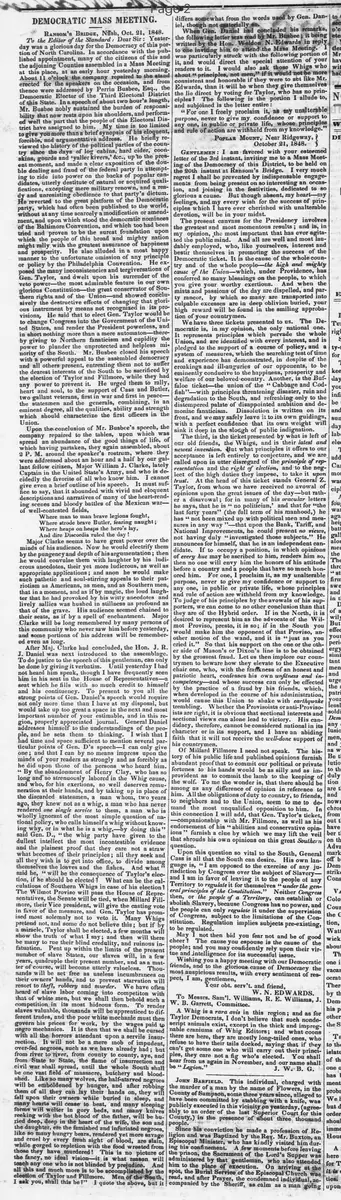
Ransom's Bridge, Nash, Oct. 21, 1848.
To the Editor of the Standard: Dear Sir: Yesterday was a glorious day for the Democracy of this portion of North Carolina. In accordance with the published appointment, many of the citizens of this and the adjoining counties assembled in a Mass Meeting at this place, at an early hour yesterday morning. About 11 o'clock the company repaired to the stand erected for the speakers on the occasion, and from thence were addressed by Perrin Busbee, Esq., the Democratic Elector of the Third Electoral District of this State. In a speech of about two hours' length, Mr. Busbee nobly sustained the burden of responsibility that now rests upon his shoulders, and performed well the part that the people of this Electoral District have assigned to him. My time is too limited to give you more than a brief synopsis of his eloquent, forcible, and argumentative address. He briefly reviewed the history of the political parties of the country since the days of log cabins, hard cider, coonskins, gourds and 'yaller kivers,' &c., up to the present moment, and made a clear exposition of the double dealing and fraud of the federal party in attempting to ride into power on the backs of popular candidates, utterly destitute of natural or acquired qualifications, excepting mere military renown, and a ready and unresisting obedience to that party's dictum. He reverted to the great platform of the Democratic party, which had often been published to the world, without at any time scarcely a modification or amendment, and upon which stood the democratic nominees of the Baltimore Convention, and which too had been tried and proven to be the surest foundation upon which the people of this broad and mighty nation might rally with the greatest assurance of happiness and prosperity. He also alluded in a most happy manner to the unfortunate omission of any principle or policy by the Philadelphia Convention. He exposed the many inconsistencies and tergiversations of Gen. Taylor, and dwelt upon his surrender of the veto power-the most admirable feature in our own glorious Constitution-the great conservator of Southern rights and of the Union-and showed conclusively the destructive effects of changing that glorious instrument by means not recognized in its provisions. He said that to elect Gen. Taylor would be to change Congress into the Government of the United States, and render the President powerless, and in short nothing more than a mere automaton-thereby giving to Northern fanaticism and cupidity the power to plunder the unprotected and helpless minority of the South. Mr. Busbee closed his speech with a powerful appeal to the assembled democracy and all others present, entreating them not to suffer the dearest interests of the South to be sacrificed by the election of Taylor and Fillmore, while they had any power to prevent it. He urged them to rally, heart and soul, to the support of Cass and Butler, two gallant veterans, first in war and first in peace-the statesmen and the generals, combining, in an eminent degree, all the qualities, ability and strength which should characterize the first officers in the Union.
Upon the conclusion of Mr. Busbee's speech, the company repaired to the tables, upon which was spread an abundance of the good things of life, of which having partaken, they again assembled, about 2 P. M. around the speaker's rostrum, where they were addressed about an hour and a half by our gallant fellow citizen, Major William J. Clarke, lately Captain in the United State's Army, and who is decidedly the favorite of all who know him. I cannot give even a brief outline of his speech. It must suffice to say, that it abounded with vivid and eloquent descriptions and narratives of many of the heart-rending scenes and bloody battles of the Mexican war-of well-contested fields,
Where man to man brave legions fought,
Where strode brave Butler, fearing naught;
Where heaps on heaps the hero's lay,
And dire Discordia ruled the day!
Major Clarke seems to have great power over the minds of his audience. Now he would electrify them by the pungency and depth of his argumentation; then he would convulse them with laughter by his ludicrous anecdotes, their yet more ludicrous, as well as appropriate applications; and anon he would make such pathetic and soul-stirring appeals to their patriotism as Americans, as men, and as Southern men, that in a moment, and as if by magic, the loud laughter that he had provoked by his witty anecdotes and lively sallies was hushed in stillness as profound as that of the grave. His audience seemed chained to their seats, as if by a spell of enchantment. Major Clarke will be long remembered by many persons of this community who never saw him before yesterday, and some portions of his address will be remembered even as long.
After Maj. Clarke had concluded, the Hon. J. R. J. Daniel was next introduced to the assemblage. To do justice to the speech of this gentleman, can only be done by giving it verbatim. Until yesterday I had not heard him speak, though I have frequently seen him in his seat in the House of Representatives-a seat which he fills with so much credit to himself and his constituency. To present to you all the strong points of Gen. Daniel's speech would require not only more time than I have at my disposal, but would take up too great a space in the next and most important number of your estimable, and in this region, properly appreciated journal. General Daniel addresses himself to the understandings of the people, and he sets them to thinking. I wish that I had time and space sufficient to mention several particular points of Gen. D's speech--I can only give one; and that I can by no means impress upon the minds of your readers as strongly and as forcibly as he did upon those of the persons who heard him.
"By the abandonment of Henry Clay, who has so long and so strenuously labored in the Whig cause, and who, for his exertions, so well deserves remuneration at their hands, and by taking up in place of the discarded statesmen, a man whom, two years ago, they knew not as a whig, a man who has never rendered one single service to them, a man who is wholly ignorant of the most simple question of national policy, who calls himself a whig without knowing why, or in what he is a whig,-by doing this," said Gen. D., "the whig party have given to the dullest intellect the most incontestible evidence and the plainest proof that they care not a straw what becomes of their principles; all they seek and all they wish is to get into office, to divide among themselves the loaves and the fishes. And what, said he, will be the consequence of Taylor's election, if he should be elected? What can be the calculations of Southern Whigs in case of his election? The Wilmot Proviso will pass the House of Representatives, the Senate will be tied, when Millard Fillmore, their Vice president, will give the casting vote in favor of the measure, and Gen. Taylor has promised most solemnly not to veto it. Many Whigs pretend not, and some do not believe this; but if by a miracle, Taylor shall be elected, a few months will show the truth of what I say; and then will there be many to rue their blind credulity, and ruinous infatuation. Pent up within the limits of the present number of slave States, our slaves will, in a few years, quadruple their present number, and as a matter of course, will become utterly valueless. Thousands will be set free as useless incumbrances on their owners' hands, and to prevent starvation will resort to theft, robbery and murder. We have often heard of slave labor coming into competition with that of white men, but we shall then behold such a competition in its most hideous form. To render slaves valuable, thousands will be apprenticed to different trades, and the poor white mechanic must then govern his prices for work, by the wages paid to negro mechanics. It is then that we shall be cursed with all the horrors attendant upon a servile insurrection. It will not be a mere mob of impudent, over-fed negroes, such as we have already had; but from river to river, from county to county, aye, and from State to State, the flame of insurrection and civil war shall spread, until the whole South shall be one vast field of massacre, butchery and bloodshed. Like so many wolves, the half-starved negroes will be emboldened by hunger, and after robbing them of all they can lay their hands on, they will fall upon their owners while buried in sleep, and many hearts will cease to beat, and many sleeping forms will welter in gory beds, and many knives reeking with the hot blood of the father, will be buried deep, deep in the heart of the wife, the son and the daughter, ere the famished and infuriated negroes, like so many hungry bears, rendered yet more savage and cruel by every fresh sight of blood, are slain, while gorged to repletion with the food wrested from those they have murdered! This is no picture of the fancy, no ideal vision-it is what reason will teach any one who is not blinded by prejudice. And all this and much more is to be accomplished by the election of Taylor and Fillmore. Men of the South, I ask you, shall this be?" I quote the above, but it differs somewhat from the words used by Gen. Daniel, though not materially so.
When Gen. Daniel had concluded his remarks, the following letter was read by Mr. Busbee; it being written by the Hon. Weldon N. Edwards in reply to one inviting him to attend the Mass Meeting. I was particularly struck with the following portion of it, and would direct the special attention of your readers to it. I would also ask those Whigs who shout "principles, not men," if it would not be more consistent and honorable if they were to act like Mr. Edwards, than it will be when they give themselves the lie direct by voting for Taylor, who has no principles? The following is the portion I allude to, and subjoined is the letter entire:
"For one I freely proclaim it, as my unalterable purpose, never to give my confidence or support to any one, in public or private life, whose principles and rule of action are withheld from my knowledge."
Poplar Mount, Near Ridgeway, October 21, 1848.
Gentlemen: I am favored with your esteemed letter of the 3rd instant, inviting me to a Mass Meeting of the Democracy of this District, to be held on the 20th instant at Ransom's Bridge. I very much regret I shall be prevented by indispensable engagements from being present on so interesting an occasion, and joining in the festivities, dedicated to so glorious a cause. But though absent, my heart-my feelings, and my every wish for the success of principles which I have ever cherished with unalterable devotion, will be in your midst.
The present canvass for the Presidency involves the greatest and most momentous results; and is, in my opinion, the most important that has ever agitated the public mind. And all are well and most laudably employed, who, like yourselves, interest and bestir themselves in promoting the success of the Democratic ticket. It is the cause of the whole country and of the whole people-the high and mighty cause of the Union-which, under Providence, has conferred so many blessings on the people, to which you give your worthy exertions. And when the mists and passions of the day are dispelled, and party rancor, by which so many are transported into culpable excesses are in deep oblivion buried, your high reward will be found in the smiling approbation of your countrymen.
We have three tickets presented to us. The Democratic is, in my opinion, the only national one. It represents principles which pervade the whole Union, and are identified with every interest, and is pledged to the support of a course of policy, and a system of measures, which the searching test of time and experience has demonstrated, in despite of the croakings and ill-auguries of our opponents, to be eminently conducive to the happiness, prosperity and welfare of our beloved country. Another, is the Buffalo ticket-the union of the "Cabbage and Codfish"-with principles threatening disaster, ruin and degradation to the South, and refreshing only to the distempered palate of disappointed ambition and demoniac fanaticism. Dissolution is written on its front, and we may safely leave it to its own guidings, with a perfect confidence that its own weight will sink it deep in the slough of public indignation.
The third, is the ticket presented by what is left of our old friends, the Whigs, and is their latest and newest invention. But what principles it offers to our acceptance is left entirely to conjecture, and we are called upon in utter disregard of the principle of representation and the right of election, and to the neglect of the high duties they impose, to take it upon trust. At the head of this ticket stands General Z. Taylor, from whom we have received no avowal of opinions upon the great issues of the day-but rather a disavowal; for in many of his oracular letters he says, that he is "no politician," and that for "the last forty years" (the full term of his manhood,) he has "not been mixed up with political men and measures in any way"-that upon the Bank, Tariff, and National Improvements, he could present no views, not having duly "investigated those subjects." He announces for himself, that he is an independent candidate. If to occupy a position, in which opinions of every hue may be ascribed to him, renders him so, then no one will envy him the honors of his attitude before a country and a people that have so much honored him. For one, I proclaim it, as my unalterable purpose, never to give my confidence or support to any one, in public or private life, whose principles and rule of action are withheld from my knowledge.
To judge of his principles by the avowals of his supporters, we can come to no other conclusion than that they are of the Hybrid order. If in the North, it is desired to represent him as the advocate of the Wilmot Proviso, presto, it is so; if in the South you would make him the opponent of that Proviso, another motion of the wand, and it is "just as you cried it." So that his support on the one or the other side of Mason's and Dixon's line is to be obtained by the grossest fraud. Let us then implore our countrymen to beware how they elevate to the Executive chair one, who, with the frankness of an honest and patriotic heart, confesses his own unfitness and incompetency-and whose success can only be effected by the practice of a fraud by his friends, which, when developed in the course of his administration, would cause this Union to shake with earthquake trembling. Whether the Provisoists or anti-Provisoists are right, it is obvious that sectional interests and sectional views can alone lead to victory. His candidacy, therefore, cannot be considered national in its character or in its support, and I have an abiding faith that it will not receive the well-deserved support of his countrymen.
Of Millard Fillmore I need not speak. The history of his public life and published opinions furnish abundant proof that to commit our political or private fortunes to his hands would be as silly and as improvident as to commit the lamb to the keeping of the wolf. To me the wonder is, that there should be among us any difference of opinion in reference to him. All the obligations of duty to country, to friends, to neighbors and to the Union, seem to me to demand the most unqualified opposition to him. In this connection I will add, that Gen. Taylor's ticket, companionship with Mr. Fillmore, as well as his endorsement of his "abilities and conservative opinions" furnish a clue by which we may lift the veil that shrouds his own opinions on this great Southern question.
Upon this question so vital to the South, General Cass is all that the South can desire. His own language is, "I am opposed to the exercise of any jurisdiction by Congress over the subject of Slavery and I am in favor of leaving it to the people of any Territory to regulate it for themselves" under the general principles of the Constitution. Neither Congress then, or the people of a Territory, can establish or abolish Slavery, because Congress has no power, and the people can only regulate it under the supervision of Congress, subject to the limitations of the Constitution. Regulation implies subjects pre-existing, to be regulated. May I not then bid you fear not and be of good cheer? The cause you espouse is the cause of the people; and you may confidently rely upon their virtue and intelligence for its successful issue.
Wishing you a happy meeting with our Democratic friends, and to the glorious cause of Democracy the most auspicious results, with every sentiment of respect, I am, gentlemen,
Your obt. serv't. and friend,
W. N. EDWARDS.
To Messrs. Sam'l. Williams, R. E. Williams, J. W. B. Garrett, Committee.
A Whig is a rara avis in this region; and as for Taylor Democrats, I don't believe that such nondescript animals exist, except in the thick and impregnable craniums of Whig Editors; and what coons there are here, they are mostly long-tailed ones, who refuse to have their tails docked, saying that if they can't get some one who will carry out their principles, they care not a fig who's elected. You shall hear from us again in November, and our name shall be "Legion."
J. W. B. G.
What sub-type of article is it?
What themes does it cover?
What keywords are associated?
What entities or persons were involved?
Where did it happen?
Story Details
Key Persons
Location
Ransom's Bridge, Nash, North Carolina
Event Date
Oct. 21, 1848
Story Details
A Democratic mass meeting at Ransom's Bridge featured speeches by Perrin Busbee, Major William J. Clarke, and Hon. J. R. J. Daniel supporting Cass and Butler, criticizing Taylor and Fillmore for lacking principles and threatening Southern rights, especially regarding slavery and the Wilmot Proviso. A letter from Weldon N. Edwards was read, reinforcing Democratic principles.