Thank you for visiting SNEWPapers!
Sign up free
Story
October 29, 1955
The Guardian
Boston, Suffolk County, Massachusetts
What is this article about?
NIH researchers Dr. Johns and Olson reported at the American Heart Association sessions that rat heart muscles show reserve strength after induced attacks and exercise tests, using 400 animals.
Clipping
OCR Quality
90%
Excellent
Full Text
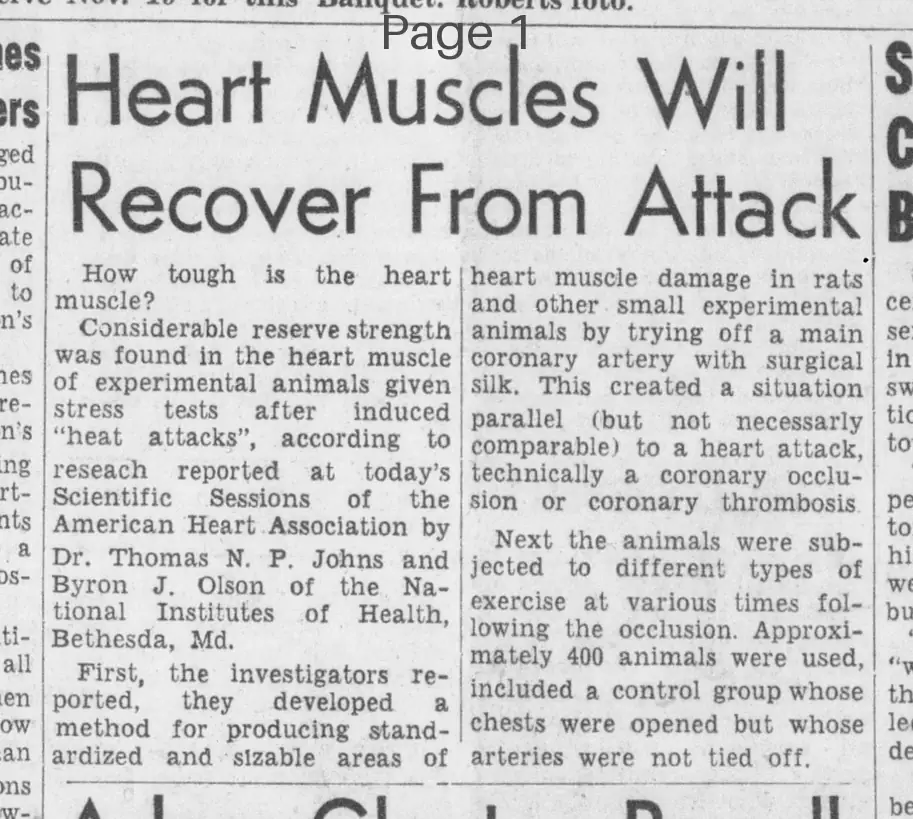
Heart Muscles Will Recover From Attack
How tough is the heart muscle?
Considerable reserve strength was found in the heart muscle of experimental animals given stress tests after induced "heart attacks", according to research reported at today's Scientific Sessions of the American Heart Association by Dr. Thomas N. P. Johns and Byron J. Olson of the National Institutes of Health, Bethesda, Md.
First, the investigators reported, they developed a method for producing standardized and sizable areas of heart muscle damage in rats and other small experimental animals by tying off a main coronary artery with surgical silk. This created a situation parallel (but not necessarily comparable) to a heart attack, technically a coronary occlusion or coronary thrombosis.
Next the animals were subjected to different types of exercise at various times following the occlusion. Approximately 400 animals were used, included a control group whose chests were opened but whose arteries were not tied off.
How tough is the heart muscle?
Considerable reserve strength was found in the heart muscle of experimental animals given stress tests after induced "heart attacks", according to research reported at today's Scientific Sessions of the American Heart Association by Dr. Thomas N. P. Johns and Byron J. Olson of the National Institutes of Health, Bethesda, Md.
First, the investigators reported, they developed a method for producing standardized and sizable areas of heart muscle damage in rats and other small experimental animals by tying off a main coronary artery with surgical silk. This created a situation parallel (but not necessarily comparable) to a heart attack, technically a coronary occlusion or coronary thrombosis.
Next the animals were subjected to different types of exercise at various times following the occlusion. Approximately 400 animals were used, included a control group whose chests were opened but whose arteries were not tied off.
What sub-type of article is it?
Medical Curiosity
What themes does it cover?
Recovery
What keywords are associated?
Heart Muscle
Recovery
Heart Attack
Rats
Exercise
Coronary Occlusion
Stress Tests
What entities or persons were involved?
Dr. Thomas N. P. Johns
Byron J. Olson
Where did it happen?
Bethesda, Md.
Story Details
Key Persons
Dr. Thomas N. P. Johns
Byron J. Olson
Location
Bethesda, Md.
Story Details
Researchers developed a method to induce heart muscle damage in rats by tying off a coronary artery, simulating a heart attack, then subjected the animals to exercise stress tests, finding considerable reserve strength in the heart muscle.