Thank you for visiting SNEWPapers!
Sign up free
Story
December 28, 1898
The Breckenridge News
Hardinsburg, Cloverport, Breckinridge County, Kentucky
What is this article about?
At the theater, young Margot becomes disillusioned with her stuffy fiancé Richard Chinnock's formal behavior, contrasting it with the affection she craves from childhood friend Don Garrick. She ends the evening by asking Don to take her home and love her truly.
Clipping
OCR Quality
98%
Excellent
Full Text
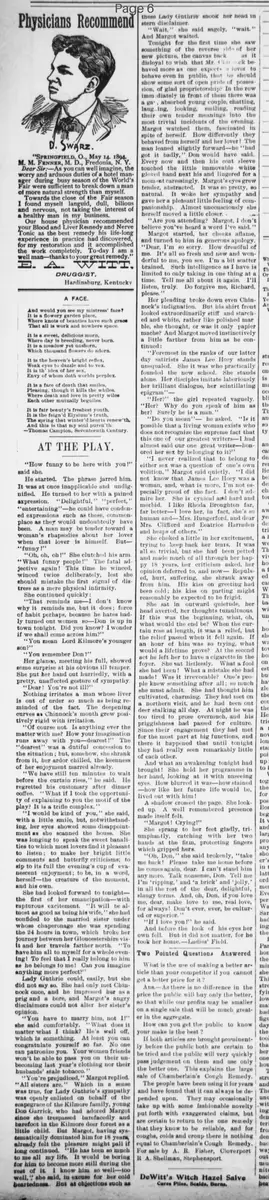
AT THE PLAY.
"How funny to be here with you!" said she.
He started. The phrase jarred him. It was at once inapplicable and undignified. He turned to her with a pained expression. "Delightful," "perfect," "entertaining"—he could have condoned expressions such as these, commonplace as they would undoubtedly have been. A man may be tender toward a woman's rhapsodies about her lover when that lover is himself. But—
"funny!"
"Oh, oh, oh!" She clutched his arm. "What funny people!" The fatal adjective again! This time he winced, winced twice deliberately, lest she should mistake the first signal of distress as a mere physical infirmity.
She continued quickly:
"That reminds me—I don't know why it reminds me, but it does: force of habit perhaps, because he hates badly turned out women so—Don is up in town tonight. Did you know? I wonder if we shall come across him?"
"You mean Lord Kilmore's younger son?"
"You remember Don?"
Her glance, meeting his full, showed some surprise at his obvious ill temper. She put her hand out hurriedly, with a pretty, unaffected gesture of sympathy.
"Dear! You're not ill?"
Nothing irritates a man whose liver is out of order so much as being reminded of the fact. The deepening curves at Chinnock's mouth grew positively rigid with irritation.
"Of course not. Is anything ever the matter with me? How your imagination runs away with you—dearest!" The "dearest" was a dutiful concession to the situation: but, somehow, she shrank from it. Her ardor chilled, the keenness of her enjoyment marred already.
"We have still ten minutes to wait before the curtain rises," he said. He regretted his customary after dinner coffee. "What if I took the opportunity of explaining to you the motif of the play? It is a trifle complex."
"I would be kind of you," she said with a little smile, but, notwithstanding, her eyes showed some disappointment as she scanned the house. She was longing to speak the sweet banalities to which most lovers find it pleasant to listen; to make her bright little comments and butterfly criticisms; to sip to its full the evening's cup of evanescent enjoyment: to be, in a word, herself—the creature of the moment, and his own.
She had looked forward to tonight—the first of her emancipation—with rapturous excitement. "It will be almost as good as being his wife," she had confided to the married sister under whose chaperonage she was spending the 24 hours in town, which broke her journey between her Gloucestershire visit and her travels farther north. "To have him all to myself for a whole evening! To feel that I really belong to him as he belongs to me! Can you imagine anything more perfect?"
Lady Guthrie could, easily, but she did not say so. She had only met Chinnock once, and he impressed her as a prig and a bore, and Margot's angry disclaimers could not alter her sister's opinion.
"You have to marry him, not I!"
she said comfortably. "What does it matter what I think? He's well off, which is something. At least you can congratulate yourself so far. No one can patronize you. Your women friends won't be able to pass you on their unbecoming last year's clothing nor their husbands' stale tobacco."
"You're prejudiced." Margot replied.
"All sisters are." Which in a sense was true, for Lady Guthrie's sympathy was openly enlisted on behalf of the scapegrace of the Kilmore family, young Don Garrick, who had adored Margot since she trespassed barefacedly and barefoot in the Kilmore deer forest as a little child. But Margot, having systematically dominated him for 18 years, already felt the pleasure might pall if long continued. "He has been so much to me all my life. It would be boring for him to become more still during the rest of it. I know him so well—too well," she said, in excuse for her coldheartedness. But at objections such as these Lady Guthrie shook her head in stern disclaimer.
"Wait," she said sagely, "wait."
And Margot waited. Tonight for the first time she saw something of the reverse side of her new picture, the canvas back as it were.
Is it disloyal to wish that Mr. Garrick behaved more as one expects a lover to behave even in public, that he should show some sort of open pride of possession, of glad proprietorship? In the row immediately in front of them there was a gay, absorbed young couple, chatting, laughing, looking, smiling, reading their own tender meanings into the most trivial incidents of the evening.
Margot watched them, fascinated in spite of herself. How differently they behaved from herself and her lover! The man leaned slightly forward—he "had got it badly," Don would have said. Every now and then his coat sleeve touched the little immovable white gloved hand next his and lingered for a moment caressingly. Margot's eyes grew tender, abstracted. It was so pretty, so natural. It woke her sympathy and gave her a pleasant little feeling of companionship. Almost unconsciously she herself moved a little closer.
"Are you attending? Margot, I don't believe you've heard a word I've said."
Margot started, her cheeks aflame, and turned to him in generous apology.
"Dear, I'm so sorry. How dreadful of me. It's all so fresh and new and wonderful to me, you see. I'm a bit scatterbrained. Such intelligence as I have is limited to only taking in one thing at a time. Tell me all about it again. I'll listen, truly. Do forgive me, Richard, please."
Her pleading broke down even Chinnock's indignation. But his shirt front looked extraordinarily stiff and starched and white, rather like polished marble, she thought, or was it only papier mache? And Margot moved instinctively a little farther from him as he continued:
"Foremost in the ranks of our latter day satirists James Lee Hoey stands unequaled. She it was who practically founded the new school. She stands alone. Her disciples imitate laboriously her brilliant dialogue, her scintillating epigram—"
"Her?" the girl repeated vaguely.
"Her? Why do you speak of him as her? Surely he is a man."
"Do you mean—" he asked. "Is it possible that a living woman exists who does not recognize the supreme fact that this one of our greatest writers—I had almost said our one great writer—honored her sex by belonging to it?"
"I never realized that to belong to either sex was a question of one's own volition," Margot said quietly, "I did not know that James Lee Hoey was a woman, and what is more, I'm not especially proud of the fact. I don't admire her. She is cynical and hard and morbid. I like Rhoda Broughton far, far better—I love her, in fact, she's so human and—Mrs. Hungerford, and dear Mrs. Clifford and Beatrice Harraden and heaps of others."
She choked a little in her excitement trying to keep back her tears. It was all so trivial, but she had been petted and made much of all through her happy 18 years, her criticism asked, her opinion deferred to, and now—Repulsed, hurt, suffering, she shrank away from him. His kiss on greeting had been cold: his kiss on parting might reasonably be expected to be frigid.
She sat in outward quietude, her head averted, her thoughts tumultuous. If this was the beginning, what, oh what would the end be? When the curtain rose at length, it was a relief, but the relief passed when it fell again. If an hour of him was so trying, what would a lifetime prove? At the second act he left her to have a cigaretto in the foyer. She sat listlessly. What a fool she had been! What a mistake she had made! Was it irrevocable? One's people knew something after all; so much she must admit. She had thought him cultivated, charming. They had met on a northern visit, and he had been out deer stalking all day. At night he was too tired to prose overmuch, and his priggishness had passed for culture.
Since their engagement they had met for the most part at big functions, and there it happened that until tonight they had really seen remarkably little of each other.
And what an awakening tonight had brought! She held her programme in her hand, looking at it with unseeing eyes. How blurred it was—how stained—how like her future life would be lived out with him!
A shadow crossed the page. She looked up. A well remembered presence made itself felt.
"Margot! Crying!"
She sprang to her feet gladly, triumphantly, catching with her two hands at the firm, protecting fingers which gripped hers.
"Oh, Don," she said brokenly, "take me back! Please take me home before he comes again, dear. I can't stand him any more. Talk nonsense, Don. Tell me I'm 'ripping' and 'a brick' and 'jolly,' in all the rest of the dear, delightful, slangy terms. And, oh, Don, if you love me, dear, make love to me, real love, for always! Don't ever, ever, be cultured or superior."
"If I love you!" he said
And before the look of his eyes her own fell. But it did not matter, for he took her home.—Ladies' Field
"How funny to be here with you!" said she.
He started. The phrase jarred him. It was at once inapplicable and undignified. He turned to her with a pained expression. "Delightful," "perfect," "entertaining"—he could have condoned expressions such as these, commonplace as they would undoubtedly have been. A man may be tender toward a woman's rhapsodies about her lover when that lover is himself. But—
"funny!"
"Oh, oh, oh!" She clutched his arm. "What funny people!" The fatal adjective again! This time he winced, winced twice deliberately, lest she should mistake the first signal of distress as a mere physical infirmity.
She continued quickly:
"That reminds me—I don't know why it reminds me, but it does: force of habit perhaps, because he hates badly turned out women so—Don is up in town tonight. Did you know? I wonder if we shall come across him?"
"You mean Lord Kilmore's younger son?"
"You remember Don?"
Her glance, meeting his full, showed some surprise at his obvious ill temper. She put her hand out hurriedly, with a pretty, unaffected gesture of sympathy.
"Dear! You're not ill?"
Nothing irritates a man whose liver is out of order so much as being reminded of the fact. The deepening curves at Chinnock's mouth grew positively rigid with irritation.
"Of course not. Is anything ever the matter with me? How your imagination runs away with you—dearest!" The "dearest" was a dutiful concession to the situation: but, somehow, she shrank from it. Her ardor chilled, the keenness of her enjoyment marred already.
"We have still ten minutes to wait before the curtain rises," he said. He regretted his customary after dinner coffee. "What if I took the opportunity of explaining to you the motif of the play? It is a trifle complex."
"I would be kind of you," she said with a little smile, but, notwithstanding, her eyes showed some disappointment as she scanned the house. She was longing to speak the sweet banalities to which most lovers find it pleasant to listen; to make her bright little comments and butterfly criticisms; to sip to its full the evening's cup of evanescent enjoyment: to be, in a word, herself—the creature of the moment, and his own.
She had looked forward to tonight—the first of her emancipation—with rapturous excitement. "It will be almost as good as being his wife," she had confided to the married sister under whose chaperonage she was spending the 24 hours in town, which broke her journey between her Gloucestershire visit and her travels farther north. "To have him all to myself for a whole evening! To feel that I really belong to him as he belongs to me! Can you imagine anything more perfect?"
Lady Guthrie could, easily, but she did not say so. She had only met Chinnock once, and he impressed her as a prig and a bore, and Margot's angry disclaimers could not alter her sister's opinion.
"You have to marry him, not I!"
she said comfortably. "What does it matter what I think? He's well off, which is something. At least you can congratulate yourself so far. No one can patronize you. Your women friends won't be able to pass you on their unbecoming last year's clothing nor their husbands' stale tobacco."
"You're prejudiced." Margot replied.
"All sisters are." Which in a sense was true, for Lady Guthrie's sympathy was openly enlisted on behalf of the scapegrace of the Kilmore family, young Don Garrick, who had adored Margot since she trespassed barefacedly and barefoot in the Kilmore deer forest as a little child. But Margot, having systematically dominated him for 18 years, already felt the pleasure might pall if long continued. "He has been so much to me all my life. It would be boring for him to become more still during the rest of it. I know him so well—too well," she said, in excuse for her coldheartedness. But at objections such as these Lady Guthrie shook her head in stern disclaimer.
"Wait," she said sagely, "wait."
And Margot waited. Tonight for the first time she saw something of the reverse side of her new picture, the canvas back as it were.
Is it disloyal to wish that Mr. Garrick behaved more as one expects a lover to behave even in public, that he should show some sort of open pride of possession, of glad proprietorship? In the row immediately in front of them there was a gay, absorbed young couple, chatting, laughing, looking, smiling, reading their own tender meanings into the most trivial incidents of the evening.
Margot watched them, fascinated in spite of herself. How differently they behaved from herself and her lover! The man leaned slightly forward—he "had got it badly," Don would have said. Every now and then his coat sleeve touched the little immovable white gloved hand next his and lingered for a moment caressingly. Margot's eyes grew tender, abstracted. It was so pretty, so natural. It woke her sympathy and gave her a pleasant little feeling of companionship. Almost unconsciously she herself moved a little closer.
"Are you attending? Margot, I don't believe you've heard a word I've said."
Margot started, her cheeks aflame, and turned to him in generous apology.
"Dear, I'm so sorry. How dreadful of me. It's all so fresh and new and wonderful to me, you see. I'm a bit scatterbrained. Such intelligence as I have is limited to only taking in one thing at a time. Tell me all about it again. I'll listen, truly. Do forgive me, Richard, please."
Her pleading broke down even Chinnock's indignation. But his shirt front looked extraordinarily stiff and starched and white, rather like polished marble, she thought, or was it only papier mache? And Margot moved instinctively a little farther from him as he continued:
"Foremost in the ranks of our latter day satirists James Lee Hoey stands unequaled. She it was who practically founded the new school. She stands alone. Her disciples imitate laboriously her brilliant dialogue, her scintillating epigram—"
"Her?" the girl repeated vaguely.
"Her? Why do you speak of him as her? Surely he is a man."
"Do you mean—" he asked. "Is it possible that a living woman exists who does not recognize the supreme fact that this one of our greatest writers—I had almost said our one great writer—honored her sex by belonging to it?"
"I never realized that to belong to either sex was a question of one's own volition," Margot said quietly, "I did not know that James Lee Hoey was a woman, and what is more, I'm not especially proud of the fact. I don't admire her. She is cynical and hard and morbid. I like Rhoda Broughton far, far better—I love her, in fact, she's so human and—Mrs. Hungerford, and dear Mrs. Clifford and Beatrice Harraden and heaps of others."
She choked a little in her excitement trying to keep back her tears. It was all so trivial, but she had been petted and made much of all through her happy 18 years, her criticism asked, her opinion deferred to, and now—Repulsed, hurt, suffering, she shrank away from him. His kiss on greeting had been cold: his kiss on parting might reasonably be expected to be frigid.
She sat in outward quietude, her head averted, her thoughts tumultuous. If this was the beginning, what, oh what would the end be? When the curtain rose at length, it was a relief, but the relief passed when it fell again. If an hour of him was so trying, what would a lifetime prove? At the second act he left her to have a cigaretto in the foyer. She sat listlessly. What a fool she had been! What a mistake she had made! Was it irrevocable? One's people knew something after all; so much she must admit. She had thought him cultivated, charming. They had met on a northern visit, and he had been out deer stalking all day. At night he was too tired to prose overmuch, and his priggishness had passed for culture.
Since their engagement they had met for the most part at big functions, and there it happened that until tonight they had really seen remarkably little of each other.
And what an awakening tonight had brought! She held her programme in her hand, looking at it with unseeing eyes. How blurred it was—how stained—how like her future life would be lived out with him!
A shadow crossed the page. She looked up. A well remembered presence made itself felt.
"Margot! Crying!"
She sprang to her feet gladly, triumphantly, catching with her two hands at the firm, protecting fingers which gripped hers.
"Oh, Don," she said brokenly, "take me back! Please take me home before he comes again, dear. I can't stand him any more. Talk nonsense, Don. Tell me I'm 'ripping' and 'a brick' and 'jolly,' in all the rest of the dear, delightful, slangy terms. And, oh, Don, if you love me, dear, make love to me, real love, for always! Don't ever, ever, be cultured or superior."
"If I love you!" he said
And before the look of his eyes her own fell. But it did not matter, for he took her home.—Ladies' Field
What sub-type of article is it?
Romance
What themes does it cover?
Love
Social Manners
Fortune Reversal
What keywords are associated?
Romantic Disillusionment
Theater Date
Engagement Regret
Social Norms
Courtship
What entities or persons were involved?
Margot
Richard Chinnock
Don Garrick
Lady Guthrie
Where did it happen?
Theater In Town
Story Details
Key Persons
Margot
Richard Chinnock
Don Garrick
Lady Guthrie
Location
Theater In Town
Story Details
Margot attends the theater with her fiancé Richard Chinnock, growing disillusioned with his priggish demeanor and realizing her preference for the more affectionate Don Garrick, whom she asks to take her home and make love to her.