Thank you for visiting SNEWPapers!
Sign up free
The Chicago Star
Chicago, Cook County, Illinois
What is this article about?
Investigative series on Capt. George Barnes, Chicago police captain heading the labor detail, detailing his strikebreaking role from 1933-46, including arrests during CIO and UAW strikes against gear manufacturers and Westinghouse. Union leaders seek City Council probe for abolition. Court cases against 69 UAW pickets continued.
Merged-components note: Second component continues the narrative on Capt. Barnes' activities against labor; sequential reading order and same subject.
Clipping
OCR Quality
Full Text
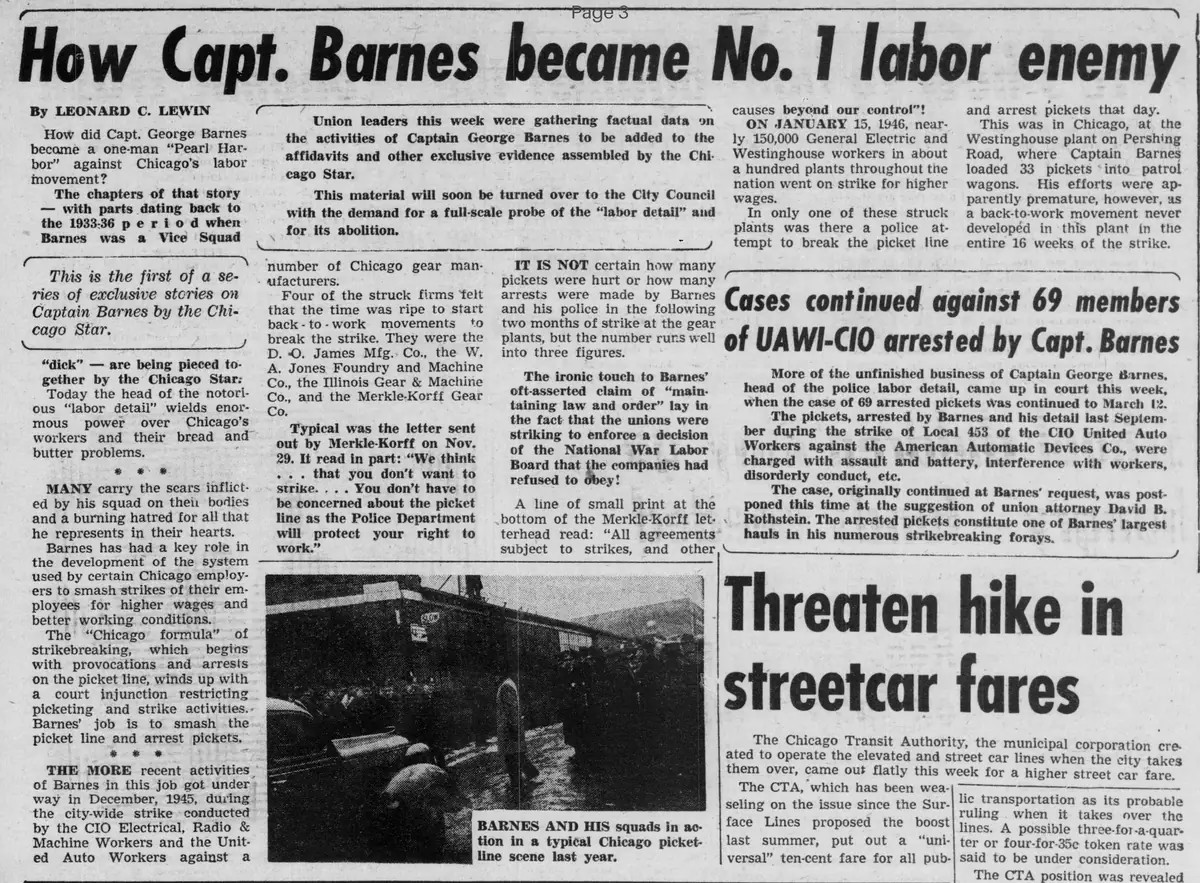
By LEONARD C. LEWIN
How did Capt. George Barnes become a one-man "Pearl Harbor" against Chicago's labor movement?
The chapters of that story, with parts dating back to the 1933-36 period when Barnes was a Vice Squad "dick," are being pieced together by the Chicago Star.
This is the first of a series of exclusive stories on Captain Barnes by the Chicago Star.
Today the head of the notorious "labor detail" wields enormous power over Chicago's workers and their bread and butter problems.
MANY carry the scars inflicted by his squad on their bodies and a burning hatred for all that he represents in their hearts.
Barnes has had a key role in the development of the system used by certain Chicago employers to smash strikes of their employees for higher wages and better working conditions.
The "Chicago formula" of strikebreaking, which begins with provocations and arrests on the picket line, winds up with a court injunction restricting picketing and strike activities.
Barnes' job is to smash the picket line and arrest pickets.
THE MORE recent activities of Barnes in this job got under way in December 1945, during the city-wide strike conducted by the CIO Electrical, Radio & Machine Workers and the United Auto Workers against a number of Chicago gear manufacturers.
Four of the struck firms felt that the time was ripe to start back-to-work movements to break the strike. They were the D. O. James Mfg. Co., the W. A. Jones Foundry and Machine Co., the Illinois Gear & Machine Co., and the Merkle-Korff Gear Co.
Typical was the letter sent out by Merkle-Korff on Nov. 29. It read in part: "We think . . . that you don't want to strike. . . . You don't have to be concerned about the picket line as the Police Department will protect your right to work."
IT IS NOT certain how many pickets were hurt or how many arrests were made by Barnes and his police in the following two months of strike at the gear plants, but the number runs well into three figures.
The ironic touch to Barnes' oft-asserted claim of "maintaining law and order" lay in the fact that the unions were striking to enforce a decision of the National War Labor Board that the companies had refused to obey!
A line of small print at the bottom of the Merkle-Korff letterhead read: "All agreements subject to strikes, and other causes beyond our control"!
ON JANUARY 15, 1946, nearly 150,000 General Electric and Westinghouse workers in about a hundred plants throughout the nation went on strike for higher wages.
In only one of these struck plants was there a police attempt to break the picket line and arrest pickets that day.
This was in Chicago, at the Westinghouse plant on Pershing Road, where Captain Barnes loaded 33 pickets into patrol wagons.
His efforts were apparently premature, however, as a back-to-work movement never developed in this plant in the entire 16 weeks of the strike.
Union leaders this week were gathering factual data on the activities of Captain George Barnes to be added to the affidavits and other exclusive evidence assembled by the Chicago Star.
This material will soon be turned over to the City Council with the demand for a full-scale probe of the "labor detail" and for its abolition.
Cases continued against 69 members of UAW-CIO arrested by Capt. Barnes
More of the unfinished business of Captain George Barnes, head of the police labor detail, came up in court this week, when the case of 69 arrested pickets was continued to March 12.
The pickets, arrested by Barnes and his detail last September during the strike of Local 453 of the CIO United Auto Workers against the American Automatic Devices Co., were charged with assault and battery, interference with workers, disorderly conduct, etc.
The case, originally continued at Barnes' request, was postponed this time at the suggestion of union attorney David B. Rothstein. The arrested pickets constitute one of Barnes' largest hauls in his numerous strikebreaking forays.
What sub-type of article is it?
What themes does it cover?
What keywords are associated?
What entities or persons were involved?
Where did it happen?
Story Details
Key Persons
Location
Chicago
Event Date
1933 1946
Story Details
Capt. Barnes, head of Chicago police labor detail, has suppressed strikes since 1930s by arresting pickets and aiding employers, notably in 1945-46 gear manufacturers and Westinghouse strikes enforcing War Labor Board decisions. Unions gather evidence for City Council probe to abolish the detail. Court continues cases against 69 UAW pickets arrested in September strike.