Thank you for visiting SNEWPapers!
Sign up free
Editorial
March 31, 1832
New Hampshire Statesman And State Journal
Concord, Merrimack County, New Hampshire
What is this article about?
This editorial notes the upcoming Connecticut election for a U.S. Senator, criticizes Van Buren's diplomatic mission, and delivers a lengthy warning from New Hampshire's recent election. It lambasts the state's anti-majority politics, Jackson's administration for corruption and vindictiveness, and urges virtue and integrity in rulers to avert national catastrophe and preserve republican institutions.
Clipping
OCR Quality
92%
Excellent
Full Text
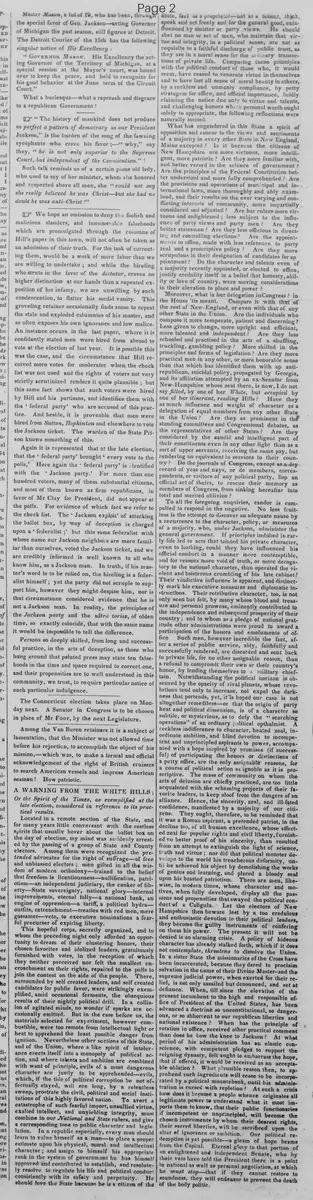
The Connecticut election takes place on Monday next. A Senator in Congress is to be chosen in place of Mr Foot, by the next Legislature.
Among the Van Buren retainers it is a subject of lamentation, that the Minister was not allowed time before his rejection, to accomplish the object of his mission,—which was, to make a formal and official acknowledgement of the right of British cruisers to search American vessels and impress American seamen! How patriotic.
A WARNING FROM THE WHITE HILLS:
Or the Spirit of the Times, as exemplified at the late election, considered in reference to its practical results.
Located in a remote section of the State, and for many years little conversant with the restless spirits that usually hover about the ballot box on the day of election, my mind was suddenly arrested by the passing of a group of State and County electors. Among them were recognized the pretended advocates for the right of suffrage—of free and unbiassed electors; men gifted in all the wisdom of modern orthodoxy—trained to the belief that freedom is licentiousness—nullification, patriotism—an independent judiciary, the canker of liberty—State sovereignty, national glory—internal improvements, eternal folly—a national bank, an engine of oppression—a tariff, a political hydra—outfits, retrenchment—treaties with red men, mere gossamer—veto, to executive nominations a fearful precursor of expiring liberty.
This hopeful corps, secretly organized, and to whom the preceding night only afforded an opportunity to dream of their clustering honors, their chosen favorites and idolized leaders, gratuitously furnished with votes, in the reception of which they neither perceived nor felt the smallest encroachment on their rights, repaired to the polls to join the contest on the side of the people. There, surrounded by self created leaders, and self created candidates for public favor, were strikingly exemplified, amid occasional ferments, the obsequious results of their nightly political drill. In a collision of agitated minds, no wonder if sparks are occasionally emitted. But in the case before us, the materials selected for experiment, however combustible, were too remote from intellectual light or heat to apprehend the least possible danger from ignition. Nevertheless other sections of this State, and of the Union, where a like spirit of intolerance erects itself into a monopoly of political action, and where talents and ambition are combined with want of principle, evils of a most dangerous character are justly to be apprehended—evils, which, if the tide of political corruption be not effectually stayed, will ere long, by 'a relentless sweep, prostrate the civil, political and social institutions of this highly favored nation. To avert a catastrophe of such fearful import, unsullied virtue, exalted intellect, and unyielding integrity, must combine in our National and State rulers, and give a corresponding tone to public character and legislation. In a republic especially, every man should learn to value himself as a man—to place a proper estimate upon his physical, moral and intellectual character; and assign to himself his appropriate rank in the system of government he has himself approved and contributed to establish, and resolutely resolve to regulate his life and political conduct consistently with its safety and perpetuity. He should love the State because he is a citizen of the State, feel as a proprietor—not as a tenant, think, speak and act freely and for the general good, uninfluenced by sinister or party views. He should abet no man or set of men, who maintain that virtue and integrity, in a political sense, are not as requisite to a faithful discharge of public trust, as they are in a moral sense for the ordinary transactions of private life. Comparing these principles with the political conduct of those who, it would seem, have ceased to venerate virtue in themselves and to have lost all sense of moral beauty in others, by a reckless and unmanly compliance, by petty stratagem for office, and official importance, boldly claiming the notice due only to virtue and talents, and challenging honors which personal worth ought solely to appropriate, the following reflections were naturally incited.
What has engendered in this State a spirit of opposition and rancor to the views and sentiments of a majority in every other State in New England, Maine excepted? Is it because the citizens of New Hampshire are more virtuous, more intelligent, more patriotic? Are they more familiar with, and better versed in the science of government?
Are the principles of the Federal Constitution better understood and more fully comprehended? Are the provisions and operations of municipal and international laws, more thoroughly and ably examined. and their results on the ever varying and conflicting interests of community, more impartially considered and adjusted? Are her rulers more virtuous and enlightened; less subject to the influence of party views and party men? Are they better statesmen? Are they less officious in directing and controlling elections? Are the appointments to office, made with less reference to party zeal and a proscriptive policy? Are they more scrupulous in their designation of candidates for appointment? Do the character and talents even of a majority recently appointed, or elected to office, justify credulity itself in a belief that honesty, ability or love of country, were moving considerations in their elevation to place and power?
Moreover, what is her delegation in Congress? in the House 'tis meant. Compare it with that of the rest of New-England, or even with that of any other State in the Union. Are the individuals who compose it more temperate, patient and discerning? Less given to change, more upright and efficient, more talented and independent? Are they less schooled and practised in the arts of a shuffling, truckling, gambling policy? More skilled in the principles and forms of legislation? Are they more practical men in any other, or more honorable sense than that which has identified them with an anti-republican, suicidal policy, propagated by Georgia, and its affiliation attempted by an ex-Senator from New-Hampshire whose seat there, is now, I do not say filled, by one of her White, but occupied by one of her itinerant, reading Hills? Have they as much influence and weight of character as a delegation of equal numbers from any other State in the Union? Are they as prominent in the standing committees and Congressional debates, as the representatives of other States? Are they considered by the candid and intelligent part of their constituents even in any other light than as a sort of upper servants, receiving the same pay, but rendering no equivalent in services to their country? Do the journals of Congress, except as a dry record of yeas and nays, or do members, correspondents, or visitors of any political party, lisp an official act of theirs, to rescue their memory as members of Congress, from sinking hereafter into total and merited oblivion?
To all the foregoing enquiries, candor is compelled to respond in the negative. No less fruitless is the attempt to discover an adequate cause by a recurrence to the character, policy, or measures of a majority, who, under Jackson, administer the general government. If principles imbibed in early life led to acts that tainted his private character, even to loathing, could they have influenced his official conduct in a manner more contemptible, and for reasons more void of truth, or more derogatory to the national character, than operated the violent and boisterous crumbling of his late cabinet?
Their vindictive influence is apparent, and distinctly mark his executive measures and diplomatic instructions. Their retributive character, too, is not only seen but felt, by many whose blood and treasure and personal prowess, eminently contributed to the independence and subsequent prosperity of their country; and to whom as a pledge of national gratitude other administrations were proud to award a participation of the honors and emoluments of office Such men, however incredible the fact, after a series of public service, ably, faithfully and successfully rendered, are discarded and sent back to private life, for no other assignable reason, than a refusal to compromit their own or their country's honor, by lending themselves to a military chieftain. Notwithstanding the political horizon is obscured by the opacity of rival planets, whose revolutions tend only to increase, not expel the darkness that portends, yet, it is hoped our case is not altogether remediless—or that the origin of party heat and political dissension, is of a character so subtile, or mysterious, as to defy the "searching operations" of an ordinary political ophthalmist. A reckless indifference to character, heated zeal, inordinate ambition, and blind devotion to incompetent and unprincipled aspirants to power, accompanied with a hope inspired by promises (if successful) of participating the honors or distinctions of a petty office, are the only assignable reasons, for a course of political action as ignoble as it is proscriptive. The mass of community on whom the arts of delusion are chiefly practiced, are too little acquainted with the scheming projects of their favorite leaders, to keep aloof from the dangers of an alliance. Hence, the sincerity, zeal, and ill-fated confidence, manifested by a majority of our citizens. They ought, therefore, to be reminded that it was a Roman aspirant, a pretended patriot, in the decline too, of all human excellence, whose affected zeal for popular rights and civil liberty, furnished no better proof of his sincerity, than resulted from an attempt to extinguish the light of science, truth and virtue; nor did that political monster develope to the world his treacherous deformity, until he achieved his object by demolishing the works of genius and learning, and placed a bloody seal upon his boasted patriotism. There are men, likewise, in modern times, whose character and motives, when fully developed, display all the passions and propensities that swayed the political conduct of a Caligula. Let the electors of New Hampshire then beware lest by a too credulous and enthusiastic devotion to their political leaders, they become the guilty instruments of conferring on them his power. The present it will not be denied is an alarming crisis. A policy of hideous character has already stalked forth, which if it does not contemplate, threatens to dissolve the Union.
In a sister State the missionaries of the Cross have been incarcerated, because they dared to proclaim salvation in the name of their Divine Master—and the supreme judicial power, when exerted for their relief, is not only assailed but denounced, and set at defiance. When, till since the elevation of the present incumbent to the high and responsible office of President of the United States, has been advanced a doctrine so unconstitutional, so dangerous, or so abhorrent to our republican liberties and national existence? When has the principle of rotation in office, received other practical comment than does he bow the knee to Jackson? At what period of his administration has an elastic conscience, with competent pledges to support the reigning dynasty, felt aught to embarrass the hope, that if offered, it would be received as an acceptable oblation? What plausible reason then, to apprehend such ingredients will cease to be incorporated by a political mountebank, until his administration is cursed with repletion? At such a crisis how does it become a people whence originates all legitimate power to understand what it most imports them to know, that their public functionaries if incompetent or unprincipled, will become the chosen instruments by whom their dearest rights, their sacred liberties, will be sacrificed upon the altar of ignorance or ambition. Our political redemption is yet possible—a gleam of hope beams from the Capital. Eternal glory to that portion of an enlightened and independent Senate, who by their veto have told the President there is a point in national as well as personal negotiation, at which he must stop—that if they cannot restore to soundness, they will endeavor to prevent the death of the body politic.
Among the Van Buren retainers it is a subject of lamentation, that the Minister was not allowed time before his rejection, to accomplish the object of his mission,—which was, to make a formal and official acknowledgement of the right of British cruisers to search American vessels and impress American seamen! How patriotic.
A WARNING FROM THE WHITE HILLS:
Or the Spirit of the Times, as exemplified at the late election, considered in reference to its practical results.
Located in a remote section of the State, and for many years little conversant with the restless spirits that usually hover about the ballot box on the day of election, my mind was suddenly arrested by the passing of a group of State and County electors. Among them were recognized the pretended advocates for the right of suffrage—of free and unbiassed electors; men gifted in all the wisdom of modern orthodoxy—trained to the belief that freedom is licentiousness—nullification, patriotism—an independent judiciary, the canker of liberty—State sovereignty, national glory—internal improvements, eternal folly—a national bank, an engine of oppression—a tariff, a political hydra—outfits, retrenchment—treaties with red men, mere gossamer—veto, to executive nominations a fearful precursor of expiring liberty.
This hopeful corps, secretly organized, and to whom the preceding night only afforded an opportunity to dream of their clustering honors, their chosen favorites and idolized leaders, gratuitously furnished with votes, in the reception of which they neither perceived nor felt the smallest encroachment on their rights, repaired to the polls to join the contest on the side of the people. There, surrounded by self created leaders, and self created candidates for public favor, were strikingly exemplified, amid occasional ferments, the obsequious results of their nightly political drill. In a collision of agitated minds, no wonder if sparks are occasionally emitted. But in the case before us, the materials selected for experiment, however combustible, were too remote from intellectual light or heat to apprehend the least possible danger from ignition. Nevertheless other sections of this State, and of the Union, where a like spirit of intolerance erects itself into a monopoly of political action, and where talents and ambition are combined with want of principle, evils of a most dangerous character are justly to be apprehended—evils, which, if the tide of political corruption be not effectually stayed, will ere long, by 'a relentless sweep, prostrate the civil, political and social institutions of this highly favored nation. To avert a catastrophe of such fearful import, unsullied virtue, exalted intellect, and unyielding integrity, must combine in our National and State rulers, and give a corresponding tone to public character and legislation. In a republic especially, every man should learn to value himself as a man—to place a proper estimate upon his physical, moral and intellectual character; and assign to himself his appropriate rank in the system of government he has himself approved and contributed to establish, and resolutely resolve to regulate his life and political conduct consistently with its safety and perpetuity. He should love the State because he is a citizen of the State, feel as a proprietor—not as a tenant, think, speak and act freely and for the general good, uninfluenced by sinister or party views. He should abet no man or set of men, who maintain that virtue and integrity, in a political sense, are not as requisite to a faithful discharge of public trust, as they are in a moral sense for the ordinary transactions of private life. Comparing these principles with the political conduct of those who, it would seem, have ceased to venerate virtue in themselves and to have lost all sense of moral beauty in others, by a reckless and unmanly compliance, by petty stratagem for office, and official importance, boldly claiming the notice due only to virtue and talents, and challenging honors which personal worth ought solely to appropriate, the following reflections were naturally incited.
What has engendered in this State a spirit of opposition and rancor to the views and sentiments of a majority in every other State in New England, Maine excepted? Is it because the citizens of New Hampshire are more virtuous, more intelligent, more patriotic? Are they more familiar with, and better versed in the science of government?
Are the principles of the Federal Constitution better understood and more fully comprehended? Are the provisions and operations of municipal and international laws, more thoroughly and ably examined. and their results on the ever varying and conflicting interests of community, more impartially considered and adjusted? Are her rulers more virtuous and enlightened; less subject to the influence of party views and party men? Are they better statesmen? Are they less officious in directing and controlling elections? Are the appointments to office, made with less reference to party zeal and a proscriptive policy? Are they more scrupulous in their designation of candidates for appointment? Do the character and talents even of a majority recently appointed, or elected to office, justify credulity itself in a belief that honesty, ability or love of country, were moving considerations in their elevation to place and power?
Moreover, what is her delegation in Congress? in the House 'tis meant. Compare it with that of the rest of New-England, or even with that of any other State in the Union. Are the individuals who compose it more temperate, patient and discerning? Less given to change, more upright and efficient, more talented and independent? Are they less schooled and practised in the arts of a shuffling, truckling, gambling policy? More skilled in the principles and forms of legislation? Are they more practical men in any other, or more honorable sense than that which has identified them with an anti-republican, suicidal policy, propagated by Georgia, and its affiliation attempted by an ex-Senator from New-Hampshire whose seat there, is now, I do not say filled, by one of her White, but occupied by one of her itinerant, reading Hills? Have they as much influence and weight of character as a delegation of equal numbers from any other State in the Union? Are they as prominent in the standing committees and Congressional debates, as the representatives of other States? Are they considered by the candid and intelligent part of their constituents even in any other light than as a sort of upper servants, receiving the same pay, but rendering no equivalent in services to their country? Do the journals of Congress, except as a dry record of yeas and nays, or do members, correspondents, or visitors of any political party, lisp an official act of theirs, to rescue their memory as members of Congress, from sinking hereafter into total and merited oblivion?
To all the foregoing enquiries, candor is compelled to respond in the negative. No less fruitless is the attempt to discover an adequate cause by a recurrence to the character, policy, or measures of a majority, who, under Jackson, administer the general government. If principles imbibed in early life led to acts that tainted his private character, even to loathing, could they have influenced his official conduct in a manner more contemptible, and for reasons more void of truth, or more derogatory to the national character, than operated the violent and boisterous crumbling of his late cabinet?
Their vindictive influence is apparent, and distinctly mark his executive measures and diplomatic instructions. Their retributive character, too, is not only seen but felt, by many whose blood and treasure and personal prowess, eminently contributed to the independence and subsequent prosperity of their country; and to whom as a pledge of national gratitude other administrations were proud to award a participation of the honors and emoluments of office Such men, however incredible the fact, after a series of public service, ably, faithfully and successfully rendered, are discarded and sent back to private life, for no other assignable reason, than a refusal to compromit their own or their country's honor, by lending themselves to a military chieftain. Notwithstanding the political horizon is obscured by the opacity of rival planets, whose revolutions tend only to increase, not expel the darkness that portends, yet, it is hoped our case is not altogether remediless—or that the origin of party heat and political dissension, is of a character so subtile, or mysterious, as to defy the "searching operations" of an ordinary political ophthalmist. A reckless indifference to character, heated zeal, inordinate ambition, and blind devotion to incompetent and unprincipled aspirants to power, accompanied with a hope inspired by promises (if successful) of participating the honors or distinctions of a petty office, are the only assignable reasons, for a course of political action as ignoble as it is proscriptive. The mass of community on whom the arts of delusion are chiefly practiced, are too little acquainted with the scheming projects of their favorite leaders, to keep aloof from the dangers of an alliance. Hence, the sincerity, zeal, and ill-fated confidence, manifested by a majority of our citizens. They ought, therefore, to be reminded that it was a Roman aspirant, a pretended patriot, in the decline too, of all human excellence, whose affected zeal for popular rights and civil liberty, furnished no better proof of his sincerity, than resulted from an attempt to extinguish the light of science, truth and virtue; nor did that political monster develope to the world his treacherous deformity, until he achieved his object by demolishing the works of genius and learning, and placed a bloody seal upon his boasted patriotism. There are men, likewise, in modern times, whose character and motives, when fully developed, display all the passions and propensities that swayed the political conduct of a Caligula. Let the electors of New Hampshire then beware lest by a too credulous and enthusiastic devotion to their political leaders, they become the guilty instruments of conferring on them his power. The present it will not be denied is an alarming crisis. A policy of hideous character has already stalked forth, which if it does not contemplate, threatens to dissolve the Union.
In a sister State the missionaries of the Cross have been incarcerated, because they dared to proclaim salvation in the name of their Divine Master—and the supreme judicial power, when exerted for their relief, is not only assailed but denounced, and set at defiance. When, till since the elevation of the present incumbent to the high and responsible office of President of the United States, has been advanced a doctrine so unconstitutional, so dangerous, or so abhorrent to our republican liberties and national existence? When has the principle of rotation in office, received other practical comment than does he bow the knee to Jackson? At what period of his administration has an elastic conscience, with competent pledges to support the reigning dynasty, felt aught to embarrass the hope, that if offered, it would be received as an acceptable oblation? What plausible reason then, to apprehend such ingredients will cease to be incorporated by a political mountebank, until his administration is cursed with repletion? At such a crisis how does it become a people whence originates all legitimate power to understand what it most imports them to know, that their public functionaries if incompetent or unprincipled, will become the chosen instruments by whom their dearest rights, their sacred liberties, will be sacrificed upon the altar of ignorance or ambition. Our political redemption is yet possible—a gleam of hope beams from the Capital. Eternal glory to that portion of an enlightened and independent Senate, who by their veto have told the President there is a point in national as well as personal negotiation, at which he must stop—that if they cannot restore to soundness, they will endeavor to prevent the death of the body politic.
What sub-type of article is it?
Partisan Politics
Constitutional
Moral Or Religious
What keywords are associated?
Jackson Administration
New Hampshire Politics
Partisan Corruption
Political Virtue
Connecticut Election
Van Buren Mission
Republican Institutions
Senate Veto
What entities or persons were involved?
Andrew Jackson
Martin Van Buren
New Hampshire Delegation
Connecticut Legislature
Samuel Foot
Editorial Details
Primary Topic
Critique Of New Hampshire Politics And Jackson Administration
Stance / Tone
Strongly Anti Jackson And Anti Corruption, Exhorting Virtue In Politics
Key Figures
Andrew Jackson
Martin Van Buren
New Hampshire Delegation
Connecticut Legislature
Samuel Foot
Key Arguments
New Hampshire's Political Spirit Opposes New England Majority Views Without Superior Virtue Or Intelligence.
Jackson's Administration Is Marked By Vindictiveness, Corruption, And Disregard For Honorable Service.
Political Leaders Exploit Delusion And Ambition, Threatening Republican Institutions.
Virtue And Integrity Are Essential In Public Trust To Prevent National Catastrophe.
Senate's Veto Offers Hope Against Executive Overreach.
Van Buren's Mission Sought To Concede British Rights To Search And Impress American Vessels.
New Hampshire's Congressional Delegation Lacks Talent, Independence, And Influence.