Thank you for visiting SNEWPapers!
Sign up free
Editorial
January 21, 1865
National Democrat
Little Rock, Pulaski County, Arkansas
What is this article about?
Editorial argues for extending suffrage to emancipated negroes as citizens, but requires literacy tests and registry laws for all voters to maintain ballot integrity and prevent fraud, opposing radical agitation.
Clipping
OCR Quality
95%
Excellent
Full Text
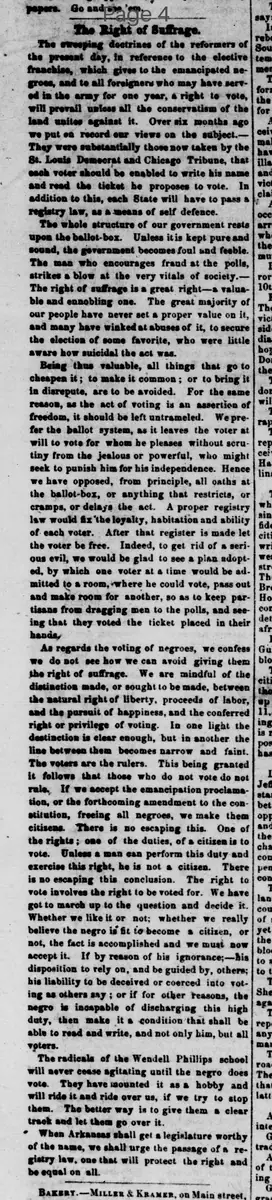
The Right of Suffrage.
The sweeping doctrine of the reformers of the present day, in reference to the elective franchise, which gives to the emancipated negroes, and to all foreigners who may have served in the army for one year, a right to vote, will prevail unless all the conservatism of the land unites against it. Over six months ago we put on record our views on the subject. They were substantially those now taken by the St. Louis Democrat and Chicago Tribune, that each voter should be enabled to write his name and read the ticket he proposes to vote. In addition to this, each State will have to pass a registry law, as a means of self defence.
The whole structure of our government rests upon the ballot-box. Unless it is kept pure and sound, the government becomes foul and feeble. The man who encourages fraud at the polls, strikes a blow at the very vitals of society. The right of suffrage is a great right—a valuable and ennobling one. The great majority of our people have never set a proper value on it, and many have winked at abuses of it, to secure the election of some favorite, who were little aware how suicidal the act was.
Being thus valuable, all things that go to cheapen it; to make it common; or to bring it in disrepute, are to be avoided. For the same reason, as the act of voting is an assertion of freedom, it should be left untrammeled. We prefer the ballot system, as it leaves the voter at will to vote for whom he pleases without scrutiny from the jealous or powerful, who might seek to punish him for his independence. Hence we have opposed, from principle, all oaths at the ballot-box, or anything that restricts, or cramps, or delays the act. A proper registry law would fix the loyalty, habitation and ability of each voter. After that register is made let the voter be free. Indeed, to get rid of a serious evil, we would be glad to see a plan adopted, by which one voter at a time would be admitted to a room, where he could vote, pass out and make room for another, so as to keep partisans from dragging men to the polls, and seeing that they voted the ticket placed in their hands.
As regards the voting of negroes, we confess we do not see how we can avoid giving them the right of suffrage. We are mindful of the distinction made, or sought to be made, between the natural right of liberty, proceeds of labor, and the pursuit of happiness, and the conferred right or privilege of voting. In one light the distinction is clear enough, but in another the line between them becomes narrow and faint. The voters are the rulers. This being granted it follows that those who do not vote do not rule. If we accept the emancipation proclamation, or the forthcoming amendment to the constitution, freeing all negroes, we make them citizens. There is no escaping this. One of the rights; one of the duties, of a citizen is to vote. Unless a man can perform this duty and exercise this right, he is not a citizen. There is no escaping this conclusion. The right to vote involves the right to be voted for. We have got to march up to the question and decide it. Whether we like it or not; whether we really believe the negro is fit to become a citizen, or not, the fact is accomplished and we must now accept it. If by reason of his ignorance; his disposition to rely on, and be guided by, others; his liability to be deceived or coerced into voting as others say; or if for other reasons, the negro is incapable of discharging this high duty, then make it a condition that shall be able to read and write, and not only him, but all voters.
The radicals of the Wendell Phillips school will never cease agitating until the negro does vote. They have mounted it as a hobby and will ride it and ride over us, if we try to stop them. The better way is to give them a clear track and let them go over it.
When Arkansas shall get a legislature worthy of the name, we shall urge the passage of a registry law, one that will protect the right and be equal on all.
The sweeping doctrine of the reformers of the present day, in reference to the elective franchise, which gives to the emancipated negroes, and to all foreigners who may have served in the army for one year, a right to vote, will prevail unless all the conservatism of the land unites against it. Over six months ago we put on record our views on the subject. They were substantially those now taken by the St. Louis Democrat and Chicago Tribune, that each voter should be enabled to write his name and read the ticket he proposes to vote. In addition to this, each State will have to pass a registry law, as a means of self defence.
The whole structure of our government rests upon the ballot-box. Unless it is kept pure and sound, the government becomes foul and feeble. The man who encourages fraud at the polls, strikes a blow at the very vitals of society. The right of suffrage is a great right—a valuable and ennobling one. The great majority of our people have never set a proper value on it, and many have winked at abuses of it, to secure the election of some favorite, who were little aware how suicidal the act was.
Being thus valuable, all things that go to cheapen it; to make it common; or to bring it in disrepute, are to be avoided. For the same reason, as the act of voting is an assertion of freedom, it should be left untrammeled. We prefer the ballot system, as it leaves the voter at will to vote for whom he pleases without scrutiny from the jealous or powerful, who might seek to punish him for his independence. Hence we have opposed, from principle, all oaths at the ballot-box, or anything that restricts, or cramps, or delays the act. A proper registry law would fix the loyalty, habitation and ability of each voter. After that register is made let the voter be free. Indeed, to get rid of a serious evil, we would be glad to see a plan adopted, by which one voter at a time would be admitted to a room, where he could vote, pass out and make room for another, so as to keep partisans from dragging men to the polls, and seeing that they voted the ticket placed in their hands.
As regards the voting of negroes, we confess we do not see how we can avoid giving them the right of suffrage. We are mindful of the distinction made, or sought to be made, between the natural right of liberty, proceeds of labor, and the pursuit of happiness, and the conferred right or privilege of voting. In one light the distinction is clear enough, but in another the line between them becomes narrow and faint. The voters are the rulers. This being granted it follows that those who do not vote do not rule. If we accept the emancipation proclamation, or the forthcoming amendment to the constitution, freeing all negroes, we make them citizens. There is no escaping this. One of the rights; one of the duties, of a citizen is to vote. Unless a man can perform this duty and exercise this right, he is not a citizen. There is no escaping this conclusion. The right to vote involves the right to be voted for. We have got to march up to the question and decide it. Whether we like it or not; whether we really believe the negro is fit to become a citizen, or not, the fact is accomplished and we must now accept it. If by reason of his ignorance; his disposition to rely on, and be guided by, others; his liability to be deceived or coerced into voting as others say; or if for other reasons, the negro is incapable of discharging this high duty, then make it a condition that shall be able to read and write, and not only him, but all voters.
The radicals of the Wendell Phillips school will never cease agitating until the negro does vote. They have mounted it as a hobby and will ride it and ride over us, if we try to stop them. The better way is to give them a clear track and let them go over it.
When Arkansas shall get a legislature worthy of the name, we shall urge the passage of a registry law, one that will protect the right and be equal on all.
What sub-type of article is it?
Suffrage
Slavery Abolition
What keywords are associated?
Suffrage
Negro Voting
Literacy Test
Registry Law
Ballot Purity
Emancipation
Citizenship Rights
What entities or persons were involved?
Wendell Phillips
St. Louis Democrat
Chicago Tribune
Arkansas Legislature
Editorial Details
Primary Topic
Extension Of Suffrage To Emancipated Negroes With Literacy And Registry Requirements
Stance / Tone
Supportive Of Negro Suffrage Under Conditions Of Literacy And Registry To Ensure Purity Of The Ballot
Key Figures
Wendell Phillips
St. Louis Democrat
Chicago Tribune
Arkansas Legislature
Key Arguments
Voters Should Be Able To Read And Write Their Names And Tickets
States Need Registry Laws For Self Defense
Ballot Box Purity Is Essential To Government Stability
Suffrage Should Be Untrammeled By Oaths Or Restrictions
Negroes Must Be Granted Suffrage As Citizens Post Emancipation
Literacy Requirement For All Voters To Address Negro Incapacity
Give Radicals A Clear Track On Negro Voting To Avoid Agitation