Thank you for visiting SNEWPapers!
Sign up free
Gazette Of The United States And Daily Evening Advertiser
Philadelphia, Philadelphia County, Pennsylvania
What is this article about?
In the Irish House of Commons on March 2, Sir Lawrence Parsons moved to limit the Great Money Bill to two months, criticizing British policy on Irish Catholics. The motion was defeated 24-146. Mr. Conolly proposed resolutions praising Earl Fitzwilliam and opposing prorogation; the first passed unanimously, others withdrawn.
Clipping
OCR Quality
Full Text
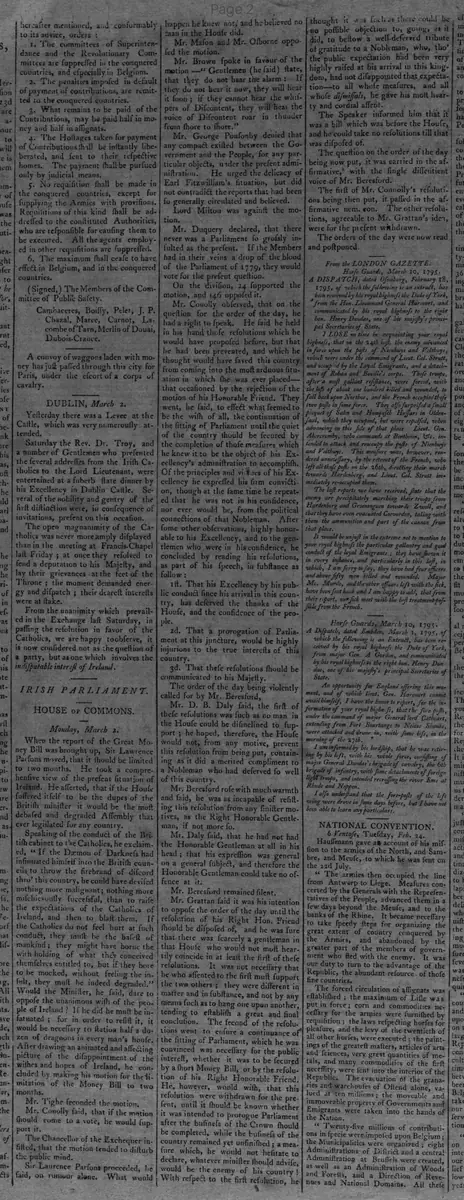
HOUSE OF COMMONS.
Monday, March 2.
When the report of the Great Money Bill was brought up, Sir Lawrence Parsons moved, that it should be limited to two months. He took a comprehensive view of the present situation of Ireland. He asserted, that if the House suffered itself to be the dupes of the British minister it would be the most debased and degraded Assembly that ever legislated for any country.
Speaking of the conduct of the British cabinet to the Catholics, he exclaimed, "If the Demon of Darkness had insinuated himself into the British councils to throw the firebrand of discord thro' this country, he could have devised nothing more malignant; nothing more mischievously successful, than to raise the expectations of the Catholics of Ireland, and then to blast them. If the Catholics do not feel hurt at such conduct, they must be the basest of mankind; they might have borne the with-holding of what they conceived themselves entitled to, but if they bore to be mocked, without feeling the insult, they must be indeed degraded."
Would the Minister, he said, dare to oppose the unanimous wish of the people of Ireland? If he did he must be infatuated; for in order to resist it, it would be necessary to station half a dozen of dragoons in every man's house.
After drawing an animated and affecting picture of the disappointment of the wishes and hopes of Ireland, he concluded by making his motion for the limitation of the Money Bill to two months.
Mr. Tighe seconded the motion.
Mr. Conolly said, that if the motion should come to a vote, he would support it.
The Chancellor of the Exchequer insisted, that the motion tended to disturb the public mind.
Sir Laurence Parsons proceeded, he said, on rumour alone. What would happen he knew not, and he believed no man in the House did.
Mr. Mason and Mr. Osborne opposed the motion.
Mr. Brown spoke in favour of the motion - "Gentlemen (he said) state, that they do not hear the alarm: If they do not hear it now, they will hear it soon; if they cannot hear the whispers of Discontent, they will hear the voice of Discontent roar in thunder from shore to shore."
Mr. George Ponsonby denied that any compact existed between the Government and the People, for any particular objects, under the present administration. He urged the delicacy of Earl Fitzwilliam's situation, but did not contradict the reports that had been so generally circulated and believed.
Lord Milton was against the motion.
Mr. Duquery declared, that there never was a Parliament so grossly insulted as the present. If the Members had in their veins a drop of the blood of the Parliament of 1782, they would vote for the present question.
On the division, 24 supported the motion, and 146 opposed it.
Mr. Conolly observed, that on the question for the order of the day, he had a right to speak. He said he held in his hand three resolutions which he would have proposed before, but that he had been prevented, and which he thought would have saved this country from coming into the most arduous situation in which she was ever placed - that occasioned by the rejection of the motion of his Honorable Friend. They went, he said, to effect what seemed to be the wish of all, the continuation of the sitting of Parliament until the quiet of the country should be secured by the completion of those measures which he knew it to be the object of his Excellency's administration to accomplish.
Of the principles and virtues of his Excellency he expressed his firm conviction, though at the same time he repeated that he was not in his confidence, nor ever would be, from the political connections of that Nobleman. After some other observations, highly honorable to his Excellency, and to the gentlemen who were in his confidence, he concluded by reading his resolutions, as part of his speech, in substance as follow:
1st. That his Excellency by his public conduct since his arrival in this country, has deserved the thanks of the House, and the confidence of the people.
2d. That a prorogation of Parliament at this juncture, would be highly injurious to the true interests of this country.
3d. That these resolutions should be communicated to his Majesty.
The order of the day being violently called for by Mr. Beresford, Mr. D. B. Daly said, the first of these resolutions was such as no man in the House could be disinclined to support; he hoped, therefore, the House would not, from any motive, prevent this resolution from being put, containing as it did a merited compliment to a Nobleman who had deserved so well of this country.
Mr. Beresford rose with much warmth and said, he was as incapable of resisting this resolution from any sinister motives, as the Right Honorable Gentleman, if not more so.
Mr. Daly said, that he had not had the Honorable Gentleman at all in his head; that his expression was general on a general subject, and therefore the Honorable Gentleman could take no offence at it.
Mr. Beresford remained silent.
Mr. Grattan said it was his intention to oppose the order of the day until the resolution of his Right Hon. Friend should be disposed of, and he was sure that there was scarcely a gentleman in that House who would not most heartily coincide in at least the first of these resolutions. It was not necessary that he who assented to the first must support the two others; they were different in matter and in substance, and not by any means such as to hang one upon another, tending to establish a great and final conclusion. The second of the resolutions went to ensure a continuance of the sitting of Parliament, which he was convinced was necessary for the public interest, whether it was to be secured by a short Money Bill, or by the resolution of his Right Honorable Friend.
He, however, would wish, that this resolution were withdrawn for the present, until it should be known whether it was intended to prorogue Parliament after the business of the Crown should be completed, while the business of the country remained yet unfinished; a measure which, he would not hesitate to declare, whatever minister should advise, would be the enemy of his country!
With respect to the first resolution, he thought it was such as there could be no possible objection to, going, as it did, to bestow a well-deserved tribute of gratitude to a Nobleman, who, tho' the public expectation had been very highly raised at his arrival in this kingdom, had not disappointed that expectation - to all whose measures, and all whose dismissals, he gave his most hearty and cordial assent.
The Speaker informed him that it was a bill which was before the House, and he could take no resolutions till that was disposed of.
The question on the order of the day being now put, it was carried in the affirmative, with the single dissentient voice of Mr. Beresford.
The first of Mr. Connolly's resolutions being then put, it passed in the affirmative nem. con. The other resolutions, agreeable to Mr. Grattan's idea, were for the present withdrawn.
The orders of the day were now read and postponed.
What sub-type of article is it?
What keywords are associated?
What entities or persons were involved?
Where did it happen?
Foreign News Details
Primary Location
Ireland
Event Date
Monday, March 2
Key Persons
Outcome
motion to limit money bill to two months defeated 24-146; first resolution praising earl fitzwilliam passed unanimously; other resolutions withdrawn.
Event Details
Debate in Irish House of Commons on limiting the Great Money Bill to two months amid criticism of British policy toward Irish Catholics and disappointment in unfulfilled expectations. Sir Lawrence Parsons led the motion, supported by several members including Mr. Conolly and Mr. Grattan, but opposed by the Chancellor of the Exchequer and others. Following defeat, Mr. Conolly proposed resolutions affirming confidence in Earl Fitzwilliam and opposing prorogation of Parliament.