Thank you for visiting SNEWPapers!
Sign up free
Story
September 27, 1822
The Rhode Island American, And General Advertiser
Providence, Providence County, Rhode Island
What is this article about?
Political dispute in Georgia: Governor Clarke replaces absent Secretary Hammond with Whitaker, citing constitutional power. Hammond's profane confrontation with officials highlights his insolence against the governor's restraint. (182 chars)
Clipping
OCR Quality
95%
Excellent
Full Text
NEW-YORK. September 20.
GEORGIA.
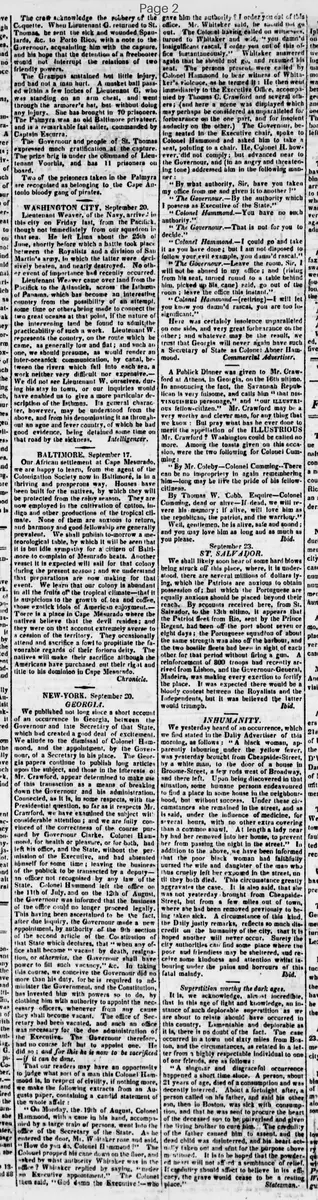
We published not long since a short account of an occurrence in Georgia, between the Governour and late Secretary of that State, which had created a good deal of excitement. We allude to the dismissal of Colonel Hammond, and the appointment, by the Governour, of a Secretary in his place. The Georgia papers continue to publish long articles upon the subject, and those in the interests of Mr. Crawford, appear determined to make use of this transaction as a means of breaking down the Governour and his administration. Connected, as it is, in some respects, with the Presidential question, so far as it respects Mr. Crawford, we have examined the subject with considerable attention; and we are fully convinced of the correctness of the course pursued by Governour Clarke. Colonel Hammond, for health or pleasure, or for both, had left his office, and the State, without the permission of the Executive, and had absented himself for some time; leaving the business of the publick to be transacted by a deputy-- an officer not recognised by any law of the State. Colonel Hammond left the office on the 11th of July, and on the 12th of August, the Governour was informed that the business of the office could no longer proceed legally. This having been ascertained to be the fact, after due inquiry, the Governour made a new appointment, by authority of the 9th section of the second article of the Constitution of that State which declares, that "when any office shall become vacant by death, resignation, or otherwise, the Governour shall have power to fill such vacancy," &c. In taking this course, we conceive the Governour did no more than his duty, for he is required to administer the Government, and the Constitution, has invested him with powers so to do, by clothing him with authority to appoint the necessary officers, whenever from any cause they shall become vacant. The office of Secretary had been vacated, and such an office was necessary for the due administration of the Executive. The Governour therefore, had no course left but to appoint one. He did so; and for this he is not to be sacrificed--if it can be done.
That our readers may have an opportunity to judge what sort of a man this Colonel Hammond is, in respect of civility, if nothing more, we make the following extracts from an Augusta paper, containing a candid statement of the whole affair:
"On Monday, the 19th of August, Colonel Hammond, with a cane in his hand, accompanied by a large train of persons, went into the office of the Secretary of the State. As he entered the door, Mr. Whitaker rose and said, "How do you do, Colonel Hammond?" The Colonel propped his cane down on the floor, and asked by what authority Whitaker was in the office? Whitaker replied by saying, "under an Executive appointment." The Colonel then said, "God damn the Executive!--who gave him the authority? I order you out of this office." Mr. Whitaker said, he should not go out. The Colonel--having called on witnesses, turned to Whitaker and said, "you damn'd insignificant rascal, I order you out of this office instantaneously."
Whitaker answered again that he should not go, and resumed his seat. The persons present were called by Colonel Hammond to bear witness of Whitaker's violence, as he termed it: He then went immediately to the Executive Office, accompanied by Thomas C. Crawford and several others; (and here a scene was displayed which may perhaps be considered as unparalleled for forbearance on the one part, and insolent audacity on the other.) The Governour, being seated in the Executive chair, spoke to Colonel Hammond and asked him to take a seat, pointing to a chair. He, Colonel H. however, did not comply; but advanced near to the Governour, and (in an angry and threatening tone) addressed him in the following manner:
"By what authority, Sir, have you taken my office from me and given it to another?"
"The Governour.--By the authority which I possess as Executive of the State,"
"Colonel Hammond.--You have no such authority."
"The Governour.--That is not for you to decide."
Colonel Hammond.--I could go and take it as you have done: but I am not disposed to follow your evil example, you damn'd rascal."
"The Governour.--Leave the room, Sir, I will not be abused in my office; and (rising from his seat, turned round to a table behind him, picked up his cane) said, go out of the room; leave the office this instant."
"Colonel Hammond--(retiring)--I will let you know you damn'd rascal, you are too insignificant."
Here was certainly insolence unparalleled on one side, and very great forbearance on the other: and whatever may be the result, we trust that Georgia will never again have such a Secretary of State as Colonel Abner Hammond.
Commercial Advertiser.
GEORGIA.
We published not long since a short account of an occurrence in Georgia, between the Governour and late Secretary of that State, which had created a good deal of excitement. We allude to the dismissal of Colonel Hammond, and the appointment, by the Governour, of a Secretary in his place. The Georgia papers continue to publish long articles upon the subject, and those in the interests of Mr. Crawford, appear determined to make use of this transaction as a means of breaking down the Governour and his administration. Connected, as it is, in some respects, with the Presidential question, so far as it respects Mr. Crawford, we have examined the subject with considerable attention; and we are fully convinced of the correctness of the course pursued by Governour Clarke. Colonel Hammond, for health or pleasure, or for both, had left his office, and the State, without the permission of the Executive, and had absented himself for some time; leaving the business of the publick to be transacted by a deputy-- an officer not recognised by any law of the State. Colonel Hammond left the office on the 11th of July, and on the 12th of August, the Governour was informed that the business of the office could no longer proceed legally. This having been ascertained to be the fact, after due inquiry, the Governour made a new appointment, by authority of the 9th section of the second article of the Constitution of that State which declares, that "when any office shall become vacant by death, resignation, or otherwise, the Governour shall have power to fill such vacancy," &c. In taking this course, we conceive the Governour did no more than his duty, for he is required to administer the Government, and the Constitution, has invested him with powers so to do, by clothing him with authority to appoint the necessary officers, whenever from any cause they shall become vacant. The office of Secretary had been vacated, and such an office was necessary for the due administration of the Executive. The Governour therefore, had no course left but to appoint one. He did so; and for this he is not to be sacrificed--if it can be done.
That our readers may have an opportunity to judge what sort of a man this Colonel Hammond is, in respect of civility, if nothing more, we make the following extracts from an Augusta paper, containing a candid statement of the whole affair:
"On Monday, the 19th of August, Colonel Hammond, with a cane in his hand, accompanied by a large train of persons, went into the office of the Secretary of the State. As he entered the door, Mr. Whitaker rose and said, "How do you do, Colonel Hammond?" The Colonel propped his cane down on the floor, and asked by what authority Whitaker was in the office? Whitaker replied by saying, "under an Executive appointment." The Colonel then said, "God damn the Executive!--who gave him the authority? I order you out of this office." Mr. Whitaker said, he should not go out. The Colonel--having called on witnesses, turned to Whitaker and said, "you damn'd insignificant rascal, I order you out of this office instantaneously."
Whitaker answered again that he should not go, and resumed his seat. The persons present were called by Colonel Hammond to bear witness of Whitaker's violence, as he termed it: He then went immediately to the Executive Office, accompanied by Thomas C. Crawford and several others; (and here a scene was displayed which may perhaps be considered as unparalleled for forbearance on the one part, and insolent audacity on the other.) The Governour, being seated in the Executive chair, spoke to Colonel Hammond and asked him to take a seat, pointing to a chair. He, Colonel H. however, did not comply; but advanced near to the Governour, and (in an angry and threatening tone) addressed him in the following manner:
"By what authority, Sir, have you taken my office from me and given it to another?"
"The Governour.--By the authority which I possess as Executive of the State,"
"Colonel Hammond.--You have no such authority."
"The Governour.--That is not for you to decide."
Colonel Hammond.--I could go and take it as you have done: but I am not disposed to follow your evil example, you damn'd rascal."
"The Governour.--Leave the room, Sir, I will not be abused in my office; and (rising from his seat, turned round to a table behind him, picked up his cane) said, go out of the room; leave the office this instant."
"Colonel Hammond--(retiring)--I will let you know you damn'd rascal, you are too insignificant."
Here was certainly insolence unparalleled on one side, and very great forbearance on the other: and whatever may be the result, we trust that Georgia will never again have such a Secretary of State as Colonel Abner Hammond.
Commercial Advertiser.
What sub-type of article is it?
Historical Event
What themes does it cover?
Justice
Bravery Heroism
Misfortune
What keywords are associated?
Georgia Politics
Secretary Dismissal
Governor Clarke
Colonel Hammond
Political Confrontation
What entities or persons were involved?
Governor Clarke
Colonel Hammond
Mr. Whitaker
Thomas C. Crawford
Where did it happen?
Georgia
Story Details
Key Persons
Governor Clarke
Colonel Hammond
Mr. Whitaker
Thomas C. Crawford
Location
Georgia
Event Date
11th Of July To 19th Of August
Story Details
Governor Clarke dismissed Colonel Hammond for unauthorized absence and appointed Mr. Whitaker as Secretary of State under constitutional authority. Hammond confronted Whitaker and the Governor aggressively, using profanity and threats, but the Governor responded with forbearance and ordered him out.