Thank you for visiting SNEWPapers!
Sign up free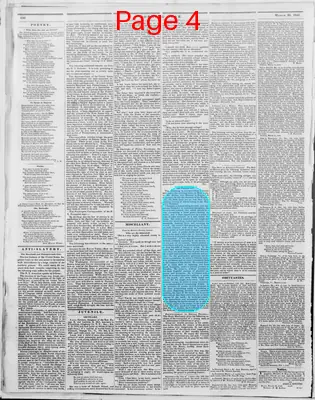
Story
March 30, 1842
Morning Star
Limerick, York County, Maine
What is this article about?
Excerpt from a lecture by Mr. Dallas in New York describing the harsh life, appearance, and character of the Russian serf, of whom there are 40 million, 20 million belonging to Emperor Nicholas. Highlights their poverty, superstition, endurance, and loyalty.
Clipping
OCR Quality
95%
Excellent
Full Text
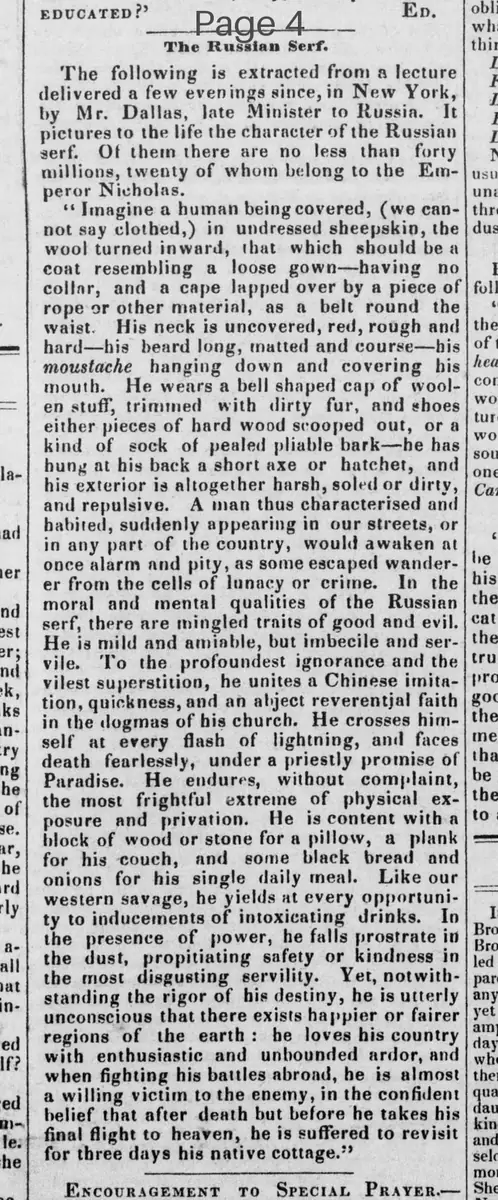
The Russian Serf.
The following is extracted from a lecture delivered a few evenings since, in New York, by Mr. Dallas, late Minister to Russia. It pictures to the life the character of the Russian serf. Of them there are no less than forty millions, twenty of whom belong to the Emperor Nicholas.
"Imagine a human being covered, (we cannot say clothed,) in undressed sheepskin, the wool turned inward, that which should be a coat resembling a loose gown-having no collar, and a cape lapped over by a piece of rope or other material, as a belt round the waist. His neck is uncovered, red, rough and hard-his beard long, matted and coarse-his moustache hanging down and covering his mouth. He wears a bell shaped cap of woolen stuff, trimmed with dirty fur, and shoes either pieces of hard wood scooped out, or a kind of sock of peeled pliable bark-he has hung at his back a short axe or hatchet, and his exterior is altogether harsh, soiled or dirty, and repulsive. A man thus characterised and habited, suddenly appearing in our streets, or in any part of the country, would awaken at once alarm and pity, as some escaped wanderer from the cells of lunacy or crime. In the moral and mental qualities of the Russian serf, there are mingled traits of good and evil. He is mild and amiable, but imbecile and servile. To the profoundest ignorance and the vilest superstition, he unites a Chinese imitation, quickness, and an abject reverential faith in the dogmas of his church. He crosses himself at every flash of lightning, and faces death fearlessly, under a priestly promise of Paradise. He endures, without complaint, the most frightful extreme of physical exposure and privation. He is content with a block of wood or stone for a pillow, a plank for his couch, and some black bread and onions for his single daily meal. Like our western savage, he yields at every opportunity to inducements of intoxicating drinks. In the presence of power, he falls prostrate in the dust, propitiating safety or kindness in the most disgusting servility. Yet, notwithstanding the rigor of his destiny, he is utterly unconscious that there exists happier or fairer regions of the earth: he loves his country with enthusiastic and unbounded ardor, and when fighting his battles abroad, he is almost a willing victim to the enemy, in the confident belief that after death but before he takes his final flight to heaven, he is suffered to revisit for three days his native cottage."
The following is extracted from a lecture delivered a few evenings since, in New York, by Mr. Dallas, late Minister to Russia. It pictures to the life the character of the Russian serf. Of them there are no less than forty millions, twenty of whom belong to the Emperor Nicholas.
"Imagine a human being covered, (we cannot say clothed,) in undressed sheepskin, the wool turned inward, that which should be a coat resembling a loose gown-having no collar, and a cape lapped over by a piece of rope or other material, as a belt round the waist. His neck is uncovered, red, rough and hard-his beard long, matted and coarse-his moustache hanging down and covering his mouth. He wears a bell shaped cap of woolen stuff, trimmed with dirty fur, and shoes either pieces of hard wood scooped out, or a kind of sock of peeled pliable bark-he has hung at his back a short axe or hatchet, and his exterior is altogether harsh, soiled or dirty, and repulsive. A man thus characterised and habited, suddenly appearing in our streets, or in any part of the country, would awaken at once alarm and pity, as some escaped wanderer from the cells of lunacy or crime. In the moral and mental qualities of the Russian serf, there are mingled traits of good and evil. He is mild and amiable, but imbecile and servile. To the profoundest ignorance and the vilest superstition, he unites a Chinese imitation, quickness, and an abject reverential faith in the dogmas of his church. He crosses himself at every flash of lightning, and faces death fearlessly, under a priestly promise of Paradise. He endures, without complaint, the most frightful extreme of physical exposure and privation. He is content with a block of wood or stone for a pillow, a plank for his couch, and some black bread and onions for his single daily meal. Like our western savage, he yields at every opportunity to inducements of intoxicating drinks. In the presence of power, he falls prostrate in the dust, propitiating safety or kindness in the most disgusting servility. Yet, notwithstanding the rigor of his destiny, he is utterly unconscious that there exists happier or fairer regions of the earth: he loves his country with enthusiastic and unbounded ardor, and when fighting his battles abroad, he is almost a willing victim to the enemy, in the confident belief that after death but before he takes his final flight to heaven, he is suffered to revisit for three days his native cottage."
What sub-type of article is it?
Biography
Curiosity
What themes does it cover?
Misfortune
Survival
Providence Divine
What keywords are associated?
Russian Serf
Serfdom
Lecture
Mr Dallas
Emperor Nicholas
Superstition
Endurance
Russia
What entities or persons were involved?
Mr. Dallas
Emperor Nicholas
Russian Serf
Where did it happen?
Russia
Story Details
Key Persons
Mr. Dallas
Emperor Nicholas
Russian Serf
Location
Russia
Story Details
Description of the Russian serf's appearance, harsh living conditions, superstitious faith, endurance of privations, servility, and patriotic loyalty despite their fate.