Thank you for visiting SNEWPapers!
Sign up free
Alexandria Gazette & Daily Advertiser
Alexandria, Virginia
What is this article about?
A popular pamphlet titled 'A letter from the King to his People' defends King George IV's conduct in his marriage to Queen Caroline, explaining the forced union, separation, and royal extravagance amid political turmoil. It has reached its 20th edition in England.
Clipping
OCR Quality
Full Text
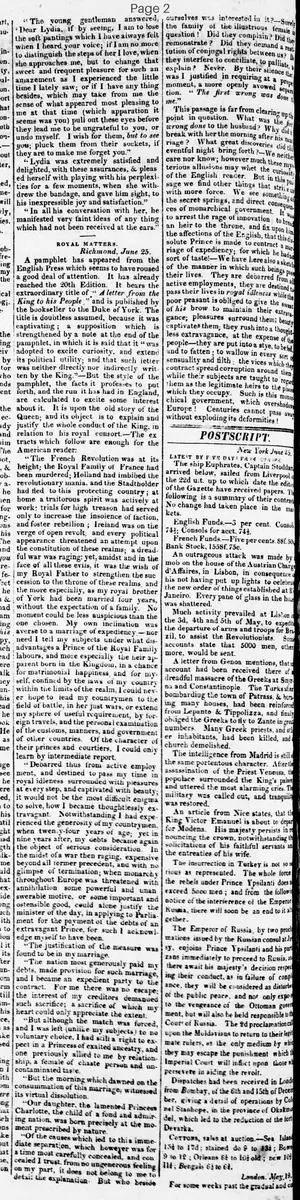
Richmond, June 25.
A pamphlet has appeared from the English Press which seems to have roused a good deal of attention. It has already reached the 20th Edition. It bears the extraordinary title of "A letter from the King to his People" and is published by the bookseller to the Duke of York. The title is doubtless assumed, because it was captivating; a supposition which is strengthened by a note at the end of the pamphlet, in which it is said that it "was adopted to excite curiosity, and extend its political utility; and that such letter was neither directly nor indirectly written by the King." But the style of the pamphlet, the facts it professes to put forth, and the run it has had in England, are calculated to excite some interest about it. It is upon the old story of the Queen: and its object is to explain and justify the whole conduct of the King, in relation to his royal consort.—The extracts which follow are enough for the American reader:
"The French Revolution was at its height: the Royal Family of France had been murdered; Holland had imbibed the revolutionary mania, and the Stadtholder had fled to this protecting country; at home a traitorous spirit was actively at work; trials for high treason had served only to increase the insolence of faction, and foster rebellion; Ireland was on the verge of open revolt: and every political appearance threatened an attempt upon the constitution of these realms; a dreadful war was raging: yet, amidst and in the face of all these evils, it was the wish of my Royal Father to strengthen the succession to the throne of these realms, and the more especially, as my royal brother of York had been married four years, without the expectation of a family. No moment could be less auspicious than the one chosen. My own inclination was averse to a marriage of expediency.—nor need I tell my subjects under what disadvantages a Prince of the Royal Family labours, and more especially the heir apparent born in the Kingdom, in a chance for matrimonial happiness. and for myself, confined by the laws of my country within the limits of the realm, I could never hope to lead my countrymen to the field of battle, in her just wars, or extend my sphere of useful requirement, by foreign travels, and the personal examination of the customs, manners, and government of other countries. Of the character of their princes and courtiers, I could only learn by intermediate report.
"Debarred thus from active employment, and destined to pass my time in royal idleness surrounded with pleasures at every step, and captivated with beauty: it would not be the most difficult enigma to solve, how I became thoughtlessly extravagant. Notwithstanding I had experienced the generosity of my countrymen, when twenty-four years of age: yet in nine years after, my debts became again the object of serious consideration. In the midst of a war then raging, expensive beyond all former precedent, and with no glimpse of termination; when monarchy throughout Europe was threatened with annihilation some powerful and unanswerable motive, or some important and ostensible good, could alone justify the minister of the day, in applying to Parliament for the payment of the debts of an extravagant Prince, for such I acknowledge myself to have been.
"The justification of the measure was found to be in my marriage.
"The nation most generously paid my debts, made provision for such marriage, and I became an expedient party to the contract. For me there was no escape: the interest of my creditors demanded such sacrifice; a sacrifice of which my heart could only appreciate the extent.
"But although the match was forced, and I was left (unlike my subjects) to no voluntary choice, I had still a right to expect in a Princess of exalted ancestry, and one previously allied to me by relationship, a female of chaste person and uncontaminated taste.
"But the morning which dawned on the consummation of this marriage, witnessed its virtual dissolution.
"Our daughter, the lamented Princess Charlotte, the child of a fond and admiring nation, was born precisely at the moment prescribed by nature.
"Of the causes which led to this immediate separation, which however was for a time most carefully concealed, and concealed I trust, from no ungenerous feeling on my part, it does not belong to me to detail: the explanation. But who besides ourselves was interested in it?—Surely the family of the illustrious female in question. Did they complain? Did they remonstrate? Did they demand a restitution of conjugal rights between us? Did they interfere to conciliate, to palliate, explain? Never. By their silence they justified me in requiring at a proper moment, a more openly avowed separation.
"The first wrong was done to the husband? This passage is far from clearing up the point in question. What was the first wrong done to the husband? Why did she break with her the morning after his marriage? What great discoveries vented or mysterious allusions? But in this passage we find other things that strike us with more force. We see something of the secret springs, and direct consequences of monarchical government. It was to arrest the rage of innovation: to breed an heir to the throne and fix the affections of the English that this dissolute of Prince expediency is made for to which contract he a hadn't mar of taste. We have here also a sketch of the manner in which such beings pass their lives. They are debarred from all active employments, they are destined to pass their lives in royal idleness while the poor peasant is obliged to give the sweat of his brow to maintain their extravagance; pleasures surround them; beauty captivates them; they rush into a thoughtless extravagance, at the expense of the people—they are put into a sty, to be fed, and to fatten; to wallow in every sort of sensuality and filth; the vices which they contract spread corruption around them while their subjects are taught to 'regard them as the legitimate heirs to the place which they occupy.
Such is this monarchical government, which overshadows Europe! Centuries cannot pass away without exploding its deformities!"
What sub-type of article is it?
What keywords are associated?
What entities or persons were involved?
Where did it happen?
Foreign News Details
Primary Location
England
Event Date
Richmond, June 25
Key Persons
Outcome
pamphlet reached 20th edition; defends king's separation from queen; nation paid king's debts for marriage; virtual dissolution of marriage on morning after consummation; birth of princess charlotte; no family complaints about separation.
Event Details
A pamphlet titled 'A letter from the King to his People,' published by the bookseller to the Duke of York, justifies the King's forced marriage to the Queen amid revolutionary threats, wars, and his extravagance. It details the King's debts paid by the nation, the marriage of expediency, immediate separation after consummation, birth of Princess Charlotte, and lack of interference from the Queen's family. The text critiques monarchical idleness and corruption.