Thank you for visiting SNEWPapers!
Sign up free
Letter to Editor
May 31, 1770
The Virginia Gazette
Williamsburg, Virginia
What is this article about?
An anonymous submission to printer Mr. Rind of London-published remarks on a Massachusetts letter, critiquing British colonial policies since 1764 for imposing revenue without consent, causing discontent and risking rebellion. Advocates repealing these laws to restore peace, commerce, and colonial rights as free English subjects.
Clipping
OCR Quality
95%
Excellent
Full Text
Mr. RIND.
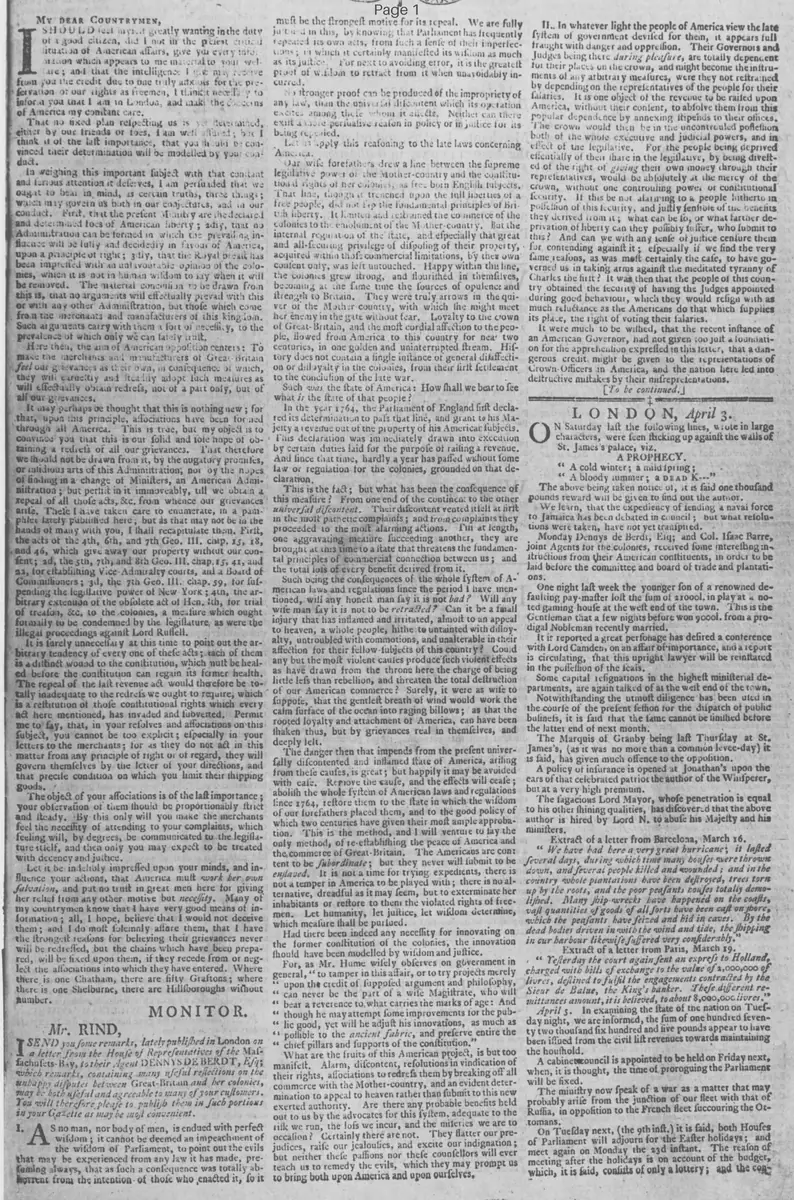
I SEND you some remarks, lately published in London on a letter from the House of Representatives of the Massachusetts-Bay, to their agent DENNYS DE BERDT, Esq; which remarks, containing many useful reflections on the unhappy disputes between Great-Britain and her colonies, may be both useful and agreeable to many of your customers. You will therefore please to publish them in such portions in your Gazette as may be most convenient.
I.
As no man, nor body of men, is endued with perfect wisdom; it cannot be deemed an impeachment of the wisdom of Parliament, to point out the evils that may be experienced from any law it has made, premising always, that as such a consequence was totally abhorrent from the intention of those who enacted it, so it must be the strongest motive for its repeal. We are fully justified in this, by knowing that Parliament has frequently repealed its own acts, from such a sense of their imperfection; in which it certainly manifested its wisdom as much as its justice. For next to avoiding error, it is the greatest proof of wisdom to retract from it when unavoidably incurred.
No stronger proof can be produced of the impropriety of any law, than the universal discontent which its operation excites among those whom it affects. Neither can there exist a more persuasive reason in policy or injustice for its being repealed.
Let us apply this reasoning to the late laws concerning America.
Our wise forefathers drew a line between the supreme legislative power of the Mother-country and the constitutional rights of her colonies, as free born English subjects. That line, though it trenched upon the mild liberties of a free people, did not infringe the fundamental principles of British liberty. It limited and examined the commerce of the colonies to the emolument of the Mother-country. But the internal regulation of the state, and especially that great and all-securing privilege of disposing of their property, acquired within those commercial limitations, by their own consent only, was left untouched. Happy within that line, the colonies grew strong, and flourished in themselves, becoming at the same time the sources of opulence and strength to Britain. They were truly arrows in the quiver of the Mother country, with which she might meet her enemy in the gate without fear. Loyalty to the crown of Great-Britain, and the most cordial affection to the people, flowed from America to this country for near two centuries, in one golden and uninterrupted stream. History does not contain a single instance of general disaffection or disloyalty in the colonies, from their first settlement to the conclusion of the late war.
Such was the state of America: How shall we bear to see what is the state of that people?
In the year 1764, the Parliament of England first declared its determination to pass that line, and grant to his Majesty a revenue out of the property of his American subjects. This declaration was immediately drawn into execution by certain duties laid for the purpose of raising a revenue. And since that time, hardly a year has passed without some law or regulation for the colonies, grounded on that declaration.
This is the fact: but what has been the consequence of this measure? From one end of the continent to the other universal discontent. Their discontent vented itself at first in the most pathetic complaints; and from complaints they proceeded to the most alarming actions. Till at length, one aggravating measure succeeding another, they are brought at this time to a state that threatens the fundamental principles of commercial connection between us; and the total loss of every benefit derived from it.
Such being the consequences of the whole system of American laws and regulations since the period I have mentioned, will any honest man say it is not bad? Will any wise man say it is not to be retracted? Can it be a small injury that has inflamed and irritated, almost to an appeal to heaven, a whole people, hitherto untainted with disloyalty, untroubled with commotions, and unalterable in their affection for their fellow-subjects of this country? Could any but the most violent causes produce such violent effects as have drawn from the throne here the charge of being little less than rebellion, and threaten the total destruction of our American commerce? Surely, it were as wise to suppose, that the gentlest breath of wind would work the calm surface of the ocean into raging billows; as that the rooted loyalty and attachment of America, can have been shaken thus, but by grievances real in themselves, and deeply felt.
The danger then that impends from the present universally discontented and inflamed state of America, arising from these causes, is great; but happily it may be avoided with ease. Remove the cause, and the effects will cease; abolish the whole system of American laws and regulations since 1764, restore them to the state in which the wisdom of our forefathers placed them, and to the good policy of which two centuries have given their most ample approbation. This is the method, and I will venture to say the only method, of re-establishing the peace of America and the commerce of Great-Britain. The Americans are content to be Subordinate; but they never will submit to be enslaved. It is not a time for trying expedients, there is not a temper in America to be played with; there is no alternative, dreadful as it may seem, but to exterminate her inhabitants or restore to them the violated rights of freemen. Let humanity, let justice, let wisdom determine, which measure shall be pursued.
Had there been indeed any necessity for innovating on the former constitution of the colonies, the innovation should have been modelled by wisdom and justice. For, as Mr. Hume wisely observes on government in general, "to tamper in this affair, or to try projects merely upon the credit of supposed argument and philosophy, can never be the part of a wise Magistrate, who will bear a reverence to what carries the marks of age: And though he may attempt some improvements for the public good, yet will he adjust his innovations, as much as possible to the ancient fabric, and preserve entire the chief pillars and supports of the constitution."
What are the fruits of this American project, is but too manifest. Alarm, discontent, resolutions in vindication of their rights, associations to redress them by breaking off all commerce with the Mother-country, and an evident determination to appeal to heaven rather than submit to this new exerted authority. Are there any probable benefits held out to us by the advocates for this system, adequate to the risk we run, the loss we incur, and the miseries we are to occasion? Certainly there are not. They flatter our prejudices, raise our jealousies, and excite our indignation; but neither these passions nor these counsellors will ever teach us to remedy the evils, which they may prompt us to bring both upon America and upon ourselves.
II. In whatever light the people of America view the late system of government devised for them, it appears full fraught with danger and oppression. Their Governors and Judges being there during pleasure, are totally dependent for their places on the crown, and might become the instruments of any arbitrary measures, were they not restrained by depending on the representatives of the people for their salaries. It is one object of the revenue to be raised upon America, without their consent, to absolve them from this popular dependence by annexing stipends to their offices. The crown would then be in the uncontrolled possession both of the whole executive and judicial powers, and in effect of the legislative. For the people being deprived essentially of their share in the legislative, by being divested of the right of granting their own money through their representatives, would be absolutely at the mercy of the crown, without one controlling power or constitutional security. If this be not slavery to a people hitherto in possession of this security, and justly sensible of the benefits they derived from it; what can be so, or what farther deprivation of liberty can they possibly suffer, who submit to this? And can we with any sense of justice censure them for contending against it; especially if we find the very same reasons, as was most certainly the case, to have governed us in taking arms against the meditated tyranny of Charles the first? It was then that the people of this country obtained the security of having the Judges appointed during good behaviour, which they would resign with as much reluctance as the Americans do that which supplies its place, the right of voting their salaries.
It were much to be wished, that the recent instance of an American Governor, had not given too just a foundation for the apprehension expressed in this letter, that a dangerous credit might be given to the representations of Crown-Officers in America, and the nation here led into destructive mistakes by their misrepresentations.
To be continued.
I SEND you some remarks, lately published in London on a letter from the House of Representatives of the Massachusetts-Bay, to their agent DENNYS DE BERDT, Esq; which remarks, containing many useful reflections on the unhappy disputes between Great-Britain and her colonies, may be both useful and agreeable to many of your customers. You will therefore please to publish them in such portions in your Gazette as may be most convenient.
I.
As no man, nor body of men, is endued with perfect wisdom; it cannot be deemed an impeachment of the wisdom of Parliament, to point out the evils that may be experienced from any law it has made, premising always, that as such a consequence was totally abhorrent from the intention of those who enacted it, so it must be the strongest motive for its repeal. We are fully justified in this, by knowing that Parliament has frequently repealed its own acts, from such a sense of their imperfection; in which it certainly manifested its wisdom as much as its justice. For next to avoiding error, it is the greatest proof of wisdom to retract from it when unavoidably incurred.
No stronger proof can be produced of the impropriety of any law, than the universal discontent which its operation excites among those whom it affects. Neither can there exist a more persuasive reason in policy or injustice for its being repealed.
Let us apply this reasoning to the late laws concerning America.
Our wise forefathers drew a line between the supreme legislative power of the Mother-country and the constitutional rights of her colonies, as free born English subjects. That line, though it trenched upon the mild liberties of a free people, did not infringe the fundamental principles of British liberty. It limited and examined the commerce of the colonies to the emolument of the Mother-country. But the internal regulation of the state, and especially that great and all-securing privilege of disposing of their property, acquired within those commercial limitations, by their own consent only, was left untouched. Happy within that line, the colonies grew strong, and flourished in themselves, becoming at the same time the sources of opulence and strength to Britain. They were truly arrows in the quiver of the Mother country, with which she might meet her enemy in the gate without fear. Loyalty to the crown of Great-Britain, and the most cordial affection to the people, flowed from America to this country for near two centuries, in one golden and uninterrupted stream. History does not contain a single instance of general disaffection or disloyalty in the colonies, from their first settlement to the conclusion of the late war.
Such was the state of America: How shall we bear to see what is the state of that people?
In the year 1764, the Parliament of England first declared its determination to pass that line, and grant to his Majesty a revenue out of the property of his American subjects. This declaration was immediately drawn into execution by certain duties laid for the purpose of raising a revenue. And since that time, hardly a year has passed without some law or regulation for the colonies, grounded on that declaration.
This is the fact: but what has been the consequence of this measure? From one end of the continent to the other universal discontent. Their discontent vented itself at first in the most pathetic complaints; and from complaints they proceeded to the most alarming actions. Till at length, one aggravating measure succeeding another, they are brought at this time to a state that threatens the fundamental principles of commercial connection between us; and the total loss of every benefit derived from it.
Such being the consequences of the whole system of American laws and regulations since the period I have mentioned, will any honest man say it is not bad? Will any wise man say it is not to be retracted? Can it be a small injury that has inflamed and irritated, almost to an appeal to heaven, a whole people, hitherto untainted with disloyalty, untroubled with commotions, and unalterable in their affection for their fellow-subjects of this country? Could any but the most violent causes produce such violent effects as have drawn from the throne here the charge of being little less than rebellion, and threaten the total destruction of our American commerce? Surely, it were as wise to suppose, that the gentlest breath of wind would work the calm surface of the ocean into raging billows; as that the rooted loyalty and attachment of America, can have been shaken thus, but by grievances real in themselves, and deeply felt.
The danger then that impends from the present universally discontented and inflamed state of America, arising from these causes, is great; but happily it may be avoided with ease. Remove the cause, and the effects will cease; abolish the whole system of American laws and regulations since 1764, restore them to the state in which the wisdom of our forefathers placed them, and to the good policy of which two centuries have given their most ample approbation. This is the method, and I will venture to say the only method, of re-establishing the peace of America and the commerce of Great-Britain. The Americans are content to be Subordinate; but they never will submit to be enslaved. It is not a time for trying expedients, there is not a temper in America to be played with; there is no alternative, dreadful as it may seem, but to exterminate her inhabitants or restore to them the violated rights of freemen. Let humanity, let justice, let wisdom determine, which measure shall be pursued.
Had there been indeed any necessity for innovating on the former constitution of the colonies, the innovation should have been modelled by wisdom and justice. For, as Mr. Hume wisely observes on government in general, "to tamper in this affair, or to try projects merely upon the credit of supposed argument and philosophy, can never be the part of a wise Magistrate, who will bear a reverence to what carries the marks of age: And though he may attempt some improvements for the public good, yet will he adjust his innovations, as much as possible to the ancient fabric, and preserve entire the chief pillars and supports of the constitution."
What are the fruits of this American project, is but too manifest. Alarm, discontent, resolutions in vindication of their rights, associations to redress them by breaking off all commerce with the Mother-country, and an evident determination to appeal to heaven rather than submit to this new exerted authority. Are there any probable benefits held out to us by the advocates for this system, adequate to the risk we run, the loss we incur, and the miseries we are to occasion? Certainly there are not. They flatter our prejudices, raise our jealousies, and excite our indignation; but neither these passions nor these counsellors will ever teach us to remedy the evils, which they may prompt us to bring both upon America and upon ourselves.
II. In whatever light the people of America view the late system of government devised for them, it appears full fraught with danger and oppression. Their Governors and Judges being there during pleasure, are totally dependent for their places on the crown, and might become the instruments of any arbitrary measures, were they not restrained by depending on the representatives of the people for their salaries. It is one object of the revenue to be raised upon America, without their consent, to absolve them from this popular dependence by annexing stipends to their offices. The crown would then be in the uncontrolled possession both of the whole executive and judicial powers, and in effect of the legislative. For the people being deprived essentially of their share in the legislative, by being divested of the right of granting their own money through their representatives, would be absolutely at the mercy of the crown, without one controlling power or constitutional security. If this be not slavery to a people hitherto in possession of this security, and justly sensible of the benefits they derived from it; what can be so, or what farther deprivation of liberty can they possibly suffer, who submit to this? And can we with any sense of justice censure them for contending against it; especially if we find the very same reasons, as was most certainly the case, to have governed us in taking arms against the meditated tyranny of Charles the first? It was then that the people of this country obtained the security of having the Judges appointed during good behaviour, which they would resign with as much reluctance as the Americans do that which supplies its place, the right of voting their salaries.
It were much to be wished, that the recent instance of an American Governor, had not given too just a foundation for the apprehension expressed in this letter, that a dangerous credit might be given to the representations of Crown-Officers in America, and the nation here led into destructive mistakes by their misrepresentations.
To be continued.
What sub-type of article is it?
Persuasive
Political
Historical
What themes does it cover?
Constitutional Rights
Politics
Economic Policy
What keywords are associated?
American Colonies
Parliament Repeal
1764 Revenue Acts
British Liberty
Colonial Discontent
Constitutional Rights
Judicial Independence
What entities or persons were involved?
Mr. Rind
Letter to Editor Details
Recipient
Mr. Rind
Main Argument
parliament should repeal all american laws and regulations since 1764, which impose revenue without colonial consent and threaten liberty, to restore peace, commerce, and the constitutional rights of the colonies as free english subjects, avoiding rebellion and slavery.
Notable Details
Quotes Mr. Hume On Government Innovation
References Historical Loyalty Of Colonies For Two Centuries
Compares To English Resistance Against Charles I
Mentions Massachusetts Letter To Agent Dennys De Berdt