Thank you for visiting SNEWPapers!
Sign up free
Gazette Of The United States
New York, New York County, New York
What is this article about?
Records of U.S. House of Representatives proceedings from February 16-18, 1791, covering petitions, bills for Vermont's admission to the Union, revenue amendments, presidential messages on British commerce and Western Territory settlements, and various reports and resolutions.
Clipping
OCR Quality
Full Text
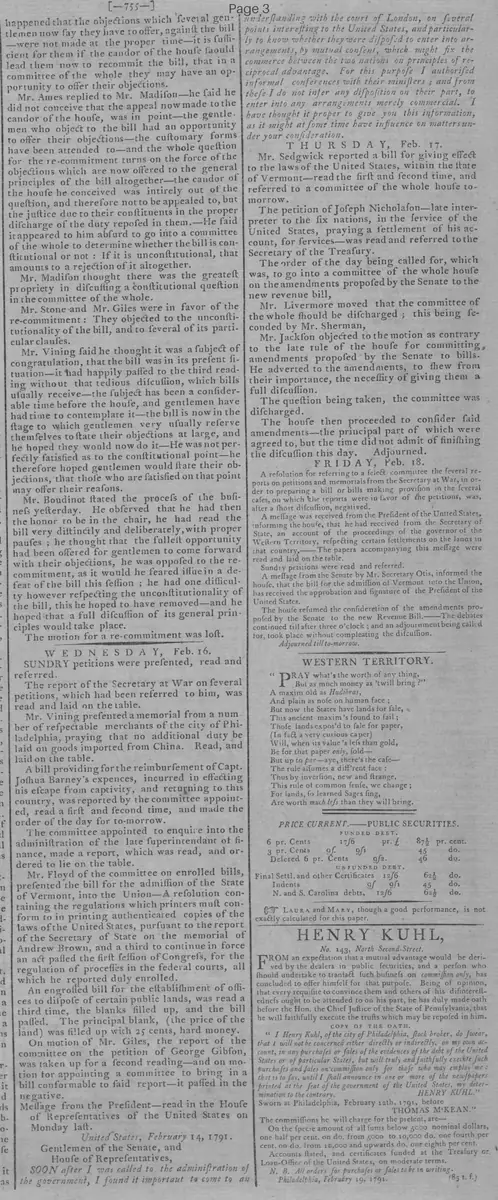
Sundry petitions were presented, read and referred.
The report of the Secretary at War on several petitions, which had been referred to him, was read and laid on the table.
Mr. Vining presented a memorial from a number of respectable merchants of the city of Philadelphia, praying that no additional duty be laid on goods imported from China. Read, and laid on the table.
A bill providing for the reimbursement of Capt. Joshua Barney's expences, incurred in effecting his escape from captivity, and returning to this country, was reported by the committee appointed, read a first and second time, and made the order of the day for to-morrow.
The committee appointed to enquire into the administration of the late superintendent of finance, made a report, which was read, and ordered to lie on the table.
Mr. Floyd of the committee on enrolled bills, presented the bill for the admission of the State of Vermont, into the Union—A resolution containing the regulations which printers must conform to in printing authenticated copies of the laws of the United States, pursuant to the report of the Secretary of State on the memorial of Andrew Brown, and a third to continue in force an act passed the first session of Congress, for the regulation of processes in the federal courts, all which he reported duly enrolled.
An engrossed bill for the establishment of offices to dispose of certain public lands, was read a third time, the blanks filled up, and the bill passed. The principal blank, (the price of the land) was filled up with 25 cents, hard money.
On motion of Mr. Giles, the report of the committee on the petition of George Gibson, was taken up for a second reading—and on motion for appointing a committee to bring in a bill conformable to said report—it passed in the negative.
Message from the President—read in the House of Representatives of the United States on Monday last.
United States, February 14, 1791.
Gentlemen of the Senate, and House of Representatives,
Soon after I was called to the administration of the government, I found it important to come to an understanding with the court of London, on several points interesting to the United States, and particularly to know whether they were disposed to enter into arrangements, by mutual consent, which might fix the commerce between the two nations on principles of reciprocal advantage. For this purpose I authorised informal conferences with their ministers; and from these I do not infer any disposition on their part, to enter into any arrangements merely commercial. I have thought it proper to give you this information, as it might at some time have influence on matters under your consideration.
THURSDAY, Feb. 17.
Mr. Sedgwick reported a bill for giving effect to the laws of the United States, within the state of Vermont—read the first and second time, and referred to a committee of the whole house to-morrow.
The petition of Joseph Nicholson—late interpreter to the six nations, in the service of the United States, praying a settlement of his account, for services—was read and referred to the Secretary of the Treasury.
The order of the day being called for, which was, to go into a committee of the whole house on the amendments proposed by the Senate to the new revenue bill,
Mr. Livermore moved that the committee of the whole should be discharged; this being seconded by Mr. Sherman,
Mr. Jackson objected to the motion as contrary to the late rule of the house for committing amendments proposed by the Senate to bills. He adverted to the amendments, to shew from their importance, the necessity of giving them a full discussion.
The question being taken, the committee was discharged.
The house then proceeded to consider said amendments—the principal part of which were agreed to, but the time did not admit of finishing the discussion this day. Adjourned.
FRIDAY, Feb. 18.
A resolution for referring to a select committee the several reports on petitions and memorials from the Secretary at War, in order to preparing a bill or bills making provision in the several cases, on which the reports were in favor of the petitions, was, after a short discussion, negatived.
A message was received from the President of the United States, informing the house, that he had received from the Secretary of State, an account of the proceedings of the governor of the Western Territory, respecting certain settlements on the lands in that country,—The papers accompanying this message were read and laid on the table.
Sundry petitions were read and referred.
A message from the Senate by Mr. Secretary Otis, informed the house, that the bill for the admission of Vermont into the Union, has received the approbation and signature of the President of the United States.
The house resumed the consideration of the amendments proposed by the Senate to the new Revenue Bill.—The debates continued till after three o'clock; and an adjournment being called for, took place without completing the discussion.
Adjourned till to-morrow.
What sub-type of article is it?
What keywords are associated?
What entities or persons were involved?
Domestic News Details
Event Date
February 16 18, 1791
Key Persons
Outcome
bill for admission of vermont into the union passed and signed by president; public lands bill passed at 25 cents per acre; senate amendments to revenue bill partially agreed; various petitions referred; presidential messages on british commerce and western territory settlements received.
Event Details
Proceedings of the U.S. House of Representatives over three days included presentation and referral of sundry petitions and memorials, reports from committees and secretaries, introduction and passage of bills related to Vermont's admission, public lands disposal, Capt. Barney's reimbursement, and printer regulations; consideration of Senate amendments to the new revenue bill; motions and debates on various reports; receipt and reading of presidential messages dated February 14, 1791, on commerce with Britain and Western Territory proceedings.