Thank you for visiting SNEWPapers!
Sign up free
Morning Star
Limerick, York County, Maine
What is this article about?
Account of the 1841 Cincinnati riot where a mob destroyed the Philanthropist newspaper's press for the third time, targeted abolitionists and Black residents, amid official inaction until Governor Corwin intervened. Editor condemns authorities' complicity.
Merged-components note: Continuation of the article on the Cincinnati riot, destruction of the Philanthropist press, and related anti-slavery events; text flows sequentially across pages with abrupt end in first part matching start of second.
Clippings
1 of 2
OCR Quality
Full Text
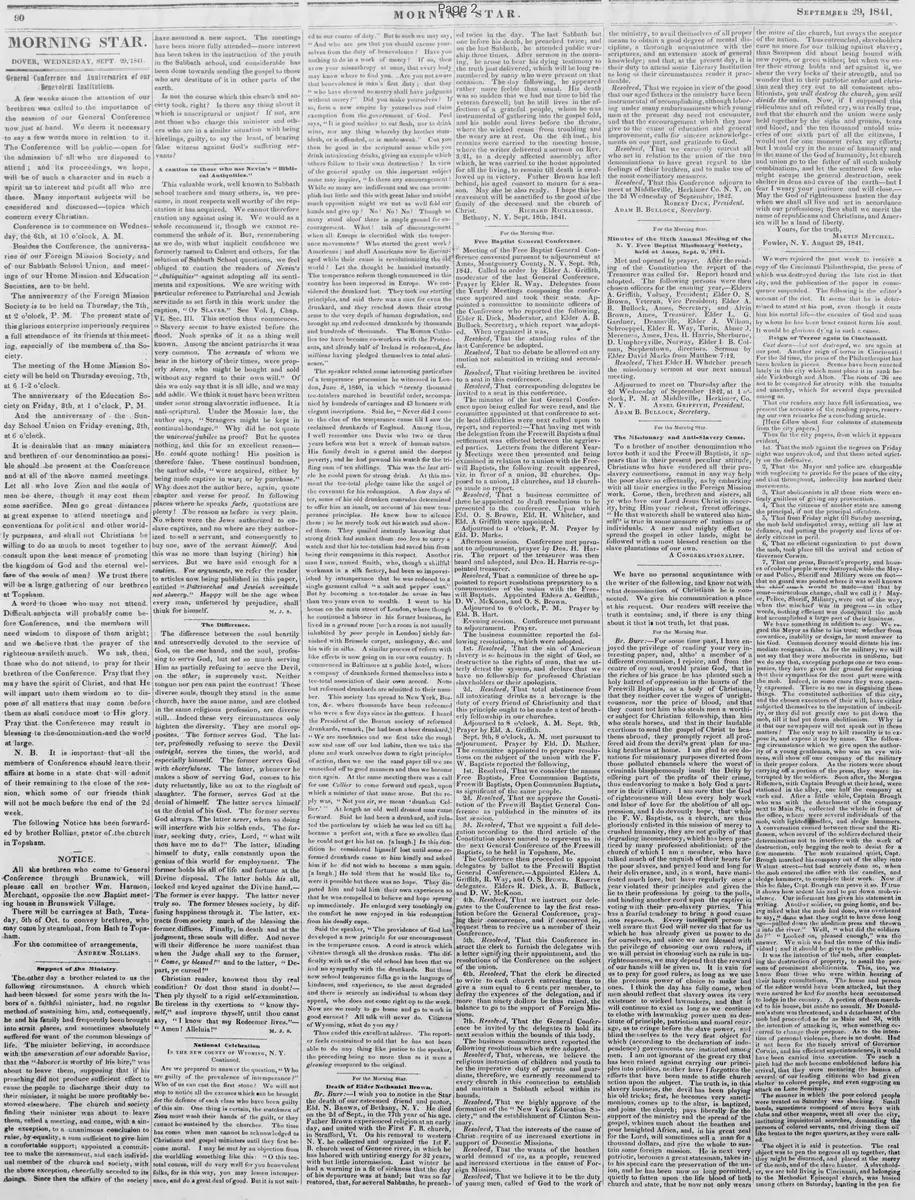
Reign of Terror again in Cincinnati.
Cast down—but not destroyed, we are again at our post. Another reign of terror in Cincinnati! For the 3d time, the press of the Philanthropist has been broken in pieces. Scenes have been enacted lately in this city which must place it in rank beside Vicksburgh and Alton. The riots of '36 are not to be compared for atrocity with the tumults and anarchy, which for several days prevailed among us.
That our readers may have full information, we present the accounts of the reading papers, reserving our own remarks for a concluding article.
[Here follow about four columns of statements from the city papers.]
Thus far the city papers, from which it appears evident,
1st. That the mob against the negroes on Friday night was unprovoked, and that these acted strictly on the defensive.
2, That the Mayor and police are chargeable with neglecting to provide for the peace of the city, and that throughout, imbecility has marked their movements.
3, That abolitionists in all these riots were entirely guiltless of giving any provocation.
4, That the citizens of another state are among the principal, if not the principal offenders.
5, That from Friday night till Sunday morning, the mob held undisputed sway, setting all law at defiance, and putting the property and lives of orderly citizens in peril.
6, That no efficient organization to put down the mob, took place till the arrival and action of Governor Corwin.
7, That our press, Burnett's property, and houses of colored people were destroyed, while the Mayor and Police, Sheriff and Military were on foot—that no guard was posted where it was well known the chief attack would be made—and that by some—miraculous change, shall we call it? Mayor, Police, Sheriff, Military, were out of the way, when the mischief was in progress—in other words, nothing efficient was done, until the mob had accomplished a large part of their business.
We have something in addition to say. We regard the Mayor as false to his trust; whether from cowardice, inability or design, he must answer to his God. Common decency would dictate his immediate resignation. As for the military, we will not say that they were mobocrats in uniform, but we do say that, excepting perhaps one or two companies, they have given fair ground for suspicion that their sympathies for the most part were with the mob. Indeed, in some cases they were openly expressed. There is no use in disguising these things. The constituted authorities of this city, and the chosen executors of their will, have either subjected themselves to the imputation of imbecility, or they did not greatly care to put down the mob, till it had put down abolitionism. Why is it that our newspapers will not speak out in these matters? The only way to kill rascality is to expose it, and expose it too by name. The following circumstance which we give upon the authority of a young gentleman, who was an eye witness, will show off one company of the military in their proper colors. As the rioters were about carrying off a portion of the press, they were interrupted by the soldiers. Soon after, the Morgan Riflemen, with Captain Brough at their head, were stationed in the alley, one half the company at each end. After a little while, Captain Brough who was with the detachment of the company next to Main St., collected the whole in front of the office, where were several individuals of the mob, with lighted candles, and sledge hammers. A conversation ensued between these and the Riflemen, when several of the soldiers declared their determination not to interfere with the work of destruction, only begging the mob to desist for a few moments. The mob remained quiet, Capt. Brough marched his company out of the alley into Walnut street—but had scarcely done so, when the mob entered the office with the candles, and sledge hammers, to complete their work. Now if this be false, Capt. Brough can prove it so. If true it shows how ardent his zeal to put down mob-violence. Our informant has given his statement in writing. Another soldier, on going home, and being asked what the mob had done, was overheard to say, "done what they ought to have done long ago—pulled down the abolition press and thrown it into the river." Well, "what did the soldiers do?" "Looked on, pleased enough," was the answer. We wish we had the name of this individual; and it should be given to the public.
It was the intention of the mob, after completing the destruction of property, to assail the persons of prominent abolitionists. This, too, we know from those who were within hearing of their hasty consultations. The house and person of the editor would have been attacked, but they were assured he had for months been accustomed to lodge in the country. A portion of them marched to his house, but made no assault. Mr Donaldson's store was threatened, and a detachment of the mob had proceeded as far as Main and 3d, with the intention of attacking it, when something occurred to change their purpose. As to the intention of personal violence, there is no doubt. Had it not been for the timely arrival of Governor Corwin, and his efficient superintendence, it would have been carried into execution. To such a pitch had the mob become emboldened before his arrival, that they were menacing the houses of several of our leading citizens who had given shelter to colored people, and even suggesting an attack on Lane Seminary.
The manner in which the poor colored people were treated on Saturday was shocking. Small bands, sometimes composed of mere boys with clubs and other weapons, went all over the city, instituting inquisitorial searches, demanding the persons of colored servants, and driving them off like brutes to the negro quarters, as they were called.
The object it is said is protection, The real object was to pen the negroes all up together, that they might be disarmed, and placed at the mercy of the mob, and of the slave hunter. A slaveholder, we are told living in Cincinnati, and belonging to the Methodist Episcopal church, was busied among others on Saturday, hunting in the pen for
SEPTEMBER 29, 1841.
a few slaves lost some days since. If we can verify this fact sufficiently, we will give his name to the public.
The meeting on Saturday turned out in truth, a mob meeting. We speak in plain terms. True, the Mayor presided—Edward Woodruff too, a law abiding citizen, was principal Secretary. But the few citizens there who really wished to maintain the laws, were subjugated by the mob. J. W. Pratt was the moving spirit of the scene. In a speech preliminary to the organization of the meeting, he took good care to denounce the abolitionists in most inflammatory terms and expressed the opinion that it was high time to redeem Cincinnati from the taint of abolitionism. Seeing some abolitionists present, he remarked that he had in his eye some of these real Simon Pures, and wondered they had the audacity to appear in such a meeting. Considering the materials of which that meeting was composed, such a speech was a vile invocation of lynch law. This man succeeded in having a committee of nine gentlemen appointed, of which he was chairman, and the resolutions reported, are his offspring, it is presumed. But we give the report of the meeting, which was stuck up in handbills all over the city, and was in fact a sufficient warrant, signed by the Mayor, and countersigned by Edward Woodruff and D. Pratt, for the action of the mob in the evening.
We shall give further particulars next week.
What sub-type of article is it?
What themes does it cover?
What keywords are associated?
What entities or persons were involved?
Where did it happen?
Story Details
Key Persons
Location
Cincinnati
Event Date
September 29, 1841
Story Details
Anti-abolitionist mob destroys Philanthropist press for third time, attacks Black neighborhoods unprovoked, officials fail to intervene until Governor Corwin arrives; editor accuses authorities of complicity and exposes military sympathy with rioters.