Thank you for visiting SNEWPapers!
Sign up free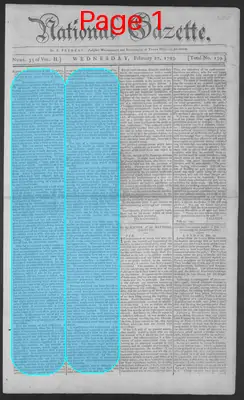
National Gazette
Philadelphia, Philadelphia County, Pennsylvania
What is this article about?
Excerpt from the U.S. Secretary of the Treasury's report explaining the use of 1790 foreign loans for reimbursements to France, Dutch debt payments, and U.S. debt purchases. Justifies subdividing loans, drawing funds early, and basing them on both authorizing acts to support public credit amid uncertainties.
Merged-components note: Continuation of the 'Report of the Secretary of the Treasury' story across adjacent columns on page 1.
Clipping
OCR Quality
Full Text
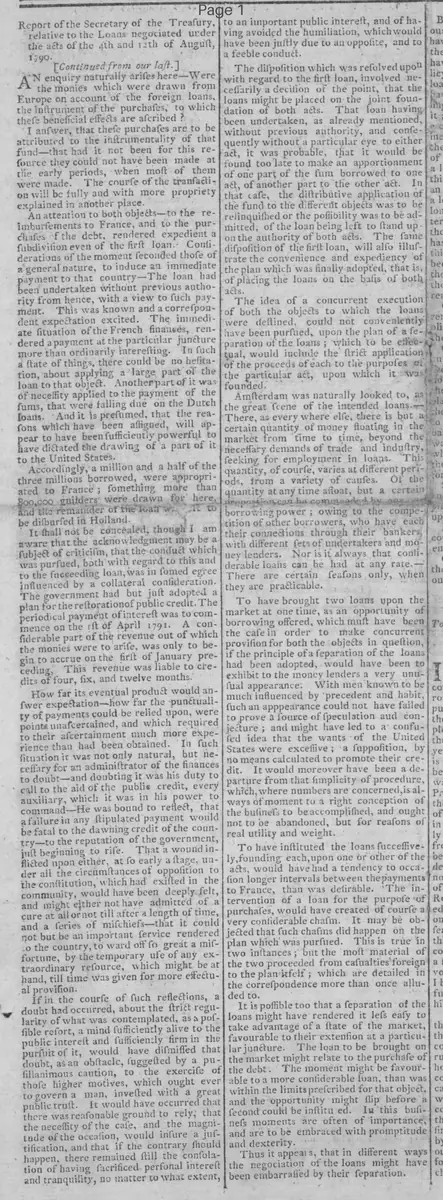
relative to the Loans negotiated under
the acts of the 4th and 12th of August,
1790.
Continued from our last.
An enquiry naturally arises here—Were
the monies which were drawn from
Europe on account of the foreign loans,
the instrument of the purchases, to which
these beneficial effects are ascribed?
I answer, that these purchases are to be
attributed to the instrumentality of that
fund—that had it not been for this re-
source they could not have been made at
this early period, when most of them
were made. The course of the transacti-
on will be fully and with more propriety
explained in another place.
An attention to both objects—to the re-
imbursements to France, and to the pur-
chases of the debt, rendered expedient a
subdivision even of the first loan.—Consid-
erations of the moment seconded those of
a general nature, to induce an immediate
payment to that country—The loan had
been undertaken without previous autho-
rity from hence, with a view to such pay-
ments. This was known and a correspon-
dent expectation excited. The immedi-
ate situation of the French finances, ren-
dered a payment at the particular juncture
more than ordinarily interesting. In such
a state of things, there could be no hesita-
tion, about applying a large part of the
loan to that object. Another part of it was
of necessity applied to the payment of the
sums, that were falling due on the Dutch
loans. And it is presumed, that the rea-
sons which have been assigned, will ap-
pear to have been sufficiently powerful to
have dictated the drawing of a part of it
to the United States.
Accordingly, a million and a half of the
three millions borrowed, were appropri-
ated to France; something more than
800,000 guilders were drawn for here,
and the remainder of the loan was to
be disbursed in Holland.
It shall not be concealed, though I am
aware that the acknowledgment may be a
subject of criticism, that the conduct which
was pursued, both with regard to this and
to the succeeding loan, was in some degree
influenced by a collateral consideration.
The government had but just adopted a
plan for the restoration of public credit. The
periodical payment of interest was to com-
mence on the 1st of April 1791. A con-
siderable part of the revenue out of which
the monies were to arise, was only to be-
ginning. This revenue was liable to cre-
dit of four, six, and twelve months.
How far its eventual product would an-
swer expectation—how far the punctuali-
ty of payments could be relied upon, were
points unascertained, and which required
to their ascertainment much more expe-
rience than had been obtained. In such
situation it was not only natural, but ne-
cessary for an administrator of the finances
to doubt—and doubting it was his duty to
call to the aid of the public credit, every
auxiliary, which it was in his power to
command—He was bound to reflect, that
a failure in any stipulated payment would
be fatal to the dawning credit of the coun-
try—to the reputation of the government,
just beginning to rise. That a wound in-
flicted upon either, at so early a stage, un-
der all the circumstances of opposition to
the constitution, which had existed in the
community, would have been deeply felt,
and might either not have admitted of a
cure at all or not till after a length of time,
and a series of mischiefs—that it could
not but be an important service rendered
to the country, to ward off so great a mis-
fortune, by the temporary use of any ex-
traordinary resource, which might be at
hand, till time was given for more effectu-
al provision.
If in the course of such reflections, a
doubt had occurred, about the strict regu-
larity of what was contemplated, as a pos-
sible resort, a mind sufficiently alive to the
public interest and sufficiently firm in the
pursuit of it, would have dismissed that
doubt, as an obstacle, suggested by a pu-
illanimous caution, to the exercise of
those higher motives, which ought ever
to govern a man, invested with a great
public trust. It would have occurred that
there was reasonable ground to rely, that
the necessity of the case, and the magni-
tude of the occasion, would insure a jus-
tification, and that if the contrary should
happen, there remained still the consola-
tion of having sacrificed personal interest
and tranquility, no matter to what extent,
to an important public interest, and of ha-
ving avoided the humiliation, which would
have been justly due to an opposite, and to
a feeble conduct.
The disposition which was resolved upon
with regard to the first loan, involved ne-
cessarily a decision of the point, that the
loans might be placed on the joint foun-
dation of both acts. That loan having
been undertaken, as already mentioned,
without previous authority, and conse-
quently without a particular eye to either
act, it was probable, that it would be
found too late to make an apportionment
of one part of the sum borrowed to one
act, of another part to the other act. In
that case, the distributive application of
the fund to the different objects was to be
relinquished or the possibility was to be ad-
mitted, of the loan being left to stand up-
on the authority of both acts. The same
disposition of the first loan, will also illus-
trate the convenience and expediency of
the plan which was finally adopted, that is,
of placing the loans on the basis of both
acts.
The idea of a concurrent execution
of both the objects to which the loans
were destined, could not conveniently
have been pursued, upon the plan of a se-
paration of the loans; which to be effec-
tual, would include the strict application,
of the proceeds of each to the purposes of
the particular act, upon which it was
founded.
Amsterdam was naturally looked to, as
the great scene of the intended loans.—
There, as every where else, there is but a
certain quantity of money floating in the
market from time to time, beyond the
necessary demands of trade and industry,
seeking for employment in loans. This
quantity, of course, varies at different peri-
ods, from a variety of causes. Of the
quantity at any time afloat, but a certain
proportion can be commanded by our
borrowing power; owing to the competi-
tition of other borrowers, who have each
their connections through their bankers,
with different sets of undertakers and mo-
ney lenders. Nor is it always that consi-
derable loans can be had at any rate.—
There are certain seasons only, when
they are practicable.
To have brought two loans upon the
market at one time, as an opportunity of
borrowing offered, which must have been
the case in order to make concurrent
provision for both the objects in question,
if the principle of a separation of the loans
had been adopted, would have been to
exhibit to the money lenders a very unu-
sual appearance: With men known to be
much influenced by precedent and habit,
such an appearance could not have failed
to prove a source of speculation and con-
jecture; and might have led to a confu-
sed idea that the wants of the United
States were excessive; a supposition, by
no means calculated to promote their cre-
dit. It would moreover have been a de-
parture from that simplicity of procedure,
which, where numbers are concerned, is al-
ways of moment to a right conception of
the business to be accomplished, and ought
not to be abandoned, but for reasons of
real utility and weight.
To have instituted the loans successive-
ly, founding each, upon one or other of the
acts, would have had a tendency to occa-
sion longer intervals between the payments
to France, than was desirable. The inter-
vention of a loan for the purpose of
purchases, would have created of course a
very considerable chasm. It may be ob-
jected that such chasms did happen on the
plan which was pursued. This is true in
two instances; but the most material of
the two proceeded from casualties foreign
to the plan itself; which are detailed in
the correspondence more than once allu-
ded to.
It is possible too that a separation of the
loans might have rendered it less easy to
take advantage of a state of the market,
favourable to their extension at a particu-
lar juncture. The loan to be brought on
the market might relate to the purchase of
the debt. The moment might be favour-
able to a more considerable loan, than was
within the limits prescribed for that object.
and the opportunity might slip before a
second could be instituted. In this busi-
ness moments are often of importance,
and are to be embraced with promptitude
and dexterity.
Thus it appears, that in different ways
the negotiation of the loans might have
been embarrassed by their separation.
What sub-type of article is it?
What themes does it cover?
What keywords are associated?
What entities or persons were involved?
Where did it happen?
Story Details
Key Persons
Location
Amsterdam, Holland, United States, Europe
Event Date
Acts Of The 4th And 12th Of August, 1790; 1st Of April 1791
Story Details
The report justifies the use of foreign loans for immediate payments to France and Dutch creditors, and for purchasing U.S. debt, emphasizing the need to support nascent public credit through flexible application of funds authorized by both 1790 acts, avoiding separation that could harm negotiations.