Thank you for visiting SNEWPapers!
Sign up free
Edwardsville Spectator
Edwardsville, Madison County, Illinois
What is this article about?
Articles from 1825 Kentucky Gazette discuss the weevil's damage to wheat crops in Kentucky and surrounding states, causing significant financial losses. Various methods to preserve grain are republished, including threshing immediately, keeping cool, using lime or salt, and proper stacking for air circulation.
Merged-components note: Continuation of the article on preserving wheat from weevils, spanning across pages 1 and 2 with sequential reading order.
Clippings
1 of 2
OCR Quality
Full Text
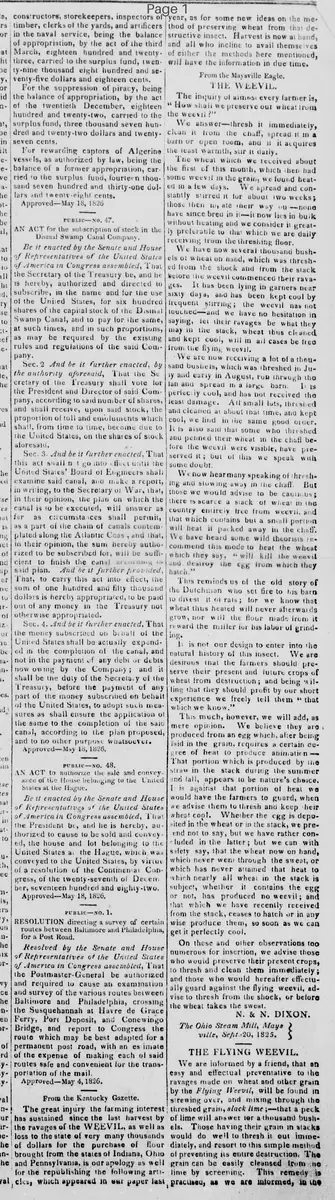
The great injury the farming interest has sustained since the last harvest by the ravages of the WEEVIL, as well as loss to the state of very many thousands of dollars for the purchase of flour brought from the states of Indiana, Ohio and Pennsylvania, is our apology as well as for the republishing the following articles, which appeared in our paper last year, as for some new ideas on the method of preserving wheat from that destructive insect. Harvest is now at hand, and all who incline to avail themselves of either the methods here mentioned, will have the information in due time.
From the Maysville Eagle.
THE WEEVIL.
The inquiry of almost every farmer is, "How shall we preserve our wheat from the weevil?"
We answer—thresh it immediately, clean it from the chaff, spread it in a barn or open room, and if it acquires the least warmth, stir it daily.
The wheat which we received about the first of this month, which then had some weevil in the grain, we found heated in a few days. We spread and constantly stirred it for about two weeks; those then lay ate their way out—none have since bred in it—it now lies in bulk without heating and we consider it greatly preferable to that which we are daily receiving from the threshing floor.
We have now several thousand bushels of wheat on hand, which was threshed from the shock and from the stack before the weevil commenced their ravages. It has been lying in garners near sixty days, and has been kept cool by frequent stirring; the weevil has not touched—and we have no hesitation in saying, let their ravages be what they may in the stack, wheat thus cleaned and kept cool, will in all cases be free from the flying weevil.
We are now receiving a lot of a thousand bushels, which was threshed in July and early in August, run through the fan and spread in a large barn. It is perfectly cool, and has not received the least damage. All small lots, threshed and cleaned at about that time, and kept cool, we find in the same good order.
It is also said that some who threshed and penned their wheat in the chaff before the weevil were visible, have preserved it; but of this we speak with some doubt.
We now hear many speaking of threshing and stowing away in the chaff. But those we would advise to be cautious; there is scarce a stack of wheat in the country entirely free from weevil, and that which contains but a small portion will heat if packed away in the chaff.
We have heard some wild theorists recommend this mode to heat the wheat which they say, "will kill the weevil and destroy the egg from which they hatch."
This reminds us of the old story of the Dutchman who set fire to his barn to divest it of rats; for we know that wheat thus heated will never afterwards grow, nor will the flour made from it reward the miller for his labor of grinding.
It is not our design to enter into the natural history of this insect. We are desirous that the farmers should preserve their present and future crops of wheat from destruction; and being willing that they should profit by our short experience we freely tell them "that which we know."
This much, however, we will add, as mere opinion. We believe they are produced from an egg which, after being laid in the grain, requires a certain degree of heat to produce animation— That portion which is produced by the straw in the stack during the summer and fall, appears to be nature's choice. It is against that portion of heat we would have the farmers to guard, when we advise them to thresh and keep their wheat cool. Whether the egg is deposited in the wheat or in the stack, we pretend not to say, but we have rather concluded in the latter; but we can with safety say, that the wheat now on hand, which never went through the sweat, or which has never attained that heat to which nearly all wheat in the stack is subject, whether it contains the egg or not, has produced no weevil; and that which we have recently received from the stack, ceases to hatch or in any wise produce them, so soon as we can get it perfectly cool.
On these and other observations too numerous for insertion, we advise those who would preserve their present crops, to thresh and clean them immediately; and those who would hereafter effectually guard against the flying weevil, advise to thresh from the shock, or before the wheat takes the sweat.
N. & N. DIXON.
The Ohio Steam Mill, Maysville, Sept. 20, 1825.
THE FLYING WEEVIL.
We are informed by a friend, that an easy and effectual preventative to the ravages made on wheat and other grain by the Flying Weevil, will be found in strewing over, and mixing through the threshed grain, slack lime;—that a peck of lime will answer for a thousand bushels. Those having their grain in stacks would do well to thresh it out immediately, and resort to this simple method of preventing its entire destruction. The grain can be easily cleansed from the lime by screening. This remedy is practised, as we are informed, in the
Southern states, where the weevil has been for some years very destructive to grain.
Ohio Republican.
WEEVIL IN WHEAT.
As the weevil is making extensive destruction of the wheat in this part of the country, you will oblige many who are interested, by publishing the following receipt, which has been practised with success by Mr. Benjamin Beasly of Brown county.
"As soon as the weevil make their appearance in the wheat it should be restacked, and on each layer of sheaves a small quantity of salt sprinkled, which effectually prevents their doing further injury."-Query. Would it not answer the same purpose to thresh out the wheat and sprinkle it thereon.
Village Register.
From the Western Herald,
Several practices have been recommended to prevent the ravages of this destroying insect. One method is to thresh or tread out the wheat and put it away in the chaff, in pens or garners; another to clean the wheat and expose it to the heat of the sun; another to scald it; another to mix some lime with the cleaned wheat. With whatever particular attention these different operations are performed, they must in a great degree produce the same effect-that is, to destroy the living insect, and to prevent the hatching of its young. But from an observation made a few days since by the writer of this article, he is of opinion, that exposure to the strong heat of the sun, fire, or scalding, are the only effectual means of destroying weevil in wheat. He discovered a great quantity of weevil in a parcel of wheat got out and cleaned for use, which had lain in the bulk for three or four weeks. On a close inspection of the wheat, he found on many of the grains a number of eggs or nits, which from the smallness of their size, and their color, being mostly a reddish cast, a little brighter than that of the wheat, but some nearly white, would escape observation unless sought with the view to see so small an object. They are generally, though not always, in the crease or indenture, which divides the grain on one side. From the freshness of the eggs there can be no doubt that they are deposited by the weevil after it arrives at maturity--that it thus propagates its own species; and by this means in certain seasons becomes so numerous as to destroy whole crops of wheat when left to its ravages.
It is probable that this discovery of the egg or nit of the weevil may have even been made before, but if so it has never been heard of by the writer. This communication is made with the view of drawing the attention of the curious and attentive farmers to the subject, in the hope that their observations and experiments, will lead to a discovery of the best means of preserving our wheat from the destructive insect.
A FARMER.
August 23, 1825.
It is admitted by the farmers generally, that the egg which produces weevil, is deposited in the grain whilst standing on the field, and that it requires a certain degree of heat and moisture, to hatch the egg into a worm, previous to which it is entirely harmless; but as soon as the worm is produced it immediately penetrates into the body of the grain, where it comes to maturity by passing through the changes common to flies: so that nothing more is necessary to preserve the grain, than to prevent it from acquiring that degree of heat and moisture necessary to hatch the egg.
It is believed by many that if wheat after cutting is let in the field several days, and suffered to get very dry, and then put up in small parcels, say one or two dozen sheaves together, so as to admit the air to pass through it freely, that for want of the necessary heat and moisture, the egg would never hatch; and what seems to warrant this belief is, that several small crops have, we learn, been saved from the weevil which have been managed in this manner; and as a further confirmation, we have been informed by an observing farmer, that a few sheaves on the very top of a stack of his last crop, where it never went through a sweat, and enjoyed a free current of air, were quite free from weevil, when the body of the same stack was entirely destroyed.
From taking a view of the different methods recommended in the foregoing extracts, we will venture to suggest the following:-Let your wheat lie on the stubble two or three days after cutting, if the weather is suitable.-When it is thoroughly dry, take it into your barn or other houses, and stack it away in the following manner:-Lay a range of sheaves parallel to one of the walls the whole length of the wall, the ears toward the wall but not touching it-Lay a second course immediately on the first with the ears the contrary way, and so that the ears extend beyond the cut ends of the sheaves of the first course; a third course is to be laid on the second with the ears projecting beyond the cut ends of the second, &c. A second range is to be made parallel to the first so as to leave a distance of two or three inches between the ears of the first and second ranges, and in this manner proceed until the room is filled: By this method of stacking, the whole of the grain will be exposed between the different ranges to a free circulation of air, and it is believed will secure it entirely from the weevil-it is at least worth making the experiment.
Ky Gaz.
What sub-type of article is it?
What keywords are associated?
What entities or persons were involved?
Where did it happen?
Domestic News Details
Primary Location
Kentucky
Event Date
1825
Key Persons
Outcome
significant crop destruction and financial losses from weevil ravages; various preservation methods suggested to prevent further damage, including threshing, cooling, lime, salt, and air circulation stacking.
Event Details
Compilation of articles advising farmers on preventing weevil damage to wheat through immediate threshing, cleaning, stirring to keep cool, using slack lime or salt, avoiding heat, and specific stacking methods for air flow.