Thank you for visiting SNEWPapers!
Sign up free
The Rhode Island Republican
Newport, Newport County, Rhode Island
What is this article about?
Rhode Island General Assembly convened in Providence yesterday; organized with Tillinghast as Speaker; debated admitting uncertified members and resuming control over insolvent laws amid concerns of abuse; various petitions and committees handled.
Clipping
OCR Quality
Full Text
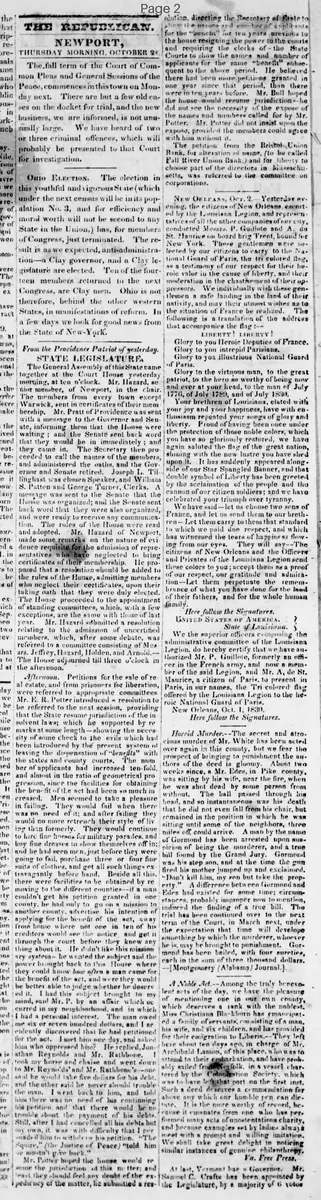
STATE LEGISLATURE,
The General Assembly of this State came together at the Court House yesterday morning, at ten o'clock. Mr. Hazard, senior member, of Newport, in the chair. The members from every town except Warwick, sent in certificates of their membership. Mr. Pratt of Providence was sent with a message to the Governor and Senate, informing them that the House were waiting: and the Senate sent back word that they would be in immediately; and they came in. The Secretary then proceeded to call the names of the members, and administered the oaths, and the Governor and Senate retired. Joseph L. Tillinghast was chosen Speaker, and William S. Patten and George Turner, Clerks. A message was sent to the Senate that the House was organized; and the Senate sent back word that they were also organized, and were ready to receive any communication. The rules of the House were read and adopted. Mr. Hazard of Newport, made some remarks on the nature of evidence requisite for the admission of representatives who have neglected to bring certificates of their membership. He proposed that a resolution should be added to the rules of the House, admitting members who neglect their certificates, upon their taking oath that they were duly elected. The House proceeded to the appointment of standing committees, which, with a few exceptions, are the same with those of last year.
Mr. Hazard submitted a resolution relating to the admission of uncertified members, which, after some debate, was referred to a committee consisting of Messrs. Jeffrey, Hazard, Holden, and Arnold.-- The House adjourned till three o'clock in the afternoon.
Afternoon. Petitions for the sale of real estate, and from prisoners for liberation, were referred to appropriate committees. Mr. E.R. Potter introduced a resolution to be referred to the next session, providing that the State resume jurisdiction of the insolvent laws; which he supported by remarks at some length--showing the necessity of some check to the evils which had been introduced by the present system of leaving the dispensation of "benefits" with the states and county courts. The number of applicants had increased ten-fold and almost in the ratio of geometrical progression, since the facilities for obtaining the benefit of the act had been so much increased. Men seemed to take a pleasure in failing. They would fail when there was no need of it; and after failing they would no more retrench their style of living than formerly. They would continue to hire fine horses for military parades, and buy fine dresses to show themselves off in: and he had seen men, just before they were going to fail, purchase three or four fine suits of clothes, and get all such things extravagantly before hand. Beside all this, there were facilities to be obtained by removing to the different counties--if a man couldn't get his petition granted in one county, he had only to go on a mission to another county, advertise his intention of applying for the benefit of the act, away from home where not one in ten of his creditors would see the notice, and get it through the court before they knew any thing about it. He didn't like this missionary system--he wanted the subject and the power brought back to this House where they could know how often a man came for the benefit of the act, and where they would be better able to judge whether he deserved it. I had this subject brought to my mind, said Mr. P. by an affair which occurred in my neighborhood, and in which I had a personal interest. The man owed me six or seven hundred dollars, and I accidentally discovered that he had petitioned for the act. I met him one day, and asked him who oppressed him? He replied, Jonathan Reynolds and Mr. Rathbone. I took my horse and chaise and went down to Mr. Reynolds' and Mr. Rathbone's--one said he would take five dollars for his debt, and the other said he never should trouble the man. I went back to him, and told him there was no need of his continuing his petition, and that there would be no trouble about the payment of his debts. Still, after I had concelled all his debts but my own, it was with difficulty that I persuaded him to withdraw his petition. "The squire," (the Justice of Peace) "told him he mustn't give back."
Mr. Potter hoped the house would resume the jurisdiction of this matter: and lest they should feel any doubt of the expediency of the matter, he submitted a resolution directing the Secretary of State to show the names and number of applicants for the "benefit" for ten years previous to the house resigning the power to the court, and requiring the clerks of the State Courts to show the names and number of applicants for the same "benefit" subsequent to the above period. He believed there had been more petitions granted in one year since that period, than there were in ten years before. Mr. Bull hoped the house would resume jurisdiction--he did not see the necessity of the expose of the names and numbers called for by Mr. Potter. Mr. Potter did not insist upon the expose, provided the members could agree with him without it.
The petition from the Bristol Union Bank, for alteration of name, (to be called Fall River Union Bank, and for liberty to choose part of the directors in Massachusetts, was referred to the committee on corporations.
What sub-type of article is it?
What keywords are associated?
What entities or persons were involved?
Where did it happen?
Domestic News Details
Primary Location
Providence
Event Date
Yesterday Morning, At Ten O'clock
Key Persons
Outcome
house organized with joseph l. tillinghast as speaker and william s. patten and george turner as clerks; standing committees appointed; resolution on uncertified members referred to committee; petitions referred; resolution on resuming jurisdiction of insolvent laws introduced and debated; bristol union bank petition referred.
Event Details
The General Assembly convened at the Court House in Providence. Mr. Hazard chaired initially. Members from all towns except Warwick attended. Message sent to Governor and Senate. Oaths administered. Joseph L. Tillinghast chosen Speaker, William S. Patten and George Turner Clerks. Rules adopted. Discussion on admitting uncertified members; resolution submitted and referred to committee of Messrs. Jeffrey, Hazard, Holden, and Arnold. Standing committees appointed, mostly same as last year. Afternoon: Petitions for real estate sales and prisoner liberation referred. Mr. E.R. Potter introduced resolution to resume state jurisdiction over insolvent laws, supported by remarks on abuses in current system, including personal anecdote. Resolution to obtain statistics on applicants submitted. Mr. Bull supported resuming jurisdiction without expose. Petition from Bristol Union Bank for name change and director selection referred to corporations committee.