Thank you for visiting SNEWPapers!
Sign up free
Phenix Gazette
Alexandria, Virginia
What is this article about?
Speech by Mr. Burges criticizing the Jackson administration's betrayal of Cherokee treaties, failure to protect them from Georgia's encroachments, diversion of annuities, and fraudulent mismanagement of the Post Office establishment, contrasting with past honorable policies.
Clipping
OCR Quality
Full Text
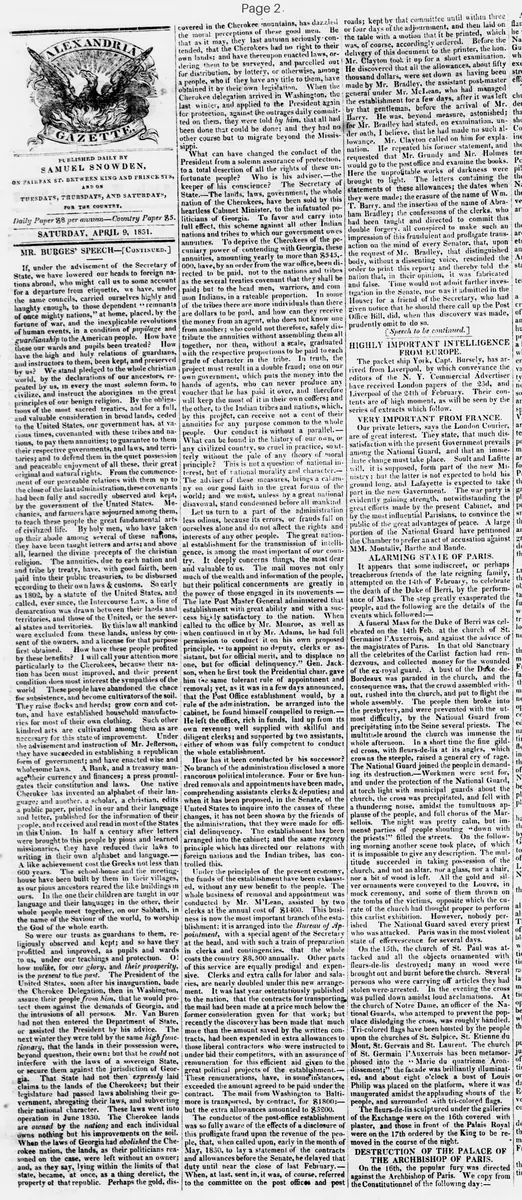
If, under the advisement of the Secretary of State, we have lowered our heads to foreign nations abroad, who might call us to some account the same councils, carried ourselves highly and haughty enough, to those dependent "remnants of once mighty nations," at home, placed by the fortune of war, and the inexplicable revolutions of human events, in a condition of pupillage and guardianship to the American people. "How have the high and holy relations of guardians, these our wards and pupils been treated? How by us? We stand pledged to the whole christian world, by the declarations of our ancestors, repeated by us, in every the most solemn form. to civilize, and instruct the aborigines in the great principles of our benign religion. By the obligations of the most sacred treaties, and for a full and valuable consideration in broad lands, ceded to the United States, our government has, at various times, covenanted with these tribes and nations, to pay them annuities; to guarantee to them their respective governments, and laws, and territories; and to defend them in the quiet possession and peaceable enjoyment of all these, their great original and natural rights. From the commencement of our peaceable relations with them up to the close of the last administration, these covenants had been fully and sacredly observed and kept, by the government of the United States. Mechanics, and farmers have sojourned among them. to teach these people the great fundamental arts of civilized life. By holy men, who have taken up their abode among several of these nations, they have been taught letters and arts; and above all, learned the divine precepts of the christian religion. The annuities, due to each nation and tribe by treaty, have, with good faith, been paid into their public treasuries, to be disbursed according to their own laws & customs. So early as 1802, by a statute of the United States, and called, ever since, the Intercourse Law, a line of demarcation was drawn between their lands and territories, and those of the United, or the several states and territories. By this law all mankind were excluded from these lands, unless by consent of the owners, and a license for that purpose first obtained. How have these people profited by these benefits? I will call your attention more particularly to the Cherokees, because their nation has been most improved, and their present condition does most interest the sympathies of the world. These people have abandoned the chase for subsistence. and become cultivators of the soil. They raise flocks and herds; grow corn and cotton, and have established household manufactories for most of their own clothing. Such other kindred arts are cultivated among them as are necessary for this state of improvement. Under the advisement and instruction of Mr. Jefferson, they have succeeded in establishing a republican form of government; and have enacted wise and wholesome laws. A Bank, and a treasury manage their currency and finances; a press promulgates their constitution and laws. One native Cherokee has invented an alphabet of their language; and another, a scholar, a christian, edits a public paper, printed in our and their language and letter, published for the information of their people, and received and read in most of the States in this Union. In half a century after letters were brought to this people by pious and learned missionaries, they have reduced their laws to writing in their own alphabet and language. A like achievement cost the Greeks not less than 600 years. The school-house and the meeting-house have been built by them in their villages, as our pious ancestors reared the like buildings in ours. In the one their children are taught in our language and their language; in the other, their whole people meet together, on our Sabbath, in the name of the Saviour of the world, to worship the God of the whole earth. So were our trusts as guardians to them, religiously observed and kept; and so have they profited and improved, as pupils and wards to us, under our teachings and protection. O! how unlike, for our glory, and their prosperity, is the present to the past. The President of the United States, soon after his inauguration, bade the Cherokee Delegation, then in Washington, assure their people from him, that he would protect them against the demands of Georgia, and the intrusions of all persons. Mr. Van Buren had not then entered the Department of State, or assisted the President by his advice. The next winter they were told by the same high functionary, that the lands in their possession were, beyond question, their own: but that he could not interfere with the laws of a sovereign State, or secure them against the jurisdiction of Georgia. That State had not then expressly laid claims to the lands of the Cherokees; but their legislature had passed laws abolishing their government, abrogating their laws, and subverting their national character. These laws went into operation in June 1830. The Cherokee lands are owned by the nation; and each individual owns nothing but his improvements on the soil. When the laws of Georgia had abolished the Cherokee nation, the lands, as their politicians reasoned on the case, were left without an owner; and, as they say, lying within the limits of that state, became, at once, as a thing derelict, the property of that republic. Perhaps the gold, discovered in the Cherokee mountains, has dazzled the moral perceptions of these good men. Be that as it may, they last autumn seriously contended, that the Cherokees had no right to their own lands; and have thereupon enacted laws, ordering them to be surveyed, and parcelled out for distribution, by lottery, or otherwise, among a people, who if they have any title to them, have obtained it by their own legislation. When the Cherokee delegation arrived in Washington, the last winter, and applied to the President again for protection, against the outrages daily committed on them, they were told by him, that all had been done that could be done; and they had no other course but to migrate beyond the Mississippi. What can have changed the conduct of the President from a solemn assurance of protection, to a total desertion of all the rights of these unfortunate people? Who is his adviser,—the keeper of his conscience? The Secretary of State. The lands, laws, government, the whole nation of the Cherokees, have been sold by this heartless Cabinet Minister, to the infatuated politicians of Georgia. To favor and carry into full effect, this scheme against all other Indian nations and tribes to which our government owes annuities. To deprive the Cherokees of the pecuniary power of contending with Georgia, these annuities, amounting yearly to more than $45,000, have, by an order from the war office, been directed to be paid, not to the nations and tribes as the several treaties covenant that they shall be paid; but to the head men, warriors, and common Indians, in a rateable proportion. In some of the tribes there are more individuals than there are dollars to be paid, and how can they receive the money from an agent, who does not know one from another; who could not therefore, safely distribute the annuities without assembling them all together, nor then, without a scale, graduated with the respective proportions to be paid to each grade of character in the tribe. In truth, the own government, which puts the money into the project must result in a double fraud; one on our hands of agents, who can never produce any voucher that he has paid it over, and therefore will keep the most of it in their own coffers; and the other, to the Indian tribes and nations, which, by this project, can receive not a cent of their annuities for any purpose common to the whole people. Our conduct is without a parallel. What can be found in the history of our own, or any civilized country, so cruel in practice, so utterly without the pale of any theory of moral principle? This is not a question of national interest, but of rational morality and character. The adviser of these measures, brings a calumny on our good faith in the great forum of the world; and we must, unless by a great national disavowal, stand condemned before all mankind Let us turn to a part of the administration less odious, because its errors, or frauds fall on ourselves alone and do not affect the rights and interests of any other people. The great national establishment for the transmission of intelligence, is among the most important of our country. It deeply concerns things, the most dear and valuable to us. The mail moves not only much of the wealth and information of the people, but their political concernments are greatly in the power of those engaged in its movements. The late Post Master General administered that establishment with great ability and with a success highly satisfactory to the nation. When called to the office by Mr. Monroe, as well as when continued in it by Mr. Adams, he had full permission to conduct it on his own proposed principle. "to appoint no deputy, clerks or assistant, but for official merit, and to displace no one, but for official delinquency." Gen. Jackson, when he first took the Presidential chair, gave him the same tolerant rule of appointment and removal; yet, as it was in a few days announced, that the Post Office establishment would, by a rule of the administration, be arranged into the cabinet, he found himself compelled to resign. He left the office, rich in funds, laid up from its own revenue; well supplied with skillful and diligent clerks; and supported by two assistants, either of whom was fully competent to conduct the whole establishment. How has it been conducted by his successor? No branch of the administration disclosed a more rancorous political intolerance. Four or five hundred removals and appointments have been made, comprehending assistants clerks & deputies; and when it has been proposed, in the Senate, of the United States to inquire into the causes of these changes, it has not been shown by the friends of the administration, that they were made for official delinquency. The establishment has been arranged into the cabinet; and the same regency principle which has directed our relations with foreign nations and the Indian tribes, has controlled this. Under the principles of the present economy, the funds of the establishment have been exhausted, without any new benefit to the people. The whole business of removal and appointment was conducted by Mr. M'Lean, assisted by two clerks at the annual cost of $1400. This business is now the most important branch of the establishment: it is arranged into the Bureau of Appointment, with a special agent of the Secretary at the head, and with such a train of preparation in clerks and contingencies, that the whole costs the country $8,500 annually. Other parts of this service are equally prodigal and expensive. Clerks and extra calls for labor and salaries, are nearly doubled under this new arrangement. It was last year ostentatiously published to the nation, that the contracts for transporting the mail had been made at a price much below the former consideration given for that work; but recently the discovery has been made that much more than the amount saved by the written contracts, had been expended in extra allowances to those liberal contractors who were instructed to under bid their competitors, with an assurance of remuneration for this efficient aid given to the great political projects of the establishment. These remunerations, have, in some instances, exceeded the amount agreed to be paid under the contract. The mail from Washington to Baltimore is transported, by contract, for $1800;— but the extra allowances amounted to $3200. The conductor of the post-office establishment was so fully aware of the effects of a disclosure of this profligate fraud upon the revenue of the people, that, when called upon, early in the month of May, 1830, to lay a statement of the contracts and allowances before the Senate, he delayed that duty until near the close of last February. When, at last, sent in, it was, of course, referred to the committee on the post offices and post roads; kept by that committee until within three or four days of the adjournment, and then laid on the table with a motion that it be printed, which was, of course, accordingly ordered. Before the delivery of this document to the printer, the hon. Mr. Clayton took it up for a short examination. He discovered that all the allowances, about fifty thousand dollars, were set down as having been made by Mr. Bradley, the assistant post-master general under Mr. McLean, who had managed the establishment for a few days, after it was left by that gentleman, before the arrival of Mr. Barry. He was, beyond measure, astonished; for Mr. Bradley had stated, on examination, under oath, I believe, that he had made no such allowances. Mr. Clayton called on him for explanation. He repeated his former statement, and requested that Mr. Grundy and Mr. Holmes would go to the post office and examine the books. Here the unprofitable works of darkness were brought to light. The letters containing the statements of these allowances; the dates when they were made; the erasure of the name of Wm. T. Barry, and the insertion of the name of Abraham Bradley; the confessions of the clerks, who had been taught and directed to commit this double forgery, all conspired to make such an impression of this fraudulent and profligate transaction on the mind of every Senator, that, upon the request of Mr. Bradley, that distinguished body, without a dissenting voice, rescinded the order to print this report; and thereby told the nation that, in their opinion, it was fabricated and false. Time would not admit further investigation in the Senate, nor was it admitted in the House; for a friend of the Secretary, who had given notice that he should there call up the Post Office Bill, did, when this discovery was made, prudently omit to do so.
[Speech to be continued.]
What sub-type of article is it?
What themes does it cover?
What keywords are associated?
What entities or persons were involved?
Where did it happen?
Story Details
Key Persons
Location
Washington, Georgia, Cherokee Lands
Event Date
1802 To June 1830
Story Details
Mr. Burges' speech denounces the Jackson administration's abandonment of treaty obligations to the Cherokees, allowing Georgia to seize their lands and diverting annuities, contrasting with prior civilizing efforts; also exposes Post Office frauds including political purges, excessive costs, and forged contract allowances under Mr. Barry.